
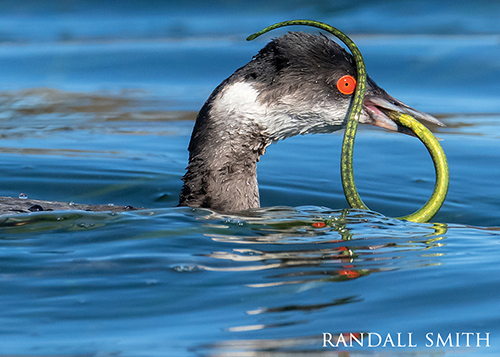

Randall Smith’s photo of an eared grebe (Podiceps nigricollis) catching a pipefish (Syngnathinae) in the Monterey Bay National Marine Sanctuary is a Second Place award winner in the ‘Sanctuary Life’ category. Photo by Randall Smith.
By Christine Heinrichs
In January, a waved albatross, a critically endangered species from the Galapagos Islands and South America, was seen off the Central Coast. The bird had traveled about 3,300 miles from its typical range, earning it an avian “vagrant,” the term used for birds outside their usual range.
Fortunately, Tammy Russell, a marine ornithologist on board the research vessel Reuben Lasker, was there to see and recognize this unusual bird, and tell the world, as reported in the New York Times.
While that sighting was exceptional, Central Coast residents and visitors can see lots of other birds and other wildlife in the Monterey Bay National Marine Sanctuary that spans from Marin County in the north down to Cambria. Learn about what you can find from the Sanctuary’s new website, montereybay.noaa.gov. It’s a wealth of information and resources to use and enjoy.
Virtual Dives, under the Multimedia tab, takes you under the surface, to the world of sea lions and kelp, the landscape of fish, anemones. Divers remove lost fishing gear and nets, “Ghost Nets,” that can entangle and snare marine life. Browse through the Multimedia Gallery at bit.ly/4rOrycm.
The dramatic coastline is dangerous to sailors. The Piedras Blancas Light Station, and others within the Sanctuary, were built to warn mariners, but many ships have sunk over the years. The website has a gallery of shipwreck profiles, reflecting the hazardous conditions sailors faced along the rocky Central Coast. The sanctuary has a database of all known aircraft and ship losses, open to the public at bit.ly/3P4VItj. The Submerged Cultural Resources Study by Smith and Hunter (2003), lists 463 vessel and aircraft losses.
Archaeological remains of hundreds of sunken ships may well be within the sanctuary, for which no records exist. No database will ever be complete, but the sanctuary seeks all historical documentation, to protect whatever cultural and historic resources are hidden beneath the surface. View some, such as the Casco, a steam schooner which sank off Point Piedras Blancas in 1913.
The Sanctuary has archived 20 years of publications, from the otters and fish to effects of human noise and the demographics of the Central Coast. Got an interest? Find resources for the wide variety of subjects encompassed by the sanctuary in its library at sanctuaries.noaa.gov/library/
Bring your camera! Several photos taken within the MBNMS were selected as winners in the 2025 Get Into Your Sanctuary Photo Contest.
Christine Heinrichs is the Monterey Bay National Marine Sanctuary Advisory Council SLO At-Large member. Follow her on Facebook, Bluesky, LinkedIn, and Substack.