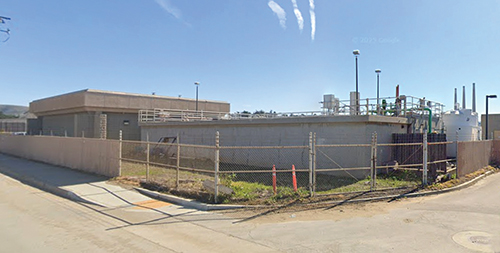

Morro Bay’s old treatment plant located on Atascadero road.
Even after their divorce, the City of Morro Bay and Cayucos Sanitary District appear to have issues communicating, but they’re working on it.
In partnership on a jointly owned sewer treatment plant on Atascadero Road from 1964-2023, the two agencies have had what could probably best be described as a rocky relationship that crumbled after their proposed new sewer project to replace the old plant collapsed in 2013 when the Coastal Commission denied on appeal an already approved plant project. It was appealed by 14 different entities, and most were from Morro Bay.
The two sides had been working together on that project, located at the same Atascadero Road property since 2003 after the Regional Water Quality Control Board ordered the old plant be upgraded to eliminate a special permit under the Clean Water Act.
When it became known that just-elected members of the City Council had lobbied against the project, which the previous city council had approved after much debate, Cayucos divorced itself from the joint project and struck out on its own, eventually building a new treatment plant called the Water Resources Recovery Facility on Toro Creek Road.
For its part, the City moved forward with a new plant of its own moving the new facility to ranchlands at the terminus of South Bay Boulevard and now called a Water Resources Center.
The two agencies had always met every few months to discuss business. And during the former project’s review, the two boards met monthly. Since the split, now over a decade ago, they have not held a single joint meeting.
That’s left the old treatment plant on Atascadero Road loosely holding the relationship together, a bit like a child caught between divorcing parents.
Morro Bay has been working on demolishing the old plant and cleaning up whatever they find in the process, with an eye at future redevelopment, preferably into something that matches the visitor-serving commercial zoning of that area and brings in tax revenues to the City. But where does the CSD fit into those plans?
Last June (2025) the City Council hired a consultant to design the decommissioning project, bringing in AQEA and awarding a $901,000 contract for “Design of the Demolition and Decommissioning of the WWTP,” according to a staff report from June 2025.
AQEA was the lower of two bids the City got for the contract.
AQEA’s contract came with a 5% contingency ($45,050), bringing the overall contract budget up to $946,000.
This cost is coming out of the Water Reclamation Center’s original budget, which allowed for the decommissioning work as part of the original Coastal Development Permit that the Coastal Commission finally settled upon when it approved the new, re-located plant.
Back in June, the City predicted AQEA’s design work would be completed in 10 months, giving a target date for its completion upcoming in May.
Recently, the City asked Cayucos to give the OK to do archaeological testing on the old plant site, taking 15 core samples, 15-feet deep at sites scattered all over the property. Cayucos has initially said “No.”
David Athey, the District’s General Manager, recommended, and the board agreed, to withhold permission to do the drilling until he has “more time to evaluate the request,” Athey told Estero Bay News. “It’s just so I can make a good recommendation back to the board.”
The permit for the demolition goes all the way back to the CDP for Morro Bay’s new plant. “The City’s Water Reclamation Facility program’s Coastal Development Permit from the California Coast Commission,” reads that June 2025 report, “includes a special condition to decommission and demolish the WWTP.
“The Demolition and Decommissioning project requires a thorough removal of all plant components [e.g., building, fences, storage tanks, etc.], with potential exception of those specified in the Wastewater Treatment Plant Removal and Restoration Plan Special Condition No. 7 [Maintenance Building, Administration Building, Chlorine Building, and Collection Shed], and the site restored to a safe and level condition, comparable to the surrounding areas.”
The CDP may require removal of the old plant but there are risks involved. “Several structures extend below the groundwater table, and dewatering in such proximity to the coastline raises significant concerns about impacts to the local groundwater basin, including the potential intrusion of seawater.”
The City was negotiating with the Commission to “limit excavation to components within five feet of the existing ground surface.
“In addition, there is a high likelihood of encountering hazardous materials during demolition, including lead-based paint, asbestos-containing materials, and potentially mercury.
“These materials must be identified, removed, and disposed of in accordance with all applicable regulations to ensure the safety of workers, nearby residents, and the surrounding environment.”
All excavation activities in the Atascadero Road/Hwy 41 corridor and along Morro Creek, including the old plant site are tricky. It’s a known archaeological area.
Indeed, pretty much every project done in the area from the beach stretching back to the eastern edge of town and following the creek, has encountered Native American artifacts of one kind or another.
Shards of pottery to arrowheads and even human remains, have been found in various spots on either side of Morro Creek and along the roadway.
That’s because in ancient times, this was one of the centers of civilization for Native Americans who made their home here for thousands of years.
So it was with some surprise that Athey went to his board requesting they delay the City. “The District was not notified, consulted or involved in any way with the City’s application to the California Coastal Commission for a Coastal Development Permit for demolition and decommissioning of the jointly owned WWTP and was unaware of the conditions of approval until recently.”
He wonders why they are drilling down so far. “The borings will be approximately 15-feet deep; however, it is unknown why the 15-foot depth was chosen. This is well below the water table where cultural resources and remains are not likely to be present. An overall archaeological work plan has not been provided to District staff. Therefore, staff cannot adequately evaluate the impacts and scope of the proposed borings.”
Athey told EBN since that Feb. 19 meeting that he’s been working with the City on getting the information he needs for an informed recommendation to the CSD board and appears satisfied at this point with how the two agencies are working together.
No mention has been made about cost sharing. The property ownership is a 60:40 split with Cayucos holding the minority share.
That’s also the breakdown that’s mainly been used over the years when divvying up the old plant’s operating and maintenance costs and was the source of many of the past disagreements that have boggled the partnership.
The plant also includes an undersea discharge pipeline that the City needs to dispose of the highly treated wastewater from its new treatment plant, at least until it finishes the water recycling portion of its project. Then it will still be needed to dispose of the unusable brine wastewater from the new plant’s desalination process, the final step in the recycling system.
Cayucos now uses an undersea pipeline left over from the former Chevron Estero Marine Terminal, for its discharge needs. It too plans to eventually recycle the treated wastewater. For now, money doesn’t appear to be an issue.
“There is no direct fiscal impact of this work,” Athey said, “as the District was not a party to the Coastal Development Permit application and is not a party to, nor has it seen, the contract for the proposed work. However, this project may impact the Property’s value as it pertains to future uses.”
The two sides have also been negotiating, Athey said, on how the future of the property shakes out. One option that’s been discussed is for the City to buy out Cayucos’ interest in the property, with terms and price still to be determined.
The costs for demolition of the old plant and remediation, if contaminants are discovered, could factor into this as well.
So, like most divorces, there will be a price to be paid by both parties.