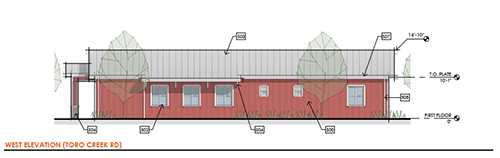

Drawing shows the design of a new Marine Mammal Center as it will look to someone driving along Toro Creek Road. Photo courtesy Marine Mammal Center
The non-profit organization that rescues sick and injured marine mammals looks like it will be rescued too.
The Marine Mammal Center and Cayucos Sanitary District have taken one more step towards an agreement that would allow the MMC to build a new triage facility on property owned by the District on Toro Creek Road.
That’s where the CSD built its new Water Resource Recovery Facility (WRRF) to treat the sewage generated by Cayucos. The property is located at 800 Toro Creek Rd. and is the site of a solar energy plant that powers the WRRF.
The CSD’s facility sits on former farmland that it purchased form Chevron when the oil company liquidated it Estero Marine Terminal and adjacent lands, which it had been leasing out to farmers for decades.
At its Feb. 19 meeting, the CSD Board approved a Resolution declaring that the portion of its WRRF is “surplus land,” meaning it is not needed for use by the treatment plant. That step should free up the two sides to move forward with a formal lease agreement and seal the deal for the MMC.
The Center has been in search of a new home for over a year after it was notified that its lease on a facility on the Morro Bay Power Plant property by plant owner Vistra would not be renewed.
The Center has used that facility for over 20 years to treat and stabilize seals, sea lions, and other marine mammals that it has rescued off SLO County beaches.
The Center had approached several governmental agencies — County Supervisors and the Morro Bay City Council among others — looking for a new home, without success. Then a few months ago, they approached the CSD and now it appears they will be able to continue this important work.
The CSD Board was unanimous in support of having the MMC join them on Toro Creek Road and had few concerns. One thing they did want however, was for the new facility to match the design of its WRRF, with the appearance of farm buildings to fit in with the rural setting. The conceptual designs that were presented to the Board in February seem to do just that.
In the Project Description, the new facility is a 1-story building for offices and animal care and treatment. There will be regular full and part-time staff plus volunteers throughout the year.
Site amenities include pedestrian and vehicle circulation and a parking lot, with water (fresh) being supplied by the CSD’s well at the treatment plant next door. The sewer services will also be connected to the WRRF.
“The project is designed to comply with the California Green Building Code and will incorporate several green building materials,” the report said. “Measures include low flow plumbing fixtures, LED light fixtures, ample insulation, energy efficient windows and doors, provisions for future solar panels and drought tolerant landscaping.
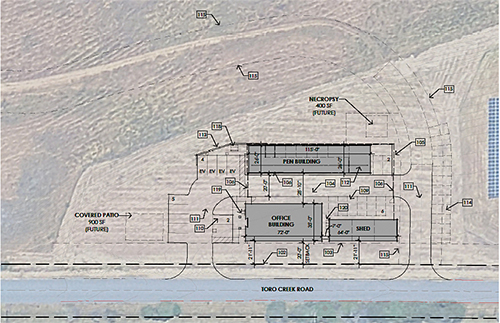
The site is 1.15 acres (50,000 square feet). The office building is 2,500 s.f., the animal pens another 2,400 s.f., and a gear storage shed is listed at 1,200 s.f. Overall, the buildings take up just 6,180 s.f. of the site.
It seems like more room will be taken up with parking, as the design document lists a total of 31 parking spaces. Just 10 are needed for the staff, and one for a rescue van, and a dozen are listed as guest parking.
It calls for four electric vehicle spaces — three standard charging stations and one EV accessible space. It also has bicycle parking, a rack and some lockers too.
The design shows red buildings with stone veneers and metal roofs. That would be a close match to the WRRF’s design. The office building and shed will be located close to Toro Creek Road with the animal pens behind it.
The CSD must report the “surplus land” finding and a finding that the site is exempt from the Surplus Lands Act to the California Housing and Community Development Dept.
The SLA is a State Law that requires public lands that are no longer needed by a government entity must first be offered — for sale or lease — to other government agencies for affordable housing development.
If none are interested it also restricts any private interests that might want the property to also building affordable housing and if no one bites, the property can eventually be sold or leased without restrictions.
But the CSD has declared this site to be “exempt” because of the location and a lack of available public services, and ag zoning, so the State shouldn’t have a problem approving the declaration.
The MMC must go through the County Planning Department for necessary permits to build its facility. Of note, the site is outside the Coastal Zone, so they shouldn’t have to go through the Coastal Commission to get approval.
When asked by EBN about the latest step in this process, the MMC was optimistic but cautious.
Dr. Jeff Boehm, the chief external relations officer at MMC, said that while the Center is making progress in ongoing and good faith discussions regarding a new potential site of operations, no lease has been signed nor is there an agreement in place at this point with the Cayucos Sanitary District.