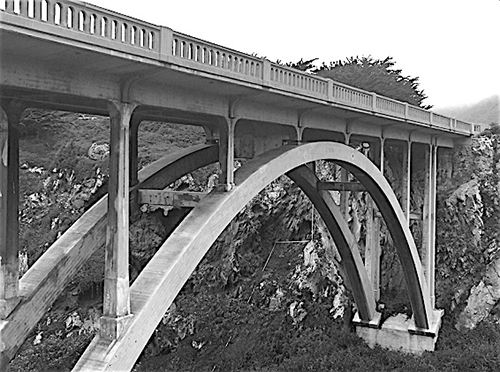

The Garrapata Creek Bridge on Hwy 1 north of Rocky Point marks the northern edge of the new 45 mph zone established by Caltrans. The bridge is one of the famous seven arched bridges along the Big Sur Coast. Photo courtesy Caltrans
Travelers will have to slow down along a stretch of Hwy 1 through Big Sur, after Caltrans reduced the maximum speed limit with the blessings of the Highway Patrol.
Caltrans announced that the speed limit for a 5.1-mile stretch of the highway has been reduced from 55 mph to 45 mph, “following a recent engineering and traffic survey,” the agency said in a news release.
The affected section begins south of Coast Road (at Bixby Bridge), Caltrans said, and extends to north of the Garrapata Creek Bridge (a couple of miles north of Rocky Point), “a scenic and heavily traveled portion of Highway 1.” The new speed limit is in effect in both directions, Caltrans said.
“This change aims to encourage the safe and orderly flow of traffic.” Speed limit signs have already been changed, Caltrans said.
The CHP commander in Monterey, which is responsible for patrolling the Big Sur Highway agreed with the decision.
“By implementing the recommended lower speed limits,” Monterey Area CHP Captain Erica Elias, said, “we can effectively promote the orderly movement of traffic while creating a safer environment for all users of Highway 1. Slower speeds will afford motorists greater reaction time in navigating the roadway, reducing the likelihood of collision and enhancing overall road safety.”
Much of Hwy 1 through that area could be considered treacherous with steep inclines, and descents and sharp curves, but this stretch is relatively flat with long sweeping turns. It would be easy to lose track of ones speed, which is made all the more dangerous by the scenic views around every bend, distracting lookie-loo drivers. Caltrans aid their comprehensive study backs up the decision.
“The engineering and traffic survey evaluated the existing speed limits, collision history, and roadway conditions that drivers may not always notice,” Caltrans said. “These conditions include the presence of pedestrians and cyclists sharing the road, the configuration of horizontal curves, direct driveway access, vehicles parked in pullouts, and pedestrian crossings.”
The agency added, “Caltrans utilizes multiple resources to determine speed limits on state highways, including the California Vehicle Code, the California Manual on Uniform Traffic Control Devices, engineering evaluations, and engineering judgment. Speed zoning decisions also align with the Safe System Approach outlined in Caltrans Director’s Policy 36 (DP-36).”
The policy has an ambitious goal. “Director’s Policy 36,” Caltrans explained, “demonstrates a department-wide commitment to prioritizing safety and achieving zero fatalities and serious injuries by 2050.
“Establishing safe and appropriate speed limits is a key component of this approach and supports the goals of the Caltrans Strategic Plan.”
Also of note, right now the entirety of Hwy 1 from SLO to Carmel is open to through traffic for the first time in about eight years, after crews sufficiently completed repairs to the Regent’s Slide zone in January.
The roadway has seen a succession of major landslides, mudslides and rockslides since May 2017 when the massive Mud Creek Slide closed the roadway for nearly two years obliterating the roadway and burying it with over 50-feet of debris. Mud Creek was one of three major slides that winter.