
Lunch with the League ICE Information
When ICE agents show up in a community, the impact is immediate: families are separated, neighbors are frightened, and questions about legality go unanswered. But what does the law require of immigration enforcement? And what happens when enforcement strays outside those boundaries?
Find out at the League of Women Voters of San Luis Obispo County Lunch with the League webinar on Wednesday, June 3, at Noon on Zoom . Registration required at www.lwvslo.org.
“ICE and the Law: Rights, Limits, and Accountability” brings together legal experts and community voices to examine how constitutional and federal law are meant to constrain ICE, what rights exist for people in those encounters, and where accountability breaks down in practice.
Moderated by Rita Casaverde, executive director of the Diversity Coalition SLO County, the panel features Sarah Goss, Esq., staff attorney at the San Luis Obispo Legal Assistance Foundation; Primitiva Hernandez, executive director of 805Undocufund; and Jared Van Ramshorst, assistant professor of political science at Cal Poly. The conversation will be grounded in local context and real experience, with space for practical next steps you can take.
Get Free Bus Passes for a Year
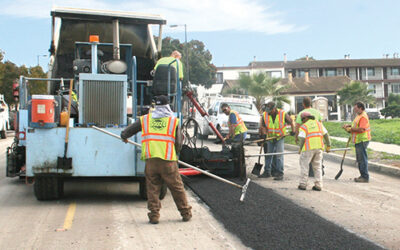
The San Luis Obispo Council of Governments (SLOCOG) is running a Transit Free Fare Pass Pilot Program allowing eligible San Luis Obispo County residents to ride participating transit services for free. Applications are available now.
Services you can pay for with the Free Fare Pass include local bus networks, regional bus networks throughout San Luis Obispo County, and Amtrak trains starting or ending within San Luis Obispo County
To be eligible applicants must be 65 and older, K–12 students or college students, people with disabilities, Medicare cardholders, veterans, low-income residents, people with long commutes or people who’ve never used transit before.
Take the survey at https://bit.ly/43b8vhH to see if you are eligible. If selected, you’ll receive a pre-paid transit debit card that is funded for select transit use in San Luis Obispo County. You can either pick it up, or have it shipped to you.
Building Density the Problem with Fire
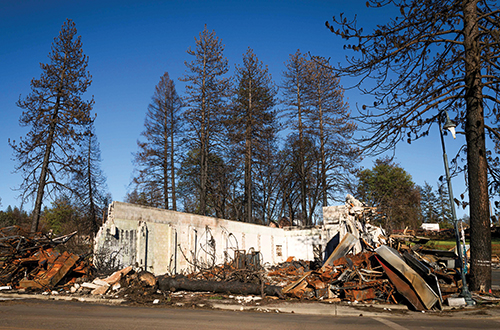
A new peer-reviewed study by Cal Poly faculty and scientists found that building density, not urban trees, was the strongest predictor of whether homes were destroyed during the catastrophic Southern California firestorms of January 2025.
The team examined 15,082 structures and 52,893 tree canopies within the Eaton and Palisades fire scars and evaluated the relative associations of urban canopy and structure density with structure damage.
“Our study shows that during extreme urban firestorms, houses become the primary fuel source,” said Reed Kenny, a Cal Poly biological sciences lecturer and the study’s lead author. “Once fire enters a neighborhood, structure-to-structure spread matters far more than the presence of trees.”
“Urban trees and structure loss in the 2025 Eaton and Palisades fires,” which appeared in online format in April, is set to be published in print in the Urban Forestry & Urban Greening journal in July. The article was coauthored by a research team of scientists and faculty from Cal Poly and the San Luis Obispo-based Urban Forest Institute, a nonprofit organization that supports sustainable urban forest management through applied research, community outreach and practical tools.
The study examined two of the most destructive urban-interface fires in California history, representing areas where wildland vegetation merges with human development. Researchers combined Cal Fire damage inspections, building footprint data, LiDAR (Light Detection and Ranging) mapping, satellite imagery and wind modeling to understand what factors most influence structure loss.
Their conclusion was clear: Houses packed closely together were far more likely to burn than homes in less dense neighborhoods.
As wildfire disasters increasingly move from forests into suburbs and cities, this study reframes a critical question: Are trees the real problem, or are vulnerable building characteristics the larger risk?
The researchers conclude that future wildfire policy should prioritize home hardening and urban design, while carefully balancing the major benefits trees provide to communities.
Read an abstract of the research at bit.ly/42RrSMR.
Send your news, community, and business briefs to EditorEBN@gmail.com. Be sure to include the who, what, why, where and when information along with a contact person.