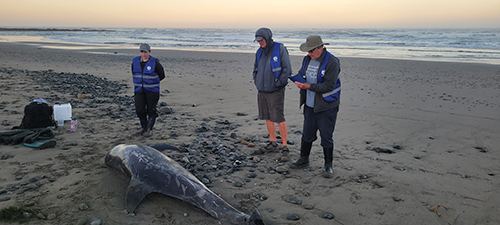

Volunteers begin work to take measurements from a Risso’s dolphin that washed up dead on a Central Coast beach. Photo courtesy of CCMART
By Christine Heinrichs
Studying dead marine animals that wash onto Central Coast beaches became urgent with the discovery of H5N1, Highly Pathogenic Avian Influenza, in elephant seals at Año Nuevo State Park in February. But seals and sea lions and other marine animals die of many other maladies.
Their dead bodies are the focus of a non-profit established last fall, Central California Marine Animal Response Team.
Barbie Halaska, CCMART’s executive director and senior scientist, quotes eighteenth century
anatomist Giovanni Morgagni, “This is the place where death delights to help the living,” a quote now standard in many pathology rooms around the world. “Marine animals are sentinel species,” she told an educational meeting of Friends of the Elephant Seal docents recently. “They are long-lived in the ocean environment. We can sample them for environmental contaminant monitoring. Their bodies can reveal pathogens, ecosystem shifts. They are silent teachers.”
CCMART is a dedicated first responder for deceased marine mammals and sea turtles in San Luis Obispo and Santa Barbara counties. The organization is part of the National Oceanic and Atmospheric Administration’s Marine Mammal Health and Stranding Network. The University of California at Davis is currently handling the H5N1 testing, posting its results at https://bit.ly/4tzh5Bw.
Marine mammals often strand when they are too sick or wounded to carry on in the ocean. The samples CCMART takes from dead animals, or the necropsy on an entire carcass, comparable to a human autopsy, may reveal not only why it died, but additional information about its life and the ocean conditions in which it lived.
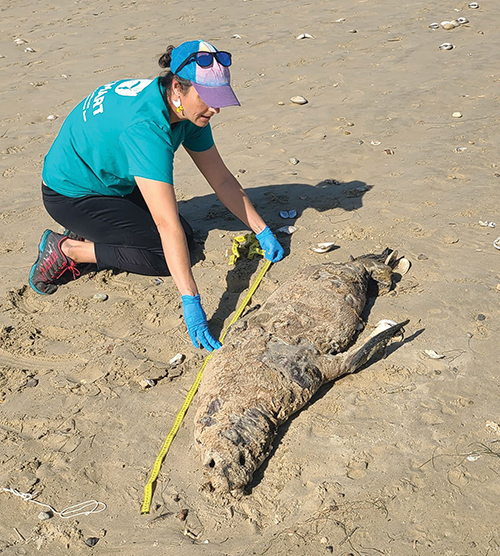
CCMART has the required special permits from State Parks and NOAA to go onto the beach to take samples from dead animals. They report every time they go onto the beach for a dead animal.
Testing Samples
Whale and seal blubber hold persistent organic pollutants, such as PCBs and PFAS (forever chemicals), and microplastics. Ear wax builds up in whales to form a lifelong plug that can be investigated to reveal events in the whale’s life history, such as hormonal changes that reflect pregnancies.
Dead marine mammals can be indicators for public health, especially sea lions that are affected by domoic acid which can be concentrated in filter feeders such as mussels, clams, and other shellfish and affect humans.
Whale baleen and seal whiskers, formally called vibrissae, can also show an extensive record of environmental contamination or even what the animals were eating before they died.
Other findings can add to knowledge of anatomy, their natural history, and the health of the population, as well as environmental contamination.
If You Find a Dead Animal
Anyone can report dead marine mammals to CCMART, by phone or through the website, https://www.ccmarineresponse.org/home; send and email to info@ccmarineresponse.org; of call the Stranding Hotline at 805-242-3560.
• Stay back at least 150 feet. The possibility of human infection is very low, but dogs might catch something. Keep the dog on a leash.
• Photos help. Try to determine the position of the dead animal in relation to the high tide line.
• Drop a pin or include the coordinates with the report.
• Having a time and location stamp on your photo app helps.
Christine Heinrichs is the Monterey Bay National Marine Sanctuary Advisory Council SLO At- Large member. Follow her on Facebook, Bluesky, LinkedIn, and Substack.