
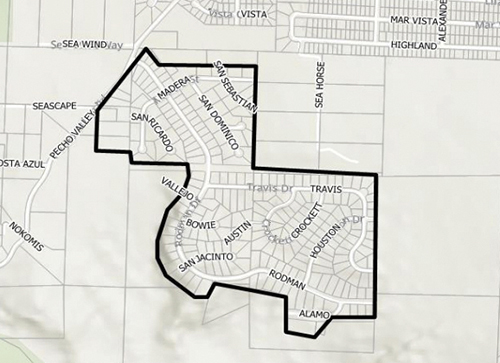

Street map shows the Cabrillo Estates neighborhood of Los Osos outlined in black. Map courtesy SLO County
A hillside neighborhood in Los Osos wants to connect to the communitywide sewer system, but the County slammed the brakes on that idea until the neighborhood can show that it has the means to pay for it all.
On May 5, Supervisors were asked to approve the “Cabrillo Estates Sewer Project” a new effort to resolve a wastewater problem for the Cabrillo Estates neighborhood made up of 202 single family homes that sit high on a hill with a panoramic view of Los Osos and Morro Bay. It’s a neighborhood of large, expensive homes and apparently affluent residents.
The project is a hangover from the County’s community sewer project that was completed in 2016 after over 30 years of haggling with the State and residents.
“Public Works staff,” reads a report from Public Works Deputy Director, Courtney Howard, “were approached by members of the Cabrillo Estates Property Owners Association (CEPOA) requesting that the County lead a project to construct the infrastructure necessary to connect their area to the WRF.”
WRF is the County’s Water Reclamation Facility, the official name for the sewer treatment plant it built off Los Osos Valley Road east of town behind the Los Osos Cemetery.
While the community sewer project used an assessment district on private property that encompassed most of the homes within Los Osos proper, Cabrillo Estates was one of the very few areas that were not required to be included. Instead, Cabrillo Estates homes are “utilizing on-site septic systems,” Howard said.
Complicating this is the fact that the neighborhood sits within a “Nitrate Loading Focus Area” for Montaña de Oro. That designation is coming out of something called the County’s “Local Agency Management Plan” or LAMP.
LAMP requires homes on septic systems that also lie within a nitrate loading zone to do more advanced sewage treatment than a septic system provides — essentially primary separation of solids and anaerobic digestion of wastewater in a leach field — and called a “supplemental treatment system” or STS.
This measure is required once a septic system fails.
Howard said there is already one STS installed and operating in Cabrillo Estates and another is in permitting now.
Installing an STS could be waived if the area meets certain requirements, which the County doesn’t believe Cabrillo Estates can do.
The property owners association is hoping for a third option. “CEPOA,” Howard said, “is requesting to connect to a County constructed community system instead.”
But that would be a “discretionary” action, Howard said, because there is a remedy through the LAMP — making homeowners design and install their own STS on each individual parcel.
Supervisors were asked to allocate $500,000 out of the General Fund contingencies to get started on a potential project, which Howard estimated would take from seven to nine years to design, permit and construct.
But the Supervisors balked at paying up front for the project.
Howard told Estero Bay News that she was directed to tell the Cabrillo Estates residents they need to show the Supervisors that they are able to pay for the entire project.
The CEPOA isn’t an official entity in the way a “Home Owners Association” or HOA would be. She said they are like volunteers and have no standing to enter into contracts or agreements.
Supervisors wanted a proper structure such as an official HOA registered with the County in place before they’d put any money up front and wait for reimbursement that might not come if a Prop. 218 vote fails to form an assessment district.
“There is a lot of work before we get to a Prop. 218 vote,” Howard said.
And if the neighborhood can come together in an official capacity, the costs to do as they’ve asked will not be cheap.
According to an estimate the County put together, it would cost about $1 million to get through the preliminary steps.
According to the County’s proposed project budget, that includes hiring a temporary staffer to work on the project ($400,000), spending $100,000 working on changes to policies; and $500,000 to conduct a Prop. 218 vote.
If the project is a “go” the costs increase dramatically. Howard’s report lists $2 to $3 million for “project development,” to include environmental analysis, endangered species consultation work, plus all the normal things that come with any development project like design, permitting and developing funding processes.
Actual construction is estimated at $11 million to $15 million and would take two to three years.
There are also the buy-in costs that would have to be paid in order to connect to the community sewer.
Howard did not list what those might be, however, when the initial assessment district was formed, property owners had an option to pay some $23,000 up front or pay over time with charges added to their bills.
Despite Supervisors’ hesitation, there appears to be a lot of support for the project. The property owners association has already taken several steps including holding town hall, neighborhood meetings; getting a $40,000 grant to commission a study; started working with County staff in 2024 on the potential project; and they’ve polled the residents.
According to Howard’s report, 75% of the owners are in favor of connecting to the County’s sewer system.
In comments sent to the Supervisors several people argued that Cabrillo Estates was an affluent neighborhood with multi-million dollar homes and did not warrant having the County pay for the up front costs for a project.
Local activist, Julie Tacker, argued that San Simeon, which is a similar size to Cabrillo Estates in terms of the number of residences, is more deserving of County assistance.
A few of the neighborhood residents wrote in urging Supervisors to approve starting the project.
Asked what happens next? Howard said she would notify the property owners of the Supervisors vote and then it’s up to them on how they want to proceed.
Howard’s presentation outlined a pretty straightforward project.
The County would come in and install a gravity-fed collection system, running collection pipes up every street in the very hilly Cabrillo Estates and installing manholes and cleanouts.
Property owners would be responsible for installing a lateral pipe out to the sewer main in the street, and then to decommission their septic tanks.
The alternative is installing the STS on each individual septic system as they fail, with homeowners picking up all the costs.
But LAMP also has a potential light at the end of the tunnel.
“The requirement for installing an STS may be waived,” Howard explained, “if the results of a site-specific hydrogeologic investigation, performed by an engineer, geologist, or environmental health specialist (i.e., qualified professional), determines that the following conditions are present:
• 3D modeling of groundwater related to nitrogen percolation, which demonstrates that discharge will not impact groundwater.
• The nitrogen concentration in the groundwater underlying the subject property is 1.0 mg-N/L (nitrates per liter) or less.”
Nitrates are a form of nitrogen associated with septic discharges and the main pollutant that caused the town to put in a community sewer in the first place.
Howard doubts Cabrillo Estates can meet the waiver criteria. “This area is known to have conditions that would likely not meet the waiver requirements.”