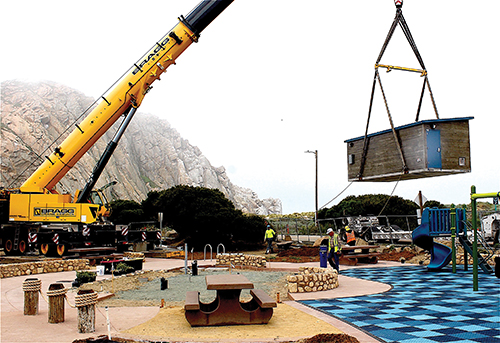

Workers with J Bruce Kies, Const., CXT Precast Concrete Products and Bragg Crane Service lift and drop into place a pre-fabricated restroom at Coleman Park in Morro Bay. The new restroom marked the completion of Phase-1 of the Coleman Park Improvements Project was nearly finished.
Photos and Story by Neil Farrell
W
ith the strength of a massive crane, the new Coleman Park restroom was lifted off the lowboy trailer, and gently eased into place marking the near completion of the first phase of the redevelopment of the bayside public park.
The operator of the 350-ton capacity, six-axle crane fired up the massive diesel engine and extended the arm with a massive strap cradle hanging from its hook.
A semi-truck towing a the heavy load trailer parked on Coleman Drive adjacent to the park and workers attached the cradle to the pre-cast lifting hooks built into the pre-fab, concrete block restroom that arrived a few hours late because of a permit snafu with SLO County.
Seems the trucking company hadn’t received a heavy load transportation permit from the County before last Thursday, May 14.
It was originally scheduled to arrive in Morro Bay about 6 a.m. from the Texas factory where it was constructed.
Though it all got started a few hours late, the work progressed quickly once the cradle was attached to the 75,000-pound building.
The big crane from Bragg Crane Service of Santa Maria, easily lifted the building over the temporary construction fence around the park, and workers on the ground guided it into the proper position to bring it down with the stall doors facing the park’s new playground.
Naturally, the in-ground pipes didn’t quite match up with the pipes of the building forcing the crew from J Bruce Kies, Const., the contractor on the job and CXT Precast Concrete Products of Spokane Valley, Wash., the manufacturer of the restroom, to do some fast footwork to make it fit. This was one of those “measure two or three times before you install it” jobs.
After some quick fixes the pipes lined up and the crane lowered the building the last 3-feet down to rest on the ground.
And with that the “Coleman Park Improvements — Phase 1,” work essentially ended. Well almost.
City Engineer Nate Stong said they would remove the construction fencing by Friday, May 22 unofficially reopening the park, but they still had to wait for Pacific Gas & Electric to come out and hook up the electricity to the building, so there wouldn’t be any lights. But all the other utilities would be usable, he said.
So the City’s newest public restroom will have to close at dusk at least until PG&E gets out and turns the power on.
But that’s the same schedule for all of the City’s public parks; they are open from dawn to dusk no matter the time of year.
Nevertheless, the improvements have transformed Coleman Park from a sad, little sand covered space to a modern design with its most striking feature a special rubber matting on the ground of the playground that Stong said they imported from New Zealand.
It’s approved by the Coastal Commission, he explained, because unlike other artificial rubberized surfaces, this one doesn’t decompose and flake off. “They’re worried about micro-plastics getting into the bay,” Stong said.
The surface is made up of squares in various shades of blue set down in a checkerboard pattern. Walking on them is a bit like walking on a wrestling or a tumbling mat that you’d find in a gym — almost spongy.
It has a life expectancy of 15 years, Stong said.
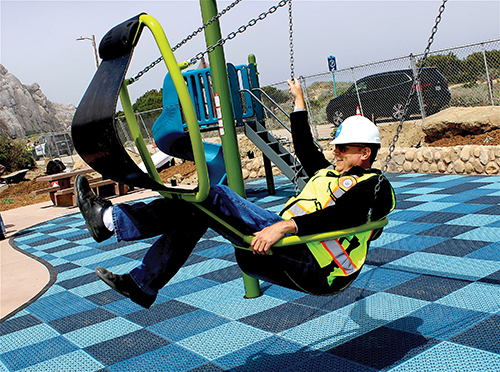
Of note the new Coleman Park has a new swing set with one unusual feature — a two-seater “tandem” swing seat that is hefty enough for adults to use, too.
The playground also has a small spiral slide, something the old park didn’t have. There’s a new drinking fountain too and a stylish rock wall around the playground where parents can sit and watch the kids play.
The pathways through the park are now concrete with picnic tables sitting on compacted crushed granite, which should make the footing much safer than the loose sand that used to cover the park.
It wasn’t cheap. The restroom cost $333,000; Kies Const.’s contract was for $724,000 (plus any change orders that may have been made); RRM Design got $192,000 for the design work; and the City spent $40,000 for construction management. The overall budget that the City Council approved came to $1.4 million, but final costs won’t be known until change any orders and cost overages are settled, and the City closes the books on the project.
Of note, the City had predicted that the restroom would be delivered and dropped into place before Memorial Day Weekend and they beat that target date by nearly two weeks.