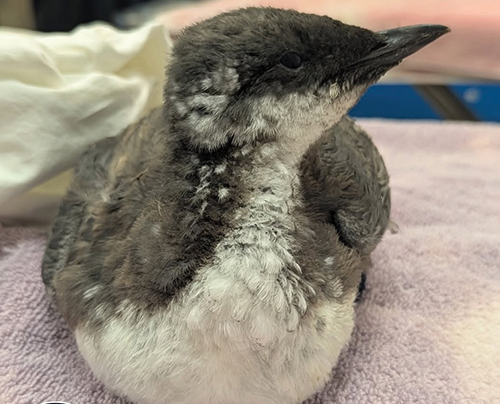

A common murre taken in by Pacific Wildlife Care is among hundreds needing lifesaving care. Photo by Pacific Wildlife Care
The recent occurrences of Marine life in distress have been on the minds of wildlife rescue organizations and concerned community members. Dolphins stranded in the Back Bay made news across the Nation (see story on page one) and the sheer number of common murres needing rehabilitation is causing alarm within the county.
On Sept 28, Pacific Wildlife Care admitted 48 common murres, the largest number of murres the rescue organization has ever taken in in a single day in nearly four decades of operation. The birds are coming to beaches throughout the county with a larger population found in Oceano and Cayucos.
Since September 1, PWC has admitted 421 murres, the vast majority arriving severely underweight.
“Finding a murre stranded on the beach is not normal,” Kristin Howland, executive director of PCW told Estero Bay News. “At Pacific Wildlife Care, we generally see common murres coming into care in small numbers throughout the year, but more often during the winter months when storms and high swell churn up natural seep oil, and oiled birds wash up to shore.”
These seabirds spend most of their lives on the open ocean, so finding one stranded on the beach is a sign that something is wrong. Extremely warm ocean temperatures may be contributing, as the fish murres depend on move into deeper, colder water where they’re harder to reach. Ocean temperatures are expected to remain unusually warm as this year’s El Niño develops.
The murres found on local shores are young, first-year birds who are still developing their diving skills. Chicks leave the breeding colony and continue to be cared for by the adult males, but if prey is scarce or hard to reach, it’s possible that the adults are struggling to provide enough food for themselves and their young, potentially leading to chick abandonment.
“Another possible factor is that the adults are molting right now,” Howland said. “Murres replace many of their feathers at once, which leaves them unable to fly for a period of time as they grow in their new flight feathers. Therefore, they aren’t able to easily travel to other places where fish might be more abundant and, since murres use their wings to ‘fly’ under water, they probably are not able to forage as efficiently or dive as deeply as they normally are. Plus, it’s energetically expensive to grow fresh feathers.”
Murres are capable of extremely deep dives, however, murres have extremely high energy demands and lose body reserves quickly when adequate prey isn’t available.
“If prey becomes less abundant or moves farther away/deeper, birds have to spend more time and energy searching for food,” Howland said. “When birds can’t get enough food, they have even less energy available for energetically expensive activities like prolonged/deep dives.”
The water isn’t likely to drop to needed cooler temperatures prior to the birds being ready for release.
“We will work with other organizations/individuals to identify groups of wild murres that appear to be doing well to release with those groups,” Howland said. “We can’t keep them indefinitely to when water temperatures normalize because the birds are susceptible to captivity-related problems.”
The budget needed to care for such a large influx of birds was unexpected and remains costly.
I don’t have a complete dollar amount for the cost of care yet, but it is already significant, and the longer this crisis continues, the greater the expense becomes,” Howland said. “Our staff are working overtime to respond to the crisis. We have called in additional support from our part-time rehabilitation technicians, added a part-time fill-in rehabilitation technician to the team, and extended the contracts of our seasonal staff. Staff and volunteers are working long days to make sure these birds receive the care they need.
“Food is another major expense. Common Murres are fed smelt, a type of fish with relatively low oil content which helps minimize the risk of contaminating the water in their pools. Since September 24, we have gone through 25 boxes of smelt at a cost of $875, or about $35 per box. At the current pace, our food costs will add up quickly, and we are now down to our last few boxes of smelt. Plus, smelt is a declining fishery, so sourcing enough frozen smelt for this many birds is a challenge.
The birds also require nutritional supplements, medications, and other specialized supplies. Donations would help cover these costs and can be made at pacificwildlifecare.org/give.
“We are so grateful to everyone in our community who has already stepped up to help support the care of these birds,” Howland said.