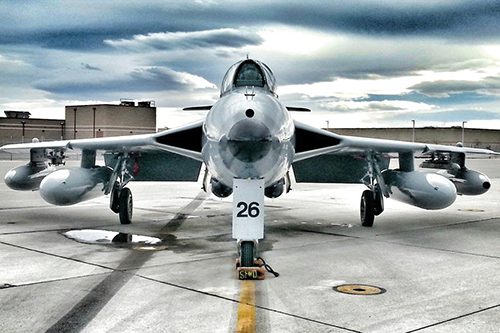

A Mk-58 Hawker Hunter Navy training jet like this one crashed into the ocean northwest of Morro Bay on Sept. 22 Photo from ATAC
There have been no reports thus far of debris in the ocean northwest of Morro Bay after a Navy training jet crashed into the sea on Sept. 22.
According to a notice from the National Oceanic and Atmospheric Administration (NOAA) on the early evening of Tuesday, Sept. 22 a Hunter Hawk military training jet crashed into the Pacific Ocean some 6 miles northwest of Morro Bay. The pilot successfully ejected from the plane.
By chance a Navy, UH-60 search-and-rescue helicopter from the Lemoore Naval Air Station was parked at the SLO County Airport at the time and responded, arriving on scene in about eight minutes and rescuing the pilot, who was reportedly uninjured.
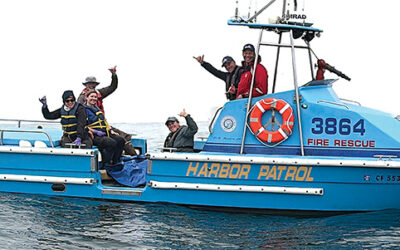
The helicopter crew had been conducting water rescue training with the Morro Bay Harbor Patrol a few days before the jet crash, which is why it was at SLO County Airport and not back home in Lemoore.
Coast Guard Station Morro Bay also responded to the scene arriving after the pilot was rescued but the plane had already sunk to the bottom. There were no reports of debris as one might expect if a jet fighter crashes into the sea and blasts apart on impact.
The Coast Guard out of the Long Beach Station contacted the NOAA Scientific Support Coordinator, “requesting a trajectory analysis for 977 gallons of JP-5 (Jet Propellant-5),” the NOAA notice reads.
The jet, a MK-58 Hawker Hunter training jet was owned by Airborne Tactical Advantage Company or ATAC, a defense contractor, and had taken off from Point Mugu Naval Air Station and flew northwest. The pilot reportedly issued an alert before ejecting from the doomed aircraft.
“In audio captured by liveatc.net, the pilot can be heard radioing a distress signal, saying ‘Mayday! Mayday! Mayday! I have lost thrust in my engine,’” one news report said.
Since the crash there have been no reports of debris in the water or washing up on shore as of last Friday, according to the Officer of the Day at USCG Station Morro Bay.
And, NOAA hasn’t issued any notices to mariners thus far about avoiding debris in the water. No fuel slicks on the water have been reported either.
It’s unclear whether the jet broke up on impact or sank to the bottom intact. There has also been no indication whether the jet was carrying any munitions when it went down.
If the jet sank intact, it’s possible that winter storms could churn up the sea floor and potentially break off pieces of the jet, which the current would likely wash ashore somewhere between Cayucos and Montaña de Oro, if it follows the normal southerly current.
Estero Bay News attempted to contact ATAC, which is headquartered in Virginia, to ask about the jet’s exact crash location, whether it broke apart, whether there were munitions on board, and if they plan to try and recover the aircraft, which may have crashed within the Chumash Heritage National Marine Sanctuary. They did not respond before deadline.
According to ATAC’s website, the Hawker Hunter, was “Originally designed as an air superiority fighter in the 1950s” and “went on to become the most successful post-war British Military aircraft with almost 2,000 units being produced.
“Of these, about one third were later rebuilt by the manufacturer to zero time standards, the last leaving the Dunsfold Factory in 1976. Aided by its high thrust to weight ratio, as well as inherent strength and adaptability, the design evolved from a pure air defense fighter into a superlative ground attack aircraft, the pinnacle of the design being the Swiss Mk-58 Hunters. This version was continuously updated to accommodate the latest weapons systems prior to being prematurely retired in the mid-1990s due to the Cold War ending.”
As to the jet’s specs, “The Hawker Hunter is a transonic single seat fighter/ground attack monoplane, with swept back wings, variable incidence tail plane, powered by flying controls and cabin pressurization. It is powered by a 15-stage axial flow Rolls Royce Avon MK 207 turbine engine, producing 10,150 pounds of thrust.”
ATAC, “Deploys the Hawker Hunter in a variety of roles. The aircraft’s steady performance allows ATAC to use it as a transonic fighter in the air-to-air role, as a stable, precise platform in the air-to-surface role. And the aircraft is a versatile opponent in all fleet integrated training exercises.”
However, even with its impressive history and capabilities, it can’t fly if the engine quits.