
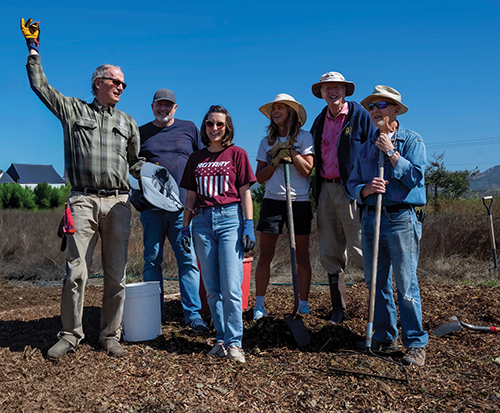

Members of Rotary, left to right. John Swift, Rick Robinett, Marisa Gomez, Cheryl Vonderahe, Don Maruska and David Preston at Saint Benedict’s Church along Los Osos Valley Road.
Story and Photos
by John Lindsey
Pollinators are the unsung heroes behind thriving ecosystems and abundant food.
Pollination is not just a fascinating natural process; it is a lifeline that sustains life on Earth. Without these vital creatures, people and most land-based ecosystems would struggle to survive. In fact, more than 80% of flowering plants depend on animal pollinators to continue their life cycles.
The U.S. Department of Agriculture (USDA) highlights this by stating, “Three-fourths of the world’s flowering plants and about one-third of the world’s food crops depend on animal pollinators to reproduce.” This shows how important pollination is for our food supply.
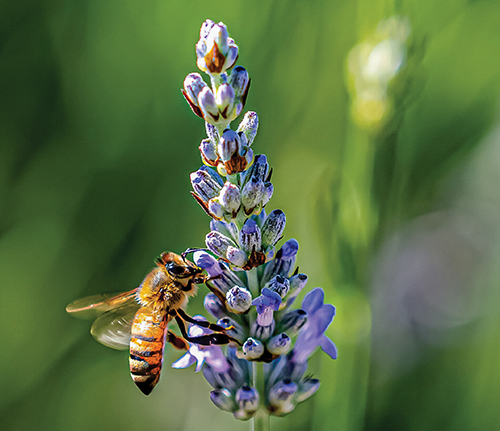
Pollinators not only help plants produce food, but they also fight soil erosion and capture and store carbon. In other words, bees and other pollinators are far more than honey-makers or flower visitors. Their tireless efforts underpin healthy ecosystems everywhere.
Pollinator conservation matters now more than ever because these small but essential creatures support both healthy ecosystems and our food supply. Their decline is alarming: in the United States, beekeepers lost nearly half of their managed honeybee colonies between April 2022 and April 2023. Butterflies are also at risk. The monarch butterfly is now endangered, and five butterfly species have disappeared from the U.S. since 1950. Around the world, species such as the Xerces blue, Morant’s blue, and Sloane’s Urania are gone forever. Fortunately, simple actions can help pollinators recover and thrive:
• Reduce or reconsider pesticide use.
• Grow gardens with native plants that attract pollinators.
• If you find bee colonies in unwanted places, reach out to local beekeepers so they can safely relocate them instead of destroying them.
• Help nonprofit groups and conservation projects by donating, volunteering, or sharing information.
Locally, two groups have come together to increase the number of native plants that pollinators like. Led by Don Maruska who is a member of the Rotary Club of San Luis Obispo de Tolosa and Rotary District 5240 Environmental Chair, has worked to increase pollinator numbers by engaging Rotary Clubs and their community partners along the Central Coast. Through a partnership with Monarch Joint Venture, they are tapping pollinator plants and technical support.
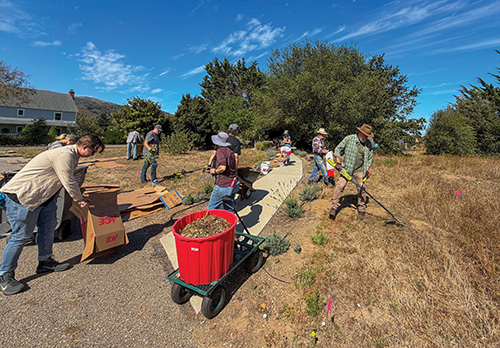
Recently, Maruska led a project with the Rotary Club of Los Osos and Los Osos Valley Garden Club at Saint Benedict’s Church on Los Osos Valley Road. The team cleared weeds, laid down cardboard to prevent new weeds, and added over three inches of mulch. In the future, they will plant pollinator-friendly plants to help local pollinators thrive.
To attract bees, butterflies, and hummingbirds, advisors suggest planting drought-tolerant native plants such as California buckwheat (the state’s top bee plant), black sage, California lilac (Ceanothus), and California poppy. Planting flowers that bloom at different times gives pollinators food all year.
By transforming our yards and neighborhoods, we can give pollinators, and the ecosystems and food systems that depend on them, a better chance to flourish.