
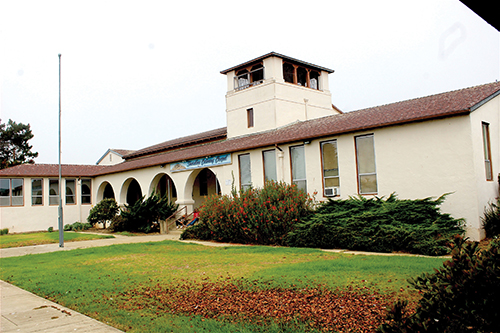

The Morro Bay City Council voted to go ahead with the purchase of Morro Elementary School. Shown here is the historic main school building, built in 1936. Photo by Neil Farrell
The Morro Bay City Council has bitten the proverbial bullet and voted to move forward with purchasing a long-closed elementary school.
The Council voted unanimously Aug. 25 to go ahead with the $5.3 million purchase of Morro Elementary, a historic school that’s been closed since the early 2000s.
City Manager John Craig’s Aug. 25 report to the Council indicated the meeting came just days before an Aug. 31 deadline to either move forward with the purchase or back out and lose a $500,000 down payment already made to the property owner, the San Luis Coastal Unified School District.
With the Council vote, the purchase will move forward with escrow with a target date of Oct. 31 for escrow to close. That’s when the City will have to pay the remaining balance of $4.8 million and therein might lie to rub. The City has not yet announced how it will pay for the old school.
“Our focus,” Craig said in his monthly City Manager Update newsletter, “now shifts to finalizing a funding plan ahead of the October 31 closing deadline.”
The due diligence report Craig and his team presented to the Council found no faults with the school, which was first built in the 1930s and has been added on to several times over the decades.
It covers a nearly 10-acre site and has a huge expanse of grass in the back that’s used by youth sports teams.
“The Due Diligence Report,” Craig said, “organizes its findings around six dimensions of suitability: physical, environmental, title and boundary, historic and regulatory, cost, and value.”
Physical Condition

The due diligence report, which was overseen by a contractor, EMBC Planning Strategies, at a cost of some $125,000, looked at the physical condition of the school’s main building from the ‘30s and an addition from the 1940s.
The goal was to “determine if they can accommodate the working use scenario within their existing footprint, without expansion,” Craig explained.
More consultants — Spectra Company and TYLin International — were brought in and “characterized the buildings as fundamentally sound, with no widespread deterioration and no condition precluding adaptive rehabilitation,” Craig said.
However, the inspections didn’t dig too deeply into the condition, which might typically include checking the building’s stability, structural strength, plumbing, electrical and mechanical systems, among other things.
The other classrooms, built in the 1960s “present no structural concerns and no further analysis was performed on them as accessory buildings,” Craig explained.
Environment
The City had another consultant, Earth Systems Pacific come in and check for contaminants or hazardous materials and didn’t find anything out of the ordinary.
However, “Asbestos-containing materials and lead surface coatings are present,” Craig said, “and will require standard abatement management during renovation, which is a normal construction cost rather than an environmental suitability concern.”
Asbestos was widely used for decades as a heat shield and fireproofing material and can be found in anything from old flooring to coatings on hot flues and even exterior tiles used for home siding.
Lead paints were widely used for many decades before also falling out of use because lead is toxic to humans. Both substances are now considered hazardous materials and require specialized abatement whenever found.
Title and Boundary
A search of the school’s title appears to put something to rest. When the school first closed in 2001, the family that had sold it to the school district specifically for a school site, had claimed the original sale terms included that it be returned to the family if it ever ceased being used for a school.
That belief was renewed when the City started talking about buying it by a member of the family and Estero Bay News specifically asked the City to investigate the claims as part of its due diligence title search. The City appears to have done just that.
Craig wrote, “A note that a reversion claim was discussed in one of the public meetings and that issue has been resolved against the underlying record: the City Attorney has confirmed the 1936 deed is a straight fee grant with no reversion clause. Standard pre-closing title clearing work continues and presents no issues to close.”
Historic and Regulatory
Craig said the old school “appears eligible for the National Register of Historic Places and the California Register of Historical Resources, a finding reached by the Chattel Historic Resource Assessment and concurred with by the City’s peer reviewer, LSA Associates.”
A citizen’s group, Friends of Morro Elementary, has submitted the site for historical recognition, and Craig said the application has not yet been taken up by the State Historical Resource Commission, but could be in the future. It’s a bit of a catch-22 for the City.
“Historic status,” Craig said, “brings both a constraint, namely rehabilitation must be designed to preserve the character-defining features identified in the Chattel assessment, and two benefits: eligibility for the California Historical Building Code, an alternative compliance pathway, which would be conditioned on installation of an automatic fire sprinkler system, and eligibility for the federal Historic Tax Credit, which reimburses 20-percent of qualified rehabilitation costs and can be used by the City to reduce construction cost through partnerships with property developers.”
The working idea right now is for the school’s oldest buildings to be transformed into a new City Hall and the current City offices on Shasta Avenue sold off for residential redevelopment. But as one might expect, there’s a potential zoning problem.
“On the regulatory side,” Craig said, “the Property is designated High Density Residential, which does not permit government office use; the current City Hall and annex buildings are designated Public Facility, which does not permit residential use.
“The working scenario requires paired General Plan amendments and a rezoning of both parcels, together with a Local Coastal Program amendment requiring California Coastal Commission action. No regulatory obstacle identified would preclude the working scenario of using the [school] property for a City Hall.”
Costs
Buying the old school has come in relatively cheaply, considering the school district had appraised it at about $10 million, making the City’s $5.3 million sale price sound like a steal. But converting and reusing it will raise the costs considerably.
The due diligence work included a rough cost estimate for rehabilitation and pegged those costs at $8.5 million (about $14 million total including the sale price). The City also considered a 0.5% interest rate if it had to borrow money for the remodel.
“The cost estimate is a pre-design estimate, not a firm cost,” Craig cautioned, “and includes a contingency of approximately 30%; this estimate does not include costs that can be easily eliminated, as it includes the anticipated work necessary to lawfully and functionally reoccupy the Main Building under the working scenario.”
These estimates also do not include any costs or potential revenues that would come from the other classrooms that might be leased out for business uses. Craig said any talk of these costs and revenues would be left to the community in a “post-closing community vision process.”
Value
Among the things that have come up during two public meetings the City held on the sale has been the potential for affordable housing to be built on the school grounds. Indeed, the Friends group has penciled in about 100 units of affordable housing that could be squeezed onto the site.
Craig said, “The Due Diligence Report identifies optional revenues to offset the City’s expenses, mostly with residential land sale revenue modeled through Residual Land Value methodology across three different scenarios of 100, 150, and 200 total homes developed jointly across the Property and the current City Hall parcels [on Harbor and Shasta].”
Citizens have had a lot of ideas on what the old school means to the community and what it could become. Craig summed it up, “The Report notes that public testimony received throughout the due diligence period has consistently supported the acquisition, preservation of the historic buildings, retention of a portion of the sports fields as open space, and residential development on the balance of the site, and has repeatedly raised public-private partnership models as the anticipated execution vehicle given the specialized expertise the project requires.”
Craig acknowledged that there are still a lot of moving parts with this property, but the City Council has made the first hard decision — to go ahead and purchase the property.
The funding sources or possible financing methods should be known soon, but at the second of the public meetings on the sale, the City Finance Director appeared confident they could get the $4.8 million out of emergency reserves without too much concern.