
The divorce between the City of Morro Bay and Cayucos Sanitary District is almost final, with the close of escrow on a purchase by the City of their jointly owned properties on Atascadero Road due in June.
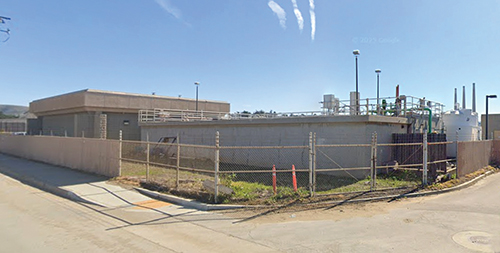
The CSD is a 40 percent owner of the old sewer treatment plant, a former cement batch plant, a portion of the Morro Dunes RV Park and a segment of beach that the plant’s offshore discharge pipe runs through.
The two sides have been partners in a treatment plant since 1954, with a major rebuilding of the plant in 1984. Their joint powers agreement was intact through the 2003 notice by the Regional Water Quality Control Board to upgrade the treatment plant to a capacity that could ensure full secondary treatment of all effluent before discharge into the ocean. That ultimately led to the dissolution of the agencies’ marriage when they couldn’t agree on a project to replace the old plant.
Cayucos broke off form the City’s plans for a new plant in 2013 and went on to build its own treatment facility on Toro Creek Road that opened in 2021.
The City pushed ahead with its Water Reclamation Facility (WRF) Project choosing to build a new plant on a hillside at the terminus of South Bay Boulevard, some 3.5 miles and 240 feet higher in elevation that the old plant.
Cayucos’ new treatment facility cost some $24 million and the City’s topped $175 million.
The CSD ceased using the old treatment plant after its new facility went on line however, the City still uses the discharge pipeline to dispose of its highly treated wastewater and unusable brine water until it can complete a recycling program that’s under study and design now.
The two agencies have always had a rocky relationship often disagreeing on costs, in particular how much is Cayucos responsible for — is it 40% of total operating and maintenance costs, or should it be charged by the actual flow to the plant?
But after the 2013 split, the only remaining issue between the two has been disposal of the old treatment plant site. Now that appears about to be settled as well, though the City is still conducting studies on what they’ll actually be buying.
The agreed upon sale price is some $3.86 million and escrow is slated to close June 22. The sale includes the treatment plant property, the old cement plant, a portion of the RV park, and the beach parcel, which is surrounded by State Parks-owned property.
With the City committed to buying the former Morro Elementary School for $5.3 million (a funding source has yet to be identified and escrow is set to close at the end of October), where is the City going to get the money to buy out Cayucos?
According to a report from City Manager John Craig, they will tap the sewer fund.
“The acquired interests,” Craig said, “will initially be Sewer Fund capital assets, and the purchase will therefore be recorded in the Sewer Capital Fund.”
That fund is the result of charges the City makes to its sewer service customers, and is mainly based on their water usage. Customers also pay for the water delivered by the City.
However, when the City put together the financing for the WRF project it raised monthly rates in anticipation of needing some $23 million in cash to complete the financing, estimated at the time at about $125 million. The remainder was to come from low interest loans both State and Federal, and grant monies.
In the end the State Revolving Loan Fund made some $100 million available for the WRF Project, so the City didn’t need so much cash, however, it didn’t lower sewer rates. The initial rates for the WRF Project were a minimum of $191 per month per customer.
Like most everything with the City’s finances, this is complicated.
“Consistent with the City’s established budgetary practices,” Craig said, “the purchase will require a three part budget amendment to add budget for the (1) transfer out of cash from the Sewer Operating Fund; (2) transfer in of cash in the Sewer Capital Fund; and, (3) create the Sewer Capital Fund expenditure budget.”
The City’s plan for the treatment plant site, given its close proximity to the beach, was always to redevelop it into a revenue generating use.
But the Coastal Commission has set down some pretty daunting restrictions for the future of the site when it denied the City (and CSD) a Coastal Development Permit for their first, jointly proposed replacement project at the same site.
The Commission decided a new plant had to be moved away from the coast to avoid “coastal hazards,” including potential tsunami run up, flooding by Morro Creek, and sea level rise.
That coastal hazard avoidance requirement is still in effect for whatever redevelopment is ultimately pursued by the City.
One possibility would seem to be most logical — another RV park like Morro Dunes. The long-time and popular park is adjacent to the old plant and is the City’s most lucrative tenant. In its initial lease agreement the park was to pay a minimum of $179,000 a year to the City, and also collect the City’s 10% transient occupancy taxes (TOT), easily making it the City’s best paying tenant (including the lease sites on the Embarcadero).
The future use will trigger another series of moves by the City.
“Once future property use is determined,” Craig said, “City Council may exercise the option to have the General Fund purchase the applicable property interests from the Sewer Fund at fair market value, as determined by an independent appraisal or appropriate valuation method, ensuring that the transaction is conducted in accordance with applicable financial and government accounting standards.
“The reallocation of assets would allow the General Fund to directly manage and utilize the property in support of governmental services and allow the Sewer fund to reinvest proceeds in its core operations and capital needs.”
In order for the City’s General Fund, which is the fund with the tightest budget and pays for most of the city’s essential functions — fire, police, administration, public works, recreation, maintenance etc. — to reap the rewards of redeveloping the treatment plant site, and potentially the old cement plant, it would have to be transferred into the General Fund’s control.
So long as it’s owned by the Sewer Fund, revenues will have to be used for the sewer department’s needs, with the exception of the annual intergovernmental transfers, which allows the City to move money out of its various so-called enterprise funds into the general Fund ostensibly to pay for services like payroll, human resources, city attorney and administration.
Those transfers are the fourth or fifth highest revenue source in the City’s annual General Fund budget.
For the past several weeks the City has been conducting it’s due diligence and investigating the old sewer plant site and absorbing those costs.
Craig’s report lists the costs for the sale at $3.86 million purchase price, $30,000 for “environmental due diligence” including testing of the soil for contaminants, and $5,000 closing costs.
Last June the City hired Anchor QEA to do the environmental work on the treatment plant site.
Once this purchase is completed and the CSD is out of the picture, the City can move forward with decommissioning and demolition of the old plant’s facilities. It already has a Coastal Commission permit, which was included as part of the CDP the City obtained for its WRF Project.
The City has a lot riding on this site, which is zoned commercial/visitor serving, and given its location so close to the beach, it should bring significant benefit to the City and the overall tourism business.
“Approval of the Agreement,” Craig said, “would allow the City to become the sole owner of the Property [and all other jointly-owned assets] and is expected to provide significant benefit to the City and its residents, including by simplifying the process for the demolition and decommissioning of the WWTP and potential future reuse of the Property for visitor serving and coastal uses.”