
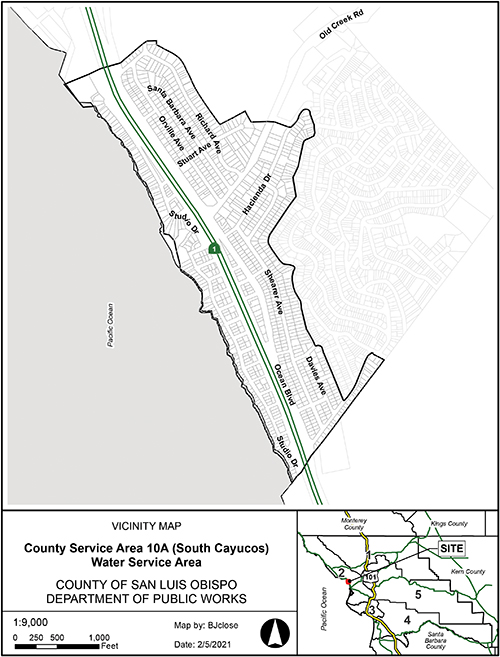

Map shows the outline of the area in South Cayucos served water by County Services Area-10A, which is facing a significant rate hike. Map courtesy SLO County
Tempers could come to boil in South Cayucos, as the County nears a big rate hike for their drinking water.
For months, the County has been working on a rate hike for the 950 water customers in its County Services Area-10A system.
That’s the name for the County-run water treatment and distribution system that serves residents roughly from the base of Whale Rock Dam south to the end of Ocean Boulevard, and on both sides of the highway.
CSA-10A also provides drinking water under contract to the two privately owned water companies — Cayucos Beach Mutual and Morro Rock Mutual.
While the County’s proposed rate hike is aimed at its own customers, the treatment plant is one of the facilities that’s due for increasing costs, so a rate hike for that service is a potential.
Cayucos residents and the Cayucos Citizens Advisory Council (CCAC) have been anticipating the rate hike for many months, and the County informed them of the proposal in May when it released a slide show spelling out why they need to raise the rates.
Under the heading of “Current Situation,” the County listed three bullet points:
• Revenues below Operations and Maintenance (O&M) budget;
• Parent Loan Payment; and,
• Reserves below target after major capital projects.
In response, and after public input, the County listed two proposed responses under “Community Feedback:”
• Keep 14 units included in the base rate; and,
• Accept lower reserves.
The County has two proposed solutions:
• Cover costs without cutting usage;
• A 15-percent increase for the first year; and,
• 5% increases for each of the following four years (years two through five).
The County’s proposal is to eventually increase rates 35% over five years, locking in the annual rate hike under a single vote by ratepayers.
According to a graph in the County’s slide show in the current 2025-26 fiscal year revenues are projected at $1.18 million but they need $1.32M to cover all their costs, a $134,000 shortfall.
By FY 2030-31 they project revenue at $1.2M and expenses at $1.53M, a shortfall of $331,000.
Assuming the numbers are correct, something’s got to give.
In a slide headlined “Why are rates being increased?” the County said costs are increasing $50,000 for “Parent Loan Payment;” $55,000 for labor costs; $45,000 for water treatment costs; and $10,000 for increased vendor costs due to inflation, for a total $160,000 shortfall.
Parent Loan Payment is an amount that the water system (CSA-10A) borrowed from the larger CSA-10, the services district that encompasses the entire community and pays for things like street and sidewalk repairs, oversees garbage service, and storm drains.
The town’s sewer system is owned and operated by the Cayucos Sanitary District, which is an entirely separate agency from the County.
The County calculated the rate increase by looking first at the base rate, which everyone pays, and then the actual usage, which is different for every customer.
The base rate — paying for the loan, labor costs, water treatment and vendor costs — needs an additional $153,000 translating to a bi-monthly rate increase of $32.66 (water bills go out every other month), or $16.33 per month.
Under “Peak Use O&M” the County said it needs an additional $7,000 a year and wants to increase the per-unit rate by $1.81, with the first 14 units falling under the base rate umbrella. One unit of water is 745 gallons.
In dollars and cents, the proposed rate hike would bump up the base rate from $217.79 (for two months) to $250.45 in the first year (15% hike).
It would then go up to $262.97 in year two; $276.12 in year three; $289.93 in year four; and $304.43 in year 5, according to the County’s slide show.
Some folks affected by the rate hike have been very vocal in opposing it.
CCAC board member, Rachel Wilson, put together a flyer for residents back in May that laid out the size of the increase compared to what the customers of the two mutual water companies are paying.
The County is proposing to increase your water rates, if you use more than eight units (now 14) of water by at least 74%, the flyer said.
She pointed out that the current bills for eight units run $217 and at the highest rate under the increase will rise to $379 (for two months usage).
As a comparison, the rate for nine units at Cayucos Beach Mutual are $169 and $157 at Morro Rock Mutual, both are non-profit companies, as is CSA-10A.
Other residents have pointed out that the list of projects needing to be done under the last big water rate hike that CSA-10A enacted was never completed.
And at a recent Dist. 2 Supervisor’s candidate forum focused on Cayucos issues, both Jim Dantona and Michael Erin Woody were asked if they would support privatizing CSA-10A, in essence turning it into a privately held, non-profit like the other two water companies?
Woody was generally in favor of the idea and Dantona was not.
Dantona appears to have won the election and will be replacing long-time Supervisor Bruce Gibson in January.
The rate hike is simply a proposal and must survive a protest vote by the ratepayers, under the State’s Proposition 218 — The Right to Vote on Taxes Act.
Under Prop 218 County staff must present its proposal to County Supervisors in a public meeting and then open a waiting period before the final hearing and tally the votes.
The County’s Water Utilities Project Manager, Laura Holder, informed the CCAC that they’ve now got a date for introducing the Prop. 218 process.
“We have secured Board of Supervisors dates to introduce the Proposition 218 rate adjustment for CSA 10A on July 7, instead of the previously planned date of June 16,” Holder said.
The Supervisors would conduct the second public hearing Sept. 1. At that time the vote tally — in the form of written protests — needs to be over 50% “No” to stop the rate hike. If the “No” votes fall short, the rate hike will go into effect.
Just the 950 lots served by CSA-10A will have a chance to vote, and it’s one vote per customer/household. So, 476 “No” votes are needed.
Of note, if readers are renters and don’t pay their water bills, the notice of the vote will be sent to the property owner or management company, whoever actually pays the water bill.
If you do pay the water bill, whether a renter or not, it should come to you at your home address, and you should be able to cast it.
Also, if a customer doesn’t respond, it’s counted as a “Yes.”
Protest votes must be in writing, an email will not suffice. You must give the address or assessor’s parcel number and indicate clearly that you are protesting the rate hike, for it to count.
Such Prop. 218 challenges are rarely successful but it’s not unheard of.
Holder told the CCAC that the County would make another presentation to the board before the deadline in September.
If readers want more information, the County has a website set up, see: https://bit.ly/4xq570g.