
By Keith Pendleton
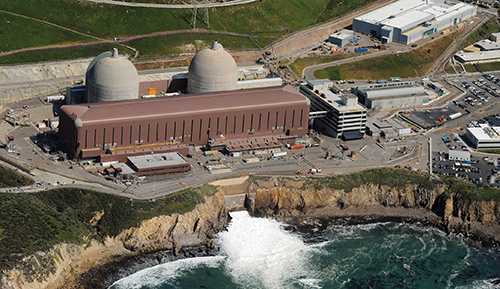
Pacific Gas & Electric will pay San Luis Obispo County $16.6 million in two installments to replace lost Unitary Tax revenue according to a press release by CA State Senator John Laird, D. Santa Cruz, whose District 17 includes nearly all of SLO County.
The Unitary Tax was paid by PG&E for operation of Diablo Canyon Nuclear Power Plant since it first added nuclear energy to the California grid. The deal covers financial impacts of the plant and its employees on county services, including schools in the local San Luis Coastal Unified School District. Meanwhile the federal government has approved a grant request by PG&E for unforeseen expenses from extending DCNPP operations until 2030. Those grant funds will go to help the utility pay the above payment plus help pay off $1.1 billion in loan retirement to help keep the plant operating according, to Ted Garrish, assistant secretary for Nuclear Energy of the U. S. Department of Energy (DOE).
Congressman Salud Carbajal D., Santa Barbara, whose district 24 includes Diablo, expressed his approval of the DOE subsidy noting that he helped shepherd legislation through congress, the Civilian Nuclear Credit Program, as part of the Bipartisan Infrastructure Law for just that kind of expense need.
Diablo Canyon has received two operating extensions from the federal Nuclear Regulatory Commission (NRC). The plant was scheduled to close Unit One in 2024 and Unit Two in 2025, but the federal government allowed for an emergency extension to 2029/2030, and state agencies followed suit with their own extension approval, including a loan to PG&E from the Water Resources Board. Recently PG&E asked to keep Diablo operating until 2044.2045. The DOE and NRC approved that extension as well, but the state legislature has not decided the further operating extension issue.
California Governor Gavin Newsom stated he will leave the extension to 2044/2045 decision-making to the next CA governor’s administration. Newsom’s term ends January 4, 2027.
Replacing the Unitary Tax and paying off the forgivable loan authorized by the state in its decision to extend Diablo’s operating license to 2029/2030 have been sticklers in passing the new legislation to keep the plant operating and additional 15 years. One controversy is whether nuclear power is indeed profitable considering the number of subsidies by all levels of government. The DOE has subsidized many regulatory expenses that would otherwise have been paid by PG&E, but the electric utility does not disclose those subsidies in its balance sheets in a way that shows true profitability according to public comments at the information session, “Diablo Canyon 2045: Local and Statewide Implications,” that took place Thursday, July 30 following the Board of Supervisors 4 – 1 in favor vote. Watch the meeting on SLO-SPAN at www.slo-span.org.
With the 2029/2030 extension, the county lost the tax revenue PG&E had been paying. The local school district and county had to cover the shortfall or lay off employees to compensate for the loss. The $16.6 million payment promise takes the loss current, but the state, county and PG&E would still negotiate for funding solutions to the end of 2029/2030.
The county’s nearly 4-hour presentation had about 38 speakers during public comment. No actions or decisions resulted from the informational meeting. Public comments fell into three general categories: those supportive of Diablo in general and the extension of operation, those who asked that continued plant operation be tied to reinstating the Unitary Tax funding, and a final category was people who were skeptical that the power plant could operate safely and profitably. Most comments were in favor of continued operation.
The SLO County presentations
Featured speakers included Dr. John Parsons of the Massachusetts Institute of Technology (MIT), who discussed the economic benefits associated with the proposed extension of Diablo’s operations through 2045; and Dr. David Roland-Holst, executive director of Berkeley Economic Advising and Research, who presented information on the plant’s positive economic impacts in San Luis Obispo and Santa Barbara Counties.
Public Comments:
The key complaint in public comments was the loss of the Unitary Tax and the effects upon SLO county agencies, especially the $10 million loss to the San Luis Obispo’s Coastal Unified School District.
Ben Lippert, with the San Luis Coastal Parent Information Network, spoke about the efforts to lobby PG&E for continued funding amid school budget cuts.
Echoing those sentiments, Brian Clausen, who is a member of the San Luis Coastal School Board, said the meetings he has had with PG&E were “the most disappointing and rude experiences of his career. The representatives from PG&E had the gall to tell us that we are bad at lobbying, and that’s why we lost our funding. They went on to say there would be no love money for our district or for our local community. If we don’t advocate for our funding, we’re not going to get it.”
Lidia Stone, a SLO City resident, said the continued Unitary Tax funding, “isn’t just a financial obligation, it is a moral obligation. PG&E is asking this community to continue hosting Diablo through 2045. The moral question is simple. If the plant can continue generating electricity, jobs and billions of dollars in value, shouldn’t the children growing up in its shadow also share in that investment?”
A Different Perspective
Mona Olivas Tucker, Chair of Northern Chumash Tribe from San Luis Obispo County, who represented the documented ancestral people of what is now called Diablo Lands, said, “Our families have lived here for thousands of years. Many of our tribal members, including me, trace our ancestry directly to the villages on the Pecho Coast. Tonight’s program covered many things, but one of the things that I feel is most important, that there was no time to really discuss, and that’s the land. It’s the land that holds the power plant. It’s the land that has supported it all of these years. The land is the most important thing there. And the people who belong to it for thousands of years are the people I represent. I want to state clearly: If the plant runs to 2045, we want our land back. If it closes tomorrow, we want our land back. We’ll take it any time we are given the opportunity. Our love and responsibility to this place do not end. We are not stepping back from our homeland. And the debate over extending the license should not overshadow the land-back conversation.”
Another voice, also speaking for a wider group, gave the following cautionary message:
“The current operation and management of Diablo Canyon causes unacceptable damage to coastal ecology and presents an overwhelming threat to our community,” said Charles Varni, International Surfriders Foundation, San Luis Obispo chair. “Surfrider opposes prolonging Diablo Canyon’s role in California’s energy system and supports retiring the plant on the fastest safe timeline while rapidly scaling storage and demand-site solutions. Our chapter’s core analysis is that California is already producing large amounts of renewable energy, so much so, that solar and wind energy are regularly curtailed and the real bottleneck is not a lack of clean generation, but a lack of storage and a lack of ability to use that clean power around the clock. Keeping Diablo online beyond the minimum transition period risks delaying investments in storage, transmission upgrades and demand responses that are essential for a resilient renewable grid and a healthier ocean. Diablo Canyon kills more marine organisms on North, Central, and South American coasts than any other facility. It is a security threat for terrorist attack.
Peg Frerking, an associate chief engineer for NASA’s Jet Propulsion Labs and the first woman to run a nuclear reactor for the Atomic Energy Commission, spoke against the 2044/2045 extension.
“Over the next twenty years, this extension will turn San Luis Obispo County into the largest radioactive waste dump in California. Although nuclear power does not produce greenhouse emissions it is dangerously dirty due to nuclear waste. Twenty years of extended operation will increase the spent nuclear fuel at Diablo Canyon by 50%. Today, the case for Diablo Canyon’s nuclear power plant to provide high-quality jobs and taxes has been presented. But choosing to extend operation also has associated risk. Is the short-term is economic advantage worth the risk? That is the question we have to answer.”
Those in Favor
Jennifer Clay, a 20-year resident of SLO who teaches in the physics department at Cal Poly and an advisor of the university’s Nuclear is Clean Energy club, voiced support for Diablo because “we believe it is a very reliable, important resource for clean energy, for the state of California and also for our community. I am in support of that extension and hope we have more opportunities like this to have these kinds of dialogues and make sure that the community is aware of the issues, and the state legislature hears our voices that we want this resource to continue.”
Jim Hopf, a retired engineer, said that it is cheaper overall to run an existing plant than to convert to something else and the plant offers high paying jobs and the site produces 17% of carbon-free generation in the state.
“Voluntarily closing such a facility is simply insane,” Hopf said. “If Diablo closes, the state government has acknowledged this, It will be replaced by gas plants to some extent. Also, there is a growing consensus that getting all of your electricity from renewable sources, solar, wind and batteries is not practical, it’s not going to happen. So, we need some nuclear in the mix if we are going to get to 100% decarbonization.”
Why DCNPP Operations Were Extended
When Diablo Canyon Nuclear Power Plant (DCNPP) was placed on the state energy grid, the facility was scheduled to operate until 2024/2025 reflecting different end-dates for the two different nuclear generators. In 2016, planning for the DCNPP closure began in earnest. Before the closure, however, PG&E was asked by the Newsom administration to keep operating due to lack of alternate energy production capacity. The emergency extension proposal gained federal, and state approvals to operate until 2029/2030. SLO County governing entities were not part of that emergency extension conversation, nor was PG&E funding of county and school district support services included in the extension legislation.