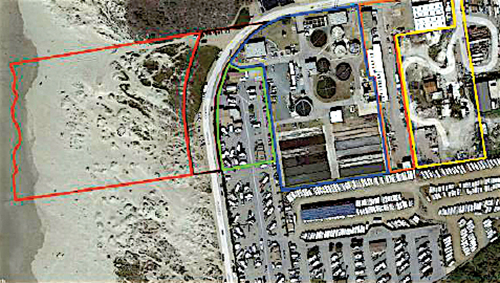

Satellite image of the properties on Atascadero Road that Morro Bay is paying nearly $4 million to the Cayucos Sanitary District to buy out the CSD’s interest. Outlined in red is a parcel on the beach; yellow is the former concrete batch plant; blue is the former sewer treatment plant property; and green is the portion of Morro Dunes RV Park owned by the City. Outlined in orange is the City’s Corp Yard. City map
The last link between Morro Bay and the Cayucos Sanitary District is being severed, after the M.B. City Council approved moving ahead with the buy out of their jointly owned former sewer treatment plant on Atascadero Road.
Governed by a Joint Powers Agreement or JPA the old plant was co-owned and operated by the two agencies and with both now operating their own, separate treatment plants, the City sought to purchase Cayucos’ 40% interest in that site and several other adjoining properties. The two entered into a sale agreement last March and the purchase price is over $3.86 million. The City had been using the interim time to make sure all was copacetic with the property.
“The Agreement,” reads a report from City Manager John Craig, “provided for a 90-day escrow period and due diligence items related to title, property inspections and a qualitative environmental assessment. Standard title policy and escrow charges would be split evenly by the City and CSD.”
Once money changes hands, that’s it for the 40-plus year partnership. “Upon the close of escrow,” Craig said, “the JPA would be deemed terminated and there would be no more jointly owned assets with the CSD.”
The deal includes the old sewer plant property, the old concrete batch plant on Atascadero Road, a portion of the Morro Dunes RV Park, and a slice of public beach where the old plant’s discharge pipe runs under.
The City also owns another parcel in between the old concrete plant (torn down in 2025) and the sewer plant where it has an incorporation maintenance yard. So with this sale, the City now owns all of the parcels on the south side of Atascadero Road from Hwy 1 except for Flippo’s and an adjacent small RV park, and two motels — Motel 6 and Morro Shores. The City also owns the property under Morro Dunes RV Park, which is leased to the park owners.
Before the sale could move forward, the City had to investigate the old sewer plant property for any contaminants. It hired Roux Associates, Inc., to conduct the environmental assessment. Roux searched through property records and conducted some limited soils testing “to evaluate the potential for hazardous materials.”
Craig said Roux’ work found four “environmental concerns” — a previously reported 50-gallon spill of diesel fuel at the old concrete plant; the 1991 removal of an underground diesel fuel tank at the concrete plant; oil stains on the floor of the sewer plant’s maintenance building, and reported detections of Per- (sic) and polyfluoroalkyl substances (PFAS) in WWTP influent, effluent and biosolids and from sludge bed concrete samples taken as part of the pre-demolition structure assessment report,” Craig’s report said.
According to the Food & Drug Administration: “Per- and polyfluoroalkyl substances are a diverse group of thousands of chemicals used in hundreds of types of products. PFAS in the environment can enter the food supply through crops and animals grown, raised, or processed in contaminated areas. It is also possible for very small amounts of PFAS to enter foods through processing and cookware.”
According to the National Institute for Health (NIH), “Per- and polyfluoroalkyl substances (PFAS) are a large, complex group of synthetic chemicals that have been used in consumer products around the world since about the 1950s. They are ingredients in various everyday products.
“For example, PFAS are used to keep food from sticking to packaging or cookware, make clothes and carpets resistant to stains, and create firefighting foam that is more effective. PFAS molecules have a chain of linked carbon and fluorine atoms. Because the carbon-fluorine bond is one of the strongest, these chemicals do not degrade easily in the environment.”
The testing at the maintenance garage was mostly clean for hydrocarbons but did show trace amounts of benzene in vapor testing hat came in above the standards set by the State Department of Toxic Substances Control, the report said.
Four test wells were dug by the old sludge drying beds and three went down as far as 5-feet below the surface. However, one of the holes cold only be dug 7-inches down.
They found PFAS compounds at levels that would be expected given the previous use of the concrete drying beds.
Groundwater tests were done using existing wells at the site and PFAS was detected well below the allowable standards for groundwater. That led Roux and the City to conclude that activities on these properties had not contaminated the groundwater with PFAS compounds.
“The PFAS detections,” Craig said, “are not surprising for wastewater treatment facilities given the ubiquitous nature of PFAS and its common presence in community effluent to such facilities. Only one soil sample was above generally expected background levels and groundwater well detections were low and below other well water detections in the area.”
The report admits that they didn’t drill any new wells down gradient of the sludge beds and might have to do so as part of a demolition plan. That should eventually have to be done; given the City has ideas of offering the property for redevelopment into some kind of tax generating usage at some point in the future.
As to the future, the City Council has talked about doing a full public parti9cipation effort on future plans for what should be prime property for some kind of commercial visitor-serving use.
Given its location, just steps from Morro Stand Beach, and easy access from Hwy 41 and Hwy 1, it’s potential would seem unlimited.
Except that the Coastal Commission could mean the City gets pipped at the post with its grandiose plans for a future payday.
The Coastal Commission, while in the process of denying the City and CSD’s original plans to replace the old sewer treatment plant, set down some findings that are sure to come back to haunt any future development plans. The Commission found that the project didn’t meet the Coastal Act requirements for visual impacts and avoidance of so-called “Coastal Hazards.”
Those Coastal Hazards included the potential for future sea level rise, and potential flooding from a tsunami and from Morro Creek. The site sits within the creek’s flood plain and has indeed flooded on more than one occasion, though never enough to cause catastrophic damage.
Whatever comes of the future for the parcels, will have to deal with these precedents set down over a decade ago during a political battle over an entirely different project.
Roux recommended monitoring the diesel spills at the concrete plant and the sewer maintenance shed during any future grading that might be done with redevelopment.
The oil-stained maintenance garage and sludge bed issues were recommended for soil testing.
The City dug test wells by the old maintenance building and the sludge drying beds to test the groundwater for PFAS.