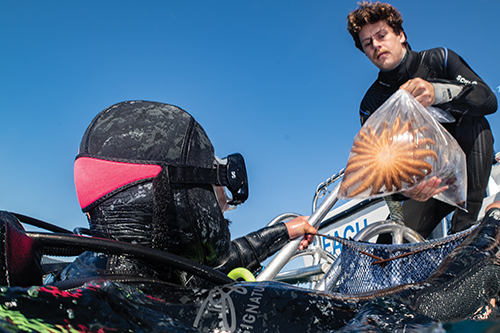

Sunflower Star Laboratory Executive Director Reuven Bank Passes a Bagged Sunflower Star to Lab Manager Andrew Kim as part of the 2026 Outplanting Fieldwork. Photo copyright Sage Ono.
By Christine Heinrichs
Like a sunflower sea star, with its 24 arms reaching across three feet or more, ocean organizations are working together to save this beautiful invertebrate. Not only for its beauty, its vibrant colors ranging from purple to orange and yellow, but because it’s an aggressive predator keeping ocean ecology in balance.
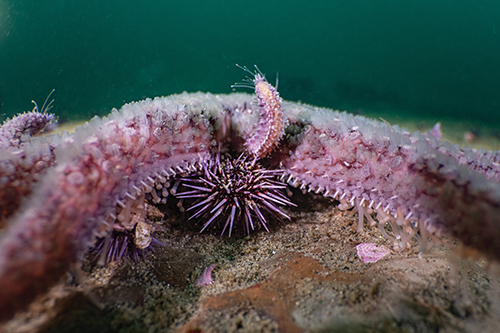
Sunflower sea stars were wiped out in local waters, and along the entire West Coast, by sea star wasting disease, which gradually infected and killed sea stars between 2013 and 2017. Sunflower stars are keystone predators in kelp forest ecosystems. They not only eat urchins, but the urchins are so scared of them that they hide in the ocean floor rocks to avoid them.
Without sunshine sea stars to eat and scare sea urchins, the urchins consumed the kelp. The urchins ate nearly all the kelp in Northern California and affected kelp forests along the entire West Coast. What was left is called urchin barrens, a desert sea floor covered with urchins.
It doesn’t work out for the urchins, either, which eventually starve when all the kelp is gone. The urchins don’t die, though. They remain in a dormant sort of hibernation, able to absorb enough nutrients from sea water to survive as long as 50 years. They are ready to eat any stray bit of kelp that tries to grow.
In some places, divers have organized to go down to the urchin barrens and smash the dormant urchins. That works, but it’s labor intensive for the divers, and not the answer to the problem along the entire West Coast. The kelp forest ecosystem needs the sunflower sea stars.
To The Rescue
The Monterey National Marine Sanctuary Advisory Council formed the Kelp Working Group in 2024. It developed the Iconic Kelp Action Plan to address the problem. Other organizations were working on it, too. One collaboration is doing research to bring the sunflower sea stars back.
Conservation nonprofit Sunflower Star Laboratory (SSL) is leading the partnership with Reef Check Foundation, Monterey Bay Aquarium, Moss Landing Marine Laboratories, The California Department of Fish and Wildlife, California State University – Monterey Bay (CSUMB), Phil Sammet’s Underwater Company, and marine operations staff at Hopkins Marine Station. Together, they have raised sunflower sea stars in their Moss Landing lab and are experimenting with introducing them to the intertidal and subtidal zones where they can eat those zombie urchins and bring balance, and the kelp forests, back.
Otters are urchin predators, too, but they aren’t interested in the starving urchins. Those urchins are too skinny to offer any food. Sunflower sea stars eat any urchin, skinny or well nourished. They can eat three or four urchins a day, inserting their tiny tube feet hydraulically into the urchin.
One experiment SSL did was to put 16 sunflower stars into enclosed pods in an urchin barren in Monterey Bay for a month. The SSL team gave half of them starving urchins and half of them well-fed urchins. The sea stars gobbled up more of the starving urchins than the well-nourished ones, but they all gained weight, increasing their weight by 50 percent in a month.
“These results highlight the powerful potential of reintroduced sunflower stars to convert barren environments back into kelp forests through predation,” SSL said in a press release.
While the sunflower sea stars were in their cages munching on urchins, SSL divers monitored how the urchins around them responded. The smell of the sea stars terrified the urchins, which retreated from a “fear halo” of several meters around the cages. Just being there sent the urchins scurrying to hide in rock crevasses, where they have to survive on other floating bits, instead of eating kelp.
Next, SSL set the sea stars free. Not a full release, but temporarily, to observe what would happen. Divers watched over them, “chaperoning” them on their two-hour uncaged “walkabouts.”
“By ground-truthing our lab and caged-trial feeding results, with free-ranging sunflower stars during our ‘walkabouts’, we can design more effective reintroduction plans, based on real consumptive data for these young stars,’ explains Ashley Kidd, SSL’s Conservation Program lead. “The walkabouts are incredibly valuable as we capture behaviors using ethograms as the stars explore the ocean floor for the first time, and we see first-hand their effect on nearby species.”
SSL had permits from the California Department of Fish and Wildlife and approvals from the Monterey Bay National Marine Sanctuary to conduct the experiments.
Not Yet Ready for Full Release
Two of the 16 sea stars showed signs of sea star wasting disease, and were removed from the ocean before the month, to be treated for the disease. Sea star wasting disease is caused by bacteria, which was detected in one of the sea stars. That’s the first time the disease was documented to be transmitted naturally. This kind of knowledge can help inform marine management and policy and conserve this species and the kelp forest ecosystem.
“Together, the multiple components of this experiment demonstrate the transformational power of sunflower stars to recover California’s beleaguered kelp forests,” said Reuven Bank, Sunflower Star Laboratory’s executive director. “This groundbreaking research from Sunflower Star Laboratory and our collaborators illustrates the power of cooperative conservation in action and lays the foundation for the future transition to permanent outplanting in our state.”
Chumash Heritage NMS Advisory Council
The Chumash Heritage National Marine Sanctuary Advisory Council is looking for six people with knowledge of Indigenous cultures, environments, histories and lived experiences in the region to form the Indigenous Cultures Activities Panel.
Applicants should have experience working with Indigenous governments; understand the traditional values and cultural heritage of Chumash Peoples; have the ability to maintain sustained, meaningful participation by attending both in-person and virtual meetings for period of at least two-years; display strong communication and collaborative capabilities; and have lived experience of the interconnectedness between Chumash cultures, animals, plants, ocean, language, and all that make up the environment. Support from Chumash governments, Elders, or Leaders is encouraged.
Call Sachiko Lamen at 805-203-6004 or email chumash.heritage@noaa.gov for more information if you want to apply. Include information about yourself and any supporting documents including letters of support, curriculum vitae, and resume. Deadline to apply is November 29, 2026. Go to sanctuaries.noaa.gov/chumash-heritage/management/co-stewardship.html.