


Support May Madness and Fireworks in Cayucos
Time is running out to get tickets for the Cayucos Chamber’s May Madness Party on May 23 from starting at 6 p.m. Cayucos Elementary School.
“This isn’t your average fundraiser,” said organizers. “It’s part community celebration, part high-energy auction night, part ‘we can’t believe we just won 49ers tickets’ excitement.’
May Madness helps fund the Cayucos 4th of July celebration, including fireworks over the pier, the parade, sand sculpture contest, Front Street Faire, foot races, and all the traditions that make our little beach town sparkle every summer. And putting it all together takes nearly $50,000 each year.
Buy tickets for an evening filled with a wine pull, reverse drawing, live and silent auctions, and dinner. VIP Sparkler Tables are still available and include premium seating and extra goodies for your crew.
Tickets available at cayucoschamber.com/shop/may-madness-tickets. Folks who can’t attend can purchase reverse drawing tickets. Winning ticket has to be present, but folks can appoint someone to be in charge of their ticket for the reverse drawing. Every ticket helps keep the boom over the bay alive for the next generation of Cayucos kids standing barefoot in the sand with their faces lit up by fireworks.
Poly Student Teams Win $30,000 at Quest Competition
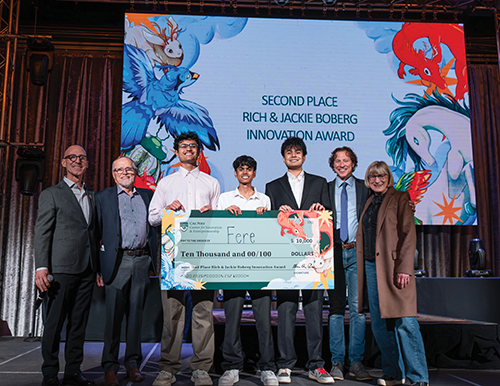
Three student startup teams split $30,000 at the Cal Poly Center for Innovation and Entrepreneurship’s (CIE) annual Innovation Quest competition where students pitched inspired business ideas to a panel of judges to fund their startups.
“Innovation Quest draws such a diverse range of students from all corners of campus,” said Sophie Hosbein, CIE’s manager of student innovation programs “This year, we had entrepreneurial students from all six Cal Poly colleges working on ideas ranging from novel medical devices to guilt-free desserts.
“After working with each team one-on-one, it was impressive to see how far they had come from their first pitch to the final presentation.”
Since the first high-stakes Innovation Quest, or IQ, was held in 2004, hundreds of thousands of dollars have been awarded to student startups that have blossomed into thriving businesses. The top three presentations and proposals in the annual competition receive cash prizes: third pick gets $5,000; a $10,000 prize for second; and $15,000 for first.
PNOIA, a suffix from the Ancient Greek verb pnein, meaning “to breathe,” received the top prize at the event.
“Building PNOIA from day one has been a labor of love, and having the CIE believe in our vision is incredibly motivating,” said Jack Mahoney of Santa Barbara, California. “This opens real doors for us to get our technology into the neonatal intensive care units (NICUs) that need it.”
PNOIA is a low-profile nasal pillow CPAP, or continuous positive airway pressure, interface designed specifically for premature infants (before 37 weeks) that unlike a ventilator improves therapeutic reliability, reduces clinical complications and simplifies care in the NICU. The startup creators include mechanical engineering student Mahoney; biomedical engineering majors Josiah Waltner and Madeline de la Concha; mechanical engineering fifth-year Aidan Geurts; and business administration senior Jordan Garver.
The Rich and Jackie Boberg Innovation Award, of $10,000, went to Fere, a specialized macOS desktop application designed to visualize, monitor and manage network connections and running processes. It operates by analyzing active network activity, providing a live, graphical representation of ports, network connections and services that gives developers a real-time visual map. The app was created by a trio of computer science freshmen: Rahul Thennarasu, Snehil Kakani, and Siddharth Balaji.
“Placing second at IQ means a lot to us. Fere started as something we built to solve our own problems as developers, and now we feel it could be something real,” Kakani said. “In the future, we want to build with the community, not just for it, and this win gives us the opportunity to do that.”
Anthropology junior Benjamin Cooper and computer science senior Nipun Batra from UC Santa Cruz received the Bakir Begovic Innovation Award, of $5,000, for their startup Rogue wave, a surf company that created what they call The Surfers’ Headphones, with an IPX8 high-level water resistance designation.
“It feels infinitely rewarding to win third place at IQ,” Cooper said. “We are so grateful to be acknowledged for all the time and effort both Nipun and I have put into this business — there were so many impressive startups and being among so many like-minded people was amazing.”
Eleven finalists from more than 60 applicants pitched their innovative ideas in Cal Poly’s Nash Family Entrepreneurship Lab. In addition to prize recipients, eight finalists were chosen.
IQ was founded 21 years ago by Cal Poly electrical engineering graduates and business leaders Carson Chen, Boberg and Pickering. Since its launch in 2004, participants have received more than $400,000 that has helped launch several successful businesses, such as iFixIt, Grinds Coffee Pouches, Mantis Composites, Guardian Bikes, Liftgator and Alydia Health.
Keeping Local Restaurants Cooking with PG&E Grants
For the sixth straight year, The PG&E Corporation Foundation (PG&E Foundation) will fund grants to support independent restaurant owners and their staffs through the California Restaurant Foundation’s (CRF) Restaurants Care Resilience Fund. The grants will support a record number of restaurants in Northern and Central California this year.
Resilience Fund grant applications will be accepted at www.restaurantscare.org/resilience June 1 through June 30.
The PG&E Foundation is contributing nearly $1.3 million to the program this year — more than any other year. The grants are designed to help build more resilient hometown businesses for the long term. A total of 213 restaurants and commercial caterers in Pacific Gas and Electric Company’s (PG&E) service area will receive $5,000 grants. That number is up from last year’s 188 grant recipients.
Since 2021, PG&E and the PG&E Foundation have contributed nearly $5.6 million to the CRF’s Restaurants Care Resilience Fund. This has provided grants to 863 local restaurants within PG&E’s service area. With this year’s contribution, the total number of restaurant grants awarded in PG&E’s service area will exceed 1,000.
Grants can be used for vital business needs, including technology and equipment upgrades. They can also help with employee training and retention and unforeseen hardships.
CRF began the Resilience Fund to support restaurants recovering from economic impacts of the COVID-19 pandemic. Since then, the fund has provided more than $11 million in grants to restaurants and caterers across California.
PG&E and The PG&E Corporation Foundation have supported the program since its inception.
California-based restaurant owners and commercial caterers in PG&E’s service area can apply.
Applicants can have up to five locations (although only one location can apply). Annual revenue cannot exceed $3 million for the location. The restaurant must be in operation for one full year to qualify, and previous grant recipients are eligible to apply for a different location or concept. Existing food businesses that are expanding into a brick-and-mortar location are also eligible to apply.
For more information on the California Restaurant Foundation, Restaurants Care, or the Restaurants Care Resilience Fund, go to restaurantscare.org.
Directors Roundtable
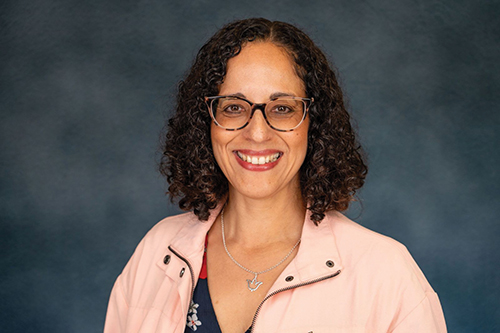
Directors Roundtable on May 28 from 12 p.m. to 1 p.m.
Admission is $10.
This is a opportunity for development directors or those serving in a fundraising role presented in collaboration with the Association of Fundraising Professionals of San Luis Obispo County.
The facilitator is Loren Leidinger, who is currently the outreach and development director at the Community Action Partnership of San Luis Obispo and is the past president of the board of the Association of Fundraising Professionals of SLO County.
Spokes roundtables are facilitated, peer networking and problem-solving opportunities held monthly. At the start of the roundtable, participants introduce themselves and share some good news or something that’s “keeping them up at night.” They may also offer a “spotlight topic” for consideration during the meeting.
A hallmark of the roundtables is confidentiality. The explicit norm is “what’s said in the roundtable stays in the roundtable.” This encourages mutual support and a candid exchange of ideas.
Participants are required to have their video on. Meeting information will be provided once you register at spokesfornonprogit.org.
Attorney General Warns of Scams
State Attorney General Rob Bonta issued an alert warning about the prevalence of fraudulent investment scams across Meta platforms, including on Facebook, Instagram, and WhatsApp, as well as on other online platforms. Scammers are increasingly using deceptive advertisements (ads) and deepfake technology to lure people into high-stakes scams to then defraud them of their savings.
“Californians, we’ve seen an uptick in investment scams across Facebook, Instagram, and WhatsApp,” Bonta said. “These scams have cost some people their life savings and typically use photos of well-known or trusted people without their permission to create the necessary trust to get into consumers’ pockets. I encourage Californians to learn about common scams and review tips to protect themselves, and I urge investors to scrutinize social media investment ads before investing.”
Common Social Media Scams
The Pump and Dump Scam:
In a pump and dump scheme, victims are lured into online investment groups and convinced to invest in low-priced stocks or deal in volatile cryptocurrencies.
The Bait: Scam ads appear on Facebook or Instagram featuring recognizable figures, like Cathie Wood (Ark Invest), Joe Kernen (CNBC), or Kevin O’Leary (Shark Tank), without their permission. Other ads may feature less well-known financial advisors, also without their permission. The ads often promise exclusive “insider” memberships or “guaranteed” high-return investment tips.
• The Shift: Once a user clicks the ad, they are pressured to move the conversation to WhatsApp or other encrypted platforms such as Telegram.
• The Hook: Victims are funneled into group chats where they receive so-called “expert” advice and false testimonials. Eventually, victims are coerced into buying stocks or crypto, with the initial fraudulent tips sometimes appearing successful and generating a profit. Victims are convinced to spend large amounts in a stock or cryptocurrency, which then goes up in price and which the scammers sell off at this inflated price, leaving the victims to lose their money once the price plummets.
The Confidence Scam:
In confidence scams, fraudsters develop trusting relationships with their victims and convince them to “invest” using fake investment platforms that drain the victims’ money. These scams can also follow a three-step process:
• The Bait: Scammers post ads suggesting that investors can make money using an investment platform or strategy. Once the user clicks on an ad, they may be asked to enter their contact information or taken to a different website to do so.
• The Investment: After the user provides their account information, they are contacted by scammers who develop a relationship of trust and confidence with the victim.
• The Scam: Once the victims seek to withdraw their profits, they are told they need to pay some kind of fee, such as a commission or tax, to do so.
Be very cautious before responding to any social media investment ads and making related investments. Reputable broker-dealers and investment advisors typically do not advertise their investment strategies on social media.
No legitimate investment is “risk-free” or offers a guaranteed return. Verify Before you invest and beware of “Deepfakes” and AI. Protect your identy at all times.
Anyone who may have fallen victim to these types of scams can report it to the California Department of Justice at oag.ca.gov/report.
Is your business, including non-profits, supporting our community? Maybe you’re launching a new business, or you’re making updates to your current business model, or re-opening. Perhaps you have a job opportunity, or have been doing some volunteer work, or are collaborating with another business or a non-profit.