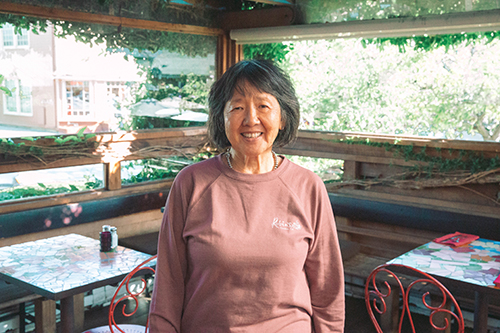

Robin’s Restaurant owner Shanny Covey in the atrium of the restored adobe home and garden setting in Cambria. Photo by Isabella Curtoni
A North Coast restaurant is tackling climate change one meal at a time and diners can participate simply by eating.
Robin’s Restaurant in Cambria, long celebrated for its seasonal, fresh food and innovative menu, is the first eatery in SLO County to join Zero Foodprint’s efforts to fund farmers implementing climate smart/regenerative practices. This decreases harmful emissions by reducing fossil fuel inputs like fertilizer made from methane, thereby reducing the damage being done to the planet. Regenerative practices draw carbon out of the air and store it underground, safely and naturally undoing damage that has already been done.
“Zero Foodprint wants to transform agriculture by funding farmers directly to make the change, provide food and beverage businesses with a way to help their customers take climate action, and build social acceptance of the need to pay a tiny bit more for food to be responsibly grown,” Dr. Erin Pearse, a Cal Poly mathematics professor and the Director of the Initiative for Climate Leadership and Resilience, told estero Bay News.
Zero Foodprint provides grants of up to $25k for farmers and ranchers to implement regenerative practices that sequester carbon, meaning capturing atmospheric CO₂ and storing it in plant material and soil organic matter.
“Being able to give back to the community, and the climate in general, makes sense for me as restaurants generate a significant amount of carbon in their operations from food waste to packaging,” said Robin’s owner Shanny Covey. “I love that Robin’s can be a vehicle to a large cause that will benefit future generations through reducing the carbon climate while contributing to better tasting food that’s healthier for all of us.”
Covey said about 45% of the restaurants produce is from local farmer’s markets.
As part of the Zero Foodprint program, Robin’s will add a 1% surcharge to all checks. This optional charge can be removed, if requested by the customer. The next time readers sit down to a meal such as Robin’s Chow, a wok-flashed pasta dish with farmer’s market vegetables, garlic, ginger, soy with choice of tofu or chicken, or prawns, they can be assured that they are making a small difference that contributes to a larger goal, even if they decline the surcharge. Robin’s will donate an additional 3% of the total collected funds. This money will go into a larger collective and be disbursed as grants by Zero Foodprint.
Pearse was a catalyst in implementing the program at Robin’s via his membership in the SLO Climate Coalition.
“SLOCC is really excited to have our first fully enrolled restaurant” Pearse said. “Robin’s is really focused on sustainability, they implement a lot of thoughtful measures, and on supporting local farmers, and this program lets them do both at once! It is a great fit. Also, it provides a way for community members to make impactful contributions to the climate crisis, just by going out to eat at Robin’s.
“The SLO Climate Coalition has the goal of getting as many businesses and farmers involved in the program as possible,” Pearse said. “We’re hoping for at least 20 businesses this year. One of SLOCC’s programs (we call it our Table-to-Farm program) is to encourage participation with Zero Foodprint. On the one hand, we are working with food and beverage businesses to participate in the collection of funds. On the other hand, we work with the local Resource Conservation Districts and other parts of the local food system [such as] Harvestly, City Farm SLO, Farm Bureau to encourage local farmers to take advantage of this excellent opportunity for going regenerative.”
The SLOCC, a local nonprofit that champions high-impact regional solutions by bringing together community expertise, creativity, and resources introduced Robin’s to Zero Foodprint, and assisted them with implementing the program.
“Any farmer in California is eligible to apply for these grants. However, farmers that supply participating restaurants get increased priority,” Pearse continued. “If we can increase local participation in the program, by farmers and by restaurants, SLO County farmers will have even better chances.”
“Shanny Covey and Robin’s Restaurant have been leaders in Central Coast hospitality for decades. They understand better than anyone that a commitment to caring for their diners includes a commitment to caring for their farmers and their community, said Zero Foodprint Program Director, Tiffany Nurrenbern. “We’re honored that Robin’s has continued to demonstrate its leadership in the region by becoming Zero Foodprint’s first member in San Luis Obispo County.”
Since launching the grant program in 2020, Zero Foodprint has funded projects with a modeled carbon benefit of 240,000 CO2e. That’s the same as not burning over 27 million gallons of gasoline or keeping 52,000 cars off the road for a year.
Find out more about Zero Foodprint at zerofoodprint.org. More information and a menu for Robin’s Restaurant, 4095 Burton Drive, is at robinsrestaurant.com. They are open for lunch Monday Through Saturday from 11 a.m. to 3 p.m. and for dinner Sunday through Thursday from 4:40 to 8 p.m. and Friday and Saturday from 4:30 p.m. to 9 p.m. There is a Sunday brunch from 10 a.m. to 2:30 p.m.
SLOCC is, currently looking for other food and beverage businesses that they can assist with joining Zero Foodprint. Interested businesses can reach them at sloclimatecoalition.org.