


Take KCBX on the Go

Local public radio fans, there’s as app for you.
KCBX Central Coast Public Radio launched its first mobile app, available for free on the Apple App Store and Google Play. Listeners can now download the app by searching KCBX in either store.
The app also offers on-demand listening for local and national programs. A dedicated news tab delivers local KCBX News stories and NPR headlines. The app supports Apple CarPlay and Android Auto, giving listeners a seamless in-car experience with live and on-demand audio at their fingertips while on the go.
Additional features include access to the KCBX Community Calendar, the full broadcast schedule, on-air playlists for local shows, and the station’s newsletter signup and donation portal. By utilizing the “Join the Conversation” feature, listeners can submit audio feedback directly to news and staff – whether to share a perspective on a local issue or tell the station why they listen.
Programming available on-demand includes locally produced shows, such as “Central Coast Voices,” “Issues and Ideas,” “Morning Cup,” and “Broken Spoke Folk Show,” along with national programs, including “Morning Edition,” “All Things Considered,” and “Wait, Wait… Don’t Tell Me!” KCBX 2 features news and talk programming, including BBC World Service, “Here and Now,” and “On Point.” The app also has
the capability to deliver push notifications for breaking news and station updates.
“KCBX has always been about community, and this app is another way to be there for our listeners, wherever they are,” said Chris McBride, general manager and president of KCBX. “One of the best features of the app is how easy it is to listen any time of day to “Morning Cup” or any of our other 25
locally hosted music shows.”
The KCBX app is free to download. Direct links are available at KCBX.org for any way people may choose to listen, along
with a frequently asked questions webpage to guide listeners through any questions.
Poly Professor Receives Botanical Society of America’s Award
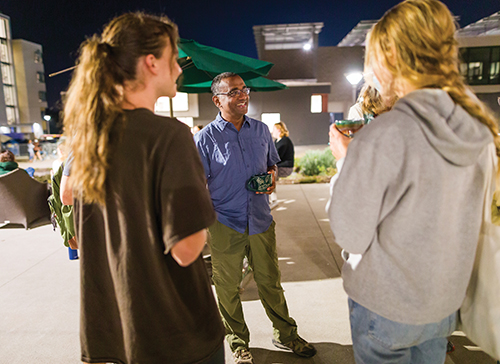
A Cal Poly biological sciences professor is a 2026 recipient of the Charles Edwin Bessey Teaching Award from the Botanical Society of America, one of its highest recognitions in botanical education.
Honoring enthusiasm and innovation in teaching botany, the society highlighted Nishi Rajakaruna’s outstanding contributions over 22 years, noting his teaching “weaves together fieldwork, food, culture, and rigorous science in ways that make botany impossible to ignore.”
The prestigious national award recognizes individuals whose “work has improved the quality of botanical education at a regional, national, or international level.”
Rajakaruna, an Arroyo Grande resident who is originally from Sri Lanka, has served in faculty positions at Cal Poly, since 2017, San José State University (2008-10) and the College of the Atlantic in Bar Harbor, Maine (2004-08 and 2010-16).
“Of all the recognitions I have received throughout my career, this one is especially meaningful because it stems from nominations and support from students whom I have had the privilege of teaching and mentoring over the past 22 years,” Rajakaruna said. “Teaching has always been my first love. It always has been and always will be. There is no greater reward than knowing that you may have made a positive difference in the lives of your students, and to be recognized by former students in this way means more to me than I can adequately express.”
During his career, he taught more than 3,500 students across 19 courses, supervised dozens of undergraduate senior projects and master’s theses, and co-authored over 110 conference presentations where a student was the presenting author, the society noted in his award.
The organization added that about 40% of his 91 peer-reviewed publications list undergraduate co-authors — many as first author, recognizing their lead role in the scientific writing process and meaning that the student’s name will be cited in future publications.
Through multiple Fulbright awards, Rajakaruna also has served as a botanical teacher and researcher South Africa, Sri Lanka, Madagascar and India. He was appointed as a Fulbright US Scholar Alumni Ambassador for 2024-26, serving as an official representative and recruiter for the Fulbright Program — the U.S. government’s flagship international academic and cultural exchange initiative.
Rajakaruna’s instruction has included commitment to student learning through field excursions, research and international collaborations.
Student nominators highlighted many of his contributions:
• A vast knowledge of plants that grow on the harsh conditions of serpentine rock (California’s state rock, which takes its name from the colors of a serpent: green, blue and cream);
• His passion for plant science, teaching botany with joy and infectious enthusiasm;
• His effort to build connections while instructing about the natural world, including, for example, his Plants, People and Civilization class; and
• Dorm-based tea sessions as one of the first professors to participate (between 2018-22) in Cal Poly’s Faculty in Residence program, where professors live and interact with students in a campus residence hall.
“I believe that Dr. Rajakaruna’s gift as a teacher of botany is rooted in three strengths: his enthusiasm for student connection, his ability to make botany both engaging and directly relevant, and his savvy in helping students reach their full potential,” said a 2023 Cal Poly alumnus in his nomination letter. “In all of my schooling, I have not met another teacher who placed so much effort in building connections with students.”
The Botanical Society of America, founded in 1893, boasts an international community of over 3,000 members and serves as an overarching network for researchers, educators, students and plant enthusiasts. The society also publishes two prominent peer-reviewed journals: the American Journal of Botany and Applications in Plant Sciences.
PG&E Warns Customers About Emerging Barcode Scam
A new twist on scams to steal money from utility customers is raking in money.
So far this year, monetary losses from scams impacting Pacific Gas and Electric Company (PG&E) customers are on track to outpace 2025, with customers losing over $211,000 through mid-year. To help customers spot the signs of a scam and avoid falling victim, PG&E offered preventions tips and is warning customers of a newly emerging scam that may be playing a part in that surge.
The most common scam continues to involve scammers placing a phone call to PG&E customers with a demand for immediate payment to avoid disconnection. A new wrinkle on that scam has emerged where scammers call customers to threaten disconnection and then send them either a barcode or QR code via text or email. The customer is then instructed to take the barcode or QR code to a store or business to present to a cashier to make payment.
“Scammers are constantly evolving their tactics to defraud customers, and the latest ‘barcode scam’ is a prime example of that,” said PG&E lead scam investigator Matt Foley in a news release. “What hasn’t changed is that they are still demanding immediate payment of your bill to avoid disconnection. If you receive a call of this nature, hang up. If someone at your door asks to see your utility bill, close the door. Then, call our 800 number or log into your account at PGE.com to verify your billing details.”
“Remember, PG&E will never ask you for financial information over the phone or for payment via bar code, QR code or pre-paid debit cards or money transfer services like Zelle, and we won’t ask to see your bill at your door.”
In 2025, PG&E received nearly 24,000 reports from customers who were targeted by scammers impersonating PG&E and lost over $301,000 in fraudulent payments with an average loss of $590. By mid-year 2026, customers have already reported over $211,000 in losses to utility scammers, representing a nearly a 30% increase in financial losses by year’s end, with an average loss of $969.
On the Central Coast, nearly 150 incidents have been reported, with the highest numbers in cities like Salinas (37), Santa Cruz (24), Watsonville (19) and Santa Maria (8).
Here’s the 2026 county breakdown:
Monterey County: 61
Santa Cruz County: 67
San Benito County: 7
Santa Barbara County: 9
San Luis Obispo County: 3
PG&E says those numbers are likely just the tip of the iceberg for overall scams, as many go unreported.
Small- and medium-sized businesses are also a target, and scammers focus their efforts during busy business hours, preying on business owners’ sense of urgency to keep the doors open and the lights on. In 2026, in less than half a year, PG&E has received nearly 656 reports of scam attempts targeting business customers. That’s on pace to easily surpass 2025, which saw 846 reports of scammers targeting businesses.
Signs of a potential scam
• Threat to disconnect: Scammers may aggressively demand immediate payment for an alleged past due bill.
• Asking to see your bill: If someone comes to your home and asks to see your bill, they are not with PG&E.
• Request for immediate payment via prepaid debit card or money transfer service: Scammers may instruct the customer to purchase a prepaid debit card then call them back supposedly to make a bill payment, or they may ask for payment via a money transfer service like Zelle.
• Refund or rebate offers: Scammers may say that your utility company overbilled you and owes you a refund, or that you are entitled to a rebate, and then ask you for your banking information.
Protect Yourself
Customers should never purchase a prepaid card to avoid service disconnection or shutoff. PG&E does not specify how customers should make a bill payment and offers a variety of ways to pay a bill, including accepting payments online, by phone, automatic bank draft, mail or in person.
If a scammer threatens immediate disconnection or shutoff of service without prior notification, customers should hang up the phone, delete the email, or shut the door. Customers with delinquent accounts receive an advance disconnection notification, typically by mail and included with their regular monthly bill.
If someone comes to your door claiming to be with PG&E, customers should know that PG&E personnel carry identification and are always prepared to show it upon request. If a customer still has doubts, they can call 800-743-5000 to confirm whether an individual is there on official company business. And remember, if someone asks to see your bill, they are not with PG&E and you should close the door.
Signing up for an online account at PGE.com is another safeguard. Not only can customers log in to check their balance and payment history, they can sign up for recurring payments, paperless billing and helpful alerts.
Scammers are now able to create authentic looking 800 numbers which appear on your phone display. The numbers don’t lead back to PG&E if called back, however, so if you have doubts, hang up and call PG&E at 1-833-500-SCAM. If customers ever feel that they are in physical danger, they should call 911.
Customers who suspect that they have been victims of fraud, or who feel threatened during
contact with one of these scammers, should contact local law enforcement. The Federal Trade Commission’s website is also a good source of information about how to protect personal information.
For more information about scams, visit pge.com/scams or consumer.ftc.gov.
Is your business, including non-profits, supporting our community? Maybe you’re launching a new business, or you’re making updates to your current business model, or re-opening. Perhaps you have a job opportunity, or have been doing some volunteer work, or are collaborating with another business or a non-profit.