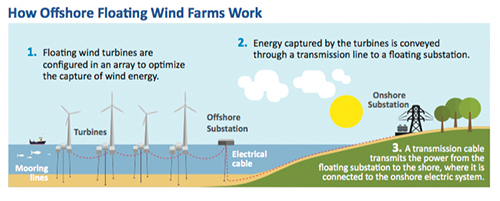

Diagram shows a simplified illustration of how offshore wind energy would work. Diagram courtesy BOEM
The State of California is threatening to sue the Trump Administration after it approved a second settlement with a wind energy lease holder that effectively terminated their leases for offshore wind farm sites off the Central Coast.
In a news release dated June 23, the California Energy Commission (CEC) and the Attorney General’s Office announced they had issued “Notices of Intent to Sue” to the Department of the Interior along with subpoenas on how the Department of the Interior reached settlements with Golden State Wind and Invenergy, two of the three companies that secured leases for the proposed 6-gigawatt floating offshore wind energy project.
That project site sits some 22 miles off the coast of San Simeon and 57 miles north of Morro Bay. Its official name is the “Morro Bay Wind Area.”
The statement reads, “California Attorney General Rob Bonta and California Energy Commission Chair David Hochschild today sent a Notice of Intent to Sue targeting an unlawful agreement between the U.S. Department of Interior and Golden State Wind, LLC (GSW) that puts at risk California’s clean energy gains, thousands of high-quality jobs, and more than $100 million in public investments in the offshore wind industry, including voter-approved climate funds.”
The notice includes an “administrative investigative subpoena,” essentially a demand that both the DOI and Golden State Wind provide documents and information about the settlement they reached back in April.
That agreement with both Golden State Wind and another company, Bluepoint Wind, was announced by the DOI on April 27.
“Under the new agreements,” DOI’s announcement said, “Bluepoint Wind and Golden State Wind have each separately agreed to voluntarily end their offshore wind leases, with the respective affiliate companies agreeing to make financial investments in reliable conventional energy projects.”
The DOI said this ends the high-cost wind projects. “These historic agreements provide dollar-for-dollar reimbursement for offshore wind leases that have been impractical to develop without relying on taxpayer subsidies.
“By cancelling these leases and promoting investments away from intermittent, higher-cost energy sources toward proven conventional solutions, these agreements support mutually beneficial investments that will now generate returns for American taxpayers.”
Golden State Wind bought its roughly 80,000-acre lease site in 2022 paying some $150 million to the Bureau of Ocean Energy Management or BOEM, which has held the money in escrow accounts while the permitting proves moves forward.
BOEM coordinated the entire auction process and is the lead agency for the project reviews and numerous studies.
It was part of a much larger lease auction with three lease sites here and an additional two, smaller leases off the Coast of Humboldt County. All told BOEM took in over $757 million for the five leases.
Interior Secretary Doug Burgum praised the settlement. “President Trump is focused on providing affordable and reliable energy to American citizens. The companies that bid for these offshore wind leases were basically sold a product in 2022 that was only viable when propped up by massive taxpayer subsidies.
“Now that hardworking Americans are no longer footing the bill for expensive, unreliable, intermittent energy projects, companies are once again investing in affordable, reliable, secure energy infrastructure. We welcome each of the projects’ willingness to actually support baseload power and lower utility bills for American families. In addition, the agreements resolve the unaddressed national security concerns at both projects.”
The company said it was happy with the deal. Michael Brown, CEO of Ocean Winds North America which owns a 50% stake in Bluepoint Wind and Golden State Wind, said, “We welcome the opportunity to engage constructively with the administration on this agreement and acknowledge the clarity they have provided with this decision and deal.
“Our priority remains disciplined capital allocation and delivering reliable energy solutions that create long-term value for ratepayers, partners, and shareholders.”
The State naturally has the opposite take on the deals.
California A.G. Bonta said, “At a time when the country needs more reliable and sustainable power supply, the Trump Administration is busy using taxpayer money to strike backroom buyouts that make clean-energy projects disappear.
“California won’t stand idly by as the Trump Administration illegally strikes deals to kill offshore wind projects and replace them with more windfalls for his fossil fuel friends; we’re putting the Administration on notice that we intend to sue.
“California,” he added, “has already made substantial investments in clean wind energy that have advanced California’s clean energy goals, created high-quality jobs, and bolstered our economy. My office will continue to fight back aggressively against the Trump Administration’s illegal attacks on wind energy projects.”
Their Notice of Intent claims the State has invested $100 million into the floating wind projects and has numerous other nearshore wind projects that the CEC has been working on for State controlled waters, within 3 miles of shore.
“California’s offshore wind strategic plan calls for the State to develop 25-gigawatts of offshore wind power by 2045,” the news release said of the CEC’s offshore wind plans, “enough to power roughly 25 million homes and provide about 13% of the state’s electricity supply, to accelerate California’s clean energy transition, create local manufacturing jobs, and drive economic development.”
They point out that after Golden State’s initial $150 million bid, they’ve committed some $30 million “for workforce training, supply chain development, and benefits to local communities like fishermen’s associations.”
Of note, commercial fishing organizations in Morro Bay and Port San Luis filed a lawsuit in Superior Court against the wind farm projects.
The CEC news release said the DOI’s and Golden State’s lease termination was “a secretive agreement” that settled litigation that had not actually been filed by either party.
And the DOI also claimed “unspecified national security concerns justified the cancellation, even though the federal government had already reviewed and approved the lease area after years of analysis and consultation with the U.S. Department of Defense,” the CEC said.
The remote location of the proposed wind farm project off San Simeon was picked after the Navy vetoed other sites that were closer to Morro Bay, where the energy has always been proposed to make landfall due to the closed power plant’s ready connection to the power grid.
The Navy had concerns about its training flight path for the Lemoore Naval Air Station that flies out over the Pacific and back to base.
The CEC and A.G. Bonta claim the State has made significant investments in the offshore floating wind projects.
“California,” the CEC said, “has invested more than $100 million to ready California’s ports, transmission systems, and industries to support offshore wind generation, investments which may be lost if the Trump administration succeeds in halting offshore wind development.
“Cancelling these projects will also threaten good-paying union jobs, reliable infrastructure investment, and sustainable economic growth.”
The hullabaloo comes weeks after a study commissioned by SLO County looking into the suitability of Morro Bay for a wind energy port, determined the cost to rebuild harbor facilities to accommodate the smallest of the working vessels the projects will need could top $130 million.
Morro Bay Harbor can’t accommodate the mid-sized work boats that will do most of the maintenance work on the wind turbines without a huge investment. And there’s no way it could be made to accommodate the biggest of the ships needed.
Morro Bay was only potentially suitable to accommodate the relatively small crew boats needed.
Neither Morro Bay nor Port San Luis could be used as a deepwater port and manufacturing site for the turbines. Long Beach has been actively seeking to become that port.
The information subpoenas are “seeking documents and information related to the company’s buyout deal with DOI.”
With regards to the Invenergy matter, the CEC and Bonta haven’t even seen the actual agreement. “That subpoena demands a copy of the settlement agreement — which DOI has not made public — and information concerning its basis, negotiation, and impact.”
Invenergy had four offshore leases, counting the one here. The others are off New York and Maine in the Atlantic. The deal will return the company’s $765 million investment. Its winning bid for the Morro Bay Wind Area lease was $145.5 million.
The CEC and Bonta are calling the settlement monies a “buyout.”
“Nationwide,” the CEC said, “this brings the total amount of taxpayer funds spent by the Trump Administration on offshore wind buyouts to nearly $2.6 billion — all to get power companies not to produce clean energy.
“If the federal government is funding buyouts, Californians who invested years of time, money, and effort preparing for these projects should not be left empty-handed while developers are rewarded for walking away.”
It should be noted that the offshore floating wind energy project here has had opposition since the idea was first proposed in 2016.
The non-profit group, REACT Alliance has led the fight against what they call the “industrialization of the ocean,” a fight that has been taken up by similar groups across the nation.
In a recent announcement following the Invenergy settlement, REACT Alliance posted, “Following the exit of Golden State Wind in April, the sole remaining lease in the Morro Bay Wind Energy Area belongs to Atlas Offshore Wind (backed by Norwegian energy firm Equinor).
“We are confident this lease will soon be cancelled as well, putting an end to floating offshore wind off the Central Coast of California.”
EBN attempted to confirm this notion that Equinor too would soon drop out and emailed the CEC’s media office.
Senior Information Officer, Stacey Shepard, responded and said they did not have any information on other deals with the DOI and referred us to that agency.
She reiterated what CEC Chair Hochschild said in the news release: “California strongly condemns yet another reckless Trump Administration misuse of taxpayer dollars that undermines clean energy growth and U.S. energy security.
“California will continue to lead the way toward a cleaner, more reliable grid powered by domestic resources. Offshore wind remains an essential component of that work.”