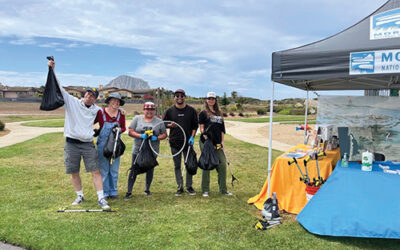
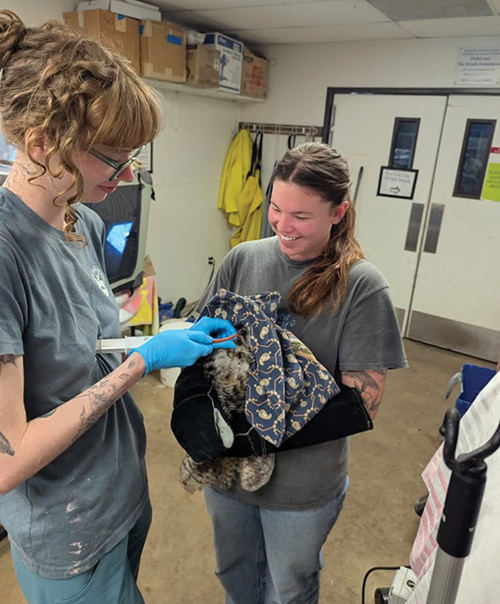

Pacific Wildlife Care staff and volunteers provide specialized medical care and rehabilitation for thousands of injured, orphaned, and sick native wild animals each year. The nonprofit has been named one of only five North American finalists for the 2026 Defender Service Awards, competing for a customized rescue vehicle and a $30,000 grant to support its wildlife rehabilitation mission.
A countywide wildlife welfare group is in the running for a far-reaching award with some significant winnings attached to it. Members of the public can help by voting.
Pacific Wildlife Care has been selected as one of five finalists from across the U.S. and Canada for the 2026 Defender Service Awards Presented by Chace Bank in the Animal, Wildlife & Marine Mammal Welfare category.
The prestigious national recognition celebrates charitable organizations whose dedication, innovation, and service create lasting impact in their communities. As a finalist, Pacific Wildlife Care will receive a $5,000 grant from Chase and will compete in a public voting campaign for the opportunity to receive a customized Land Rover Defender 130 vehicle and an additional$30,000 award to support its wildlife rehabilitation mission.
“We are incredibly honored to be recognized as one of only five wildlife organizations in North America selected as finalists for the Defender Service Awards,” Kristin Howland, executive director of Pacific Wildlife Care, told Estero Bay News. “This recognition belongs to our dedicated staff, volunteers, donors, and community partners who make our work possible every single day. It shines a national spotlight on the compassionate community we have here on the Central Coast and the thousands of native wild animals we care for each year. We’re excited to share this opportunity with our community and hope they’ll help us bring this award home to San Luis Obispo County.”
For more than 40 years, Pacific Wildlife Care has provided rescue, rehabilitation, and release services for injured, orphaned, and sick wildlife. The nonprofit responds to thousands of wildlife emergencies each year, caring for more than 3,000 wild animals annually, while educating the public about wildlife conservation and coexistence.
This recognition comes during one of the most significant milestones in the organization’s history. Pacific Wildlife Care is currently constructing a new home, the Kim & Derrel Ridenour Wildlife Rehabilitation Center in San Luis Obispo County that will dramatically expand its ability to care for wildlife and serve the community for decades to come.
The new 10-acre site will include a main building with treatment areas and staff/volunteer spaces, specialized animal enclosures, pools, and flight aviaries and other necessary site improvements and solar power infrastructure.
Key highlights include a centralized location in San Luis Obispo County allowing for quicker response times and increased accessibility, a floor plan that minimizes occurrence of human interaction and imprinting on wildlife for best chances of successful release after care, the ability to adequately separate prey and predator species to minimize stress for best chances of rehabilitation, and an increased capacity and updated facilities improve operational efficiency and create safer working conditions for staff and volunteers.
The project is expected to be complete by the end of 2026.
“Construction continues to move forward, and we remain on track to complete the new Wildlife Rehabilitation Center later this year,” Howland said. “It’s an exciting milestone for our organization as we prepare to transition into a state-of-the-art facility that will significantly expand our ability to care for injured and orphaned wildlife while serving our community for decades to come.”
As for the big prize, a customized Defender 130 would provide critical transportation capability for wildlife rescues, patient transfers, emergency response, outreach events, and operations at the organization’s new Wildlife Rehabilitation Center.
“The customized Defender 130 would be an incredible asset for Pacific Wildlife Care. Every day, we respond to wildlife emergencies throughout San Luis Obispo County — from injured raptors to orphaned mammals and songbirds, to reptiles and other native wildlife,” said Howland. “The vehicle would support wildlife rescue responses, patient transport, educational outreach, and operations at our new Wildlife Rehabilitation Center. Having a dependable, purpose-built vehicle would strengthen our ability to respond quickly and safely to wildlife in need throughout the Central Coast.
Combined with the potential $30,000 award, the prize would directly strengthen Pacific Wildlife Care’s ability to rescue and rehabilitate wildlife while expanding education and conservation efforts throughout the Central Coast.
The winners of the Defender Service Awards will be determined through public voting, which runs through August 14. Readers can vote at https://bit.ly/4fQsmtE.
“This award would have a lasting impact on our mission, and we would be incredibly grateful for our community’s support. Every vote helps bring national recognition — and potentially a customized rescue vehicle and $30,000— to the Central Coast,” Howland said. “We encourage everyone to take just a minute to vote and share the opportunity with family and friends. Together, we can help ensure Pacific Wildlife Care has the resources needed to rescue, rehabilitate, and release even more native wildlife for years to come.”
Winners will be announced during Destination Defender in Temecula, California, the weekend of September 11. Other finalists are:
• Pacific Wildlife Care – San Luis Obispo, California
• West Suburban Humane Society – Downers Grove, Illinois
• Atlantic Marine Conservation Society – Westhampton Beach, New York
• Helen Woodward Animal Center – Rancho Santa Fe, California
• Picolini’s Animal Rescue – Miami, Florida
Pacific Wildlife Care is the only licensed wildlife rehabilitation organization serving San Luis Obispo County. The non-profit was founded in 1984 by a small group of volunteers interested in the care and conservation of wildlife in San Luis Obispo County.
Over the last 4 decades, they have grown from a small group of dedicated home rehabilitators into a successful non-profit organization with a well-equipped rehabilitation center, a full-time wildlife veterinarian, a small paid staff, and nearly 200 volunteers.
Most of the animals PCW treats are impacted by human activity: tree trimming that disrupts nests, attacks by domestic pets, vehicle collisions that leave young animals orphaned, well-meaning but improper care, and more. In many cases, these animals are suffering because of human actions, not natural causes, the PCW website says.