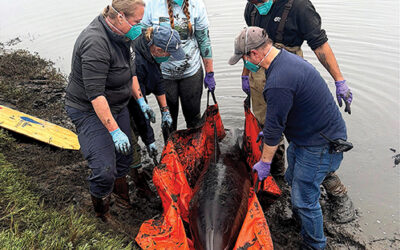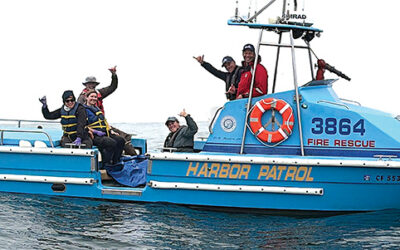


Pacific Wildlife Care representatives among nominees for 2026 Defender Service Awards at the award ceremony in Temecula, California. Photo submitted
Pacific Wildlife Care was named the winner of the 2026 Defender Service Awards under the category of Animal, Wildlife & Marine Mammal Welfare. The prestigious recognition that spans the U.S. and Canada celebrates charitable organizations whose dedication, innovation, and service create lasting impact in their communities. The prize — a land Rover Defender 130 and $30,000 to support their wildlife rehabilitation mission.
The six 2026 Defender Service Awards winners were announced during a special celebration at Destination Defender in Temecula, California.
“I was in attendance at the awards ceremony. It was pretty surreal,” Kristin Howland, executive director of Pacific Wildlife Care told Estero Bay News. “I had spent the last 24 hours with the other 11 finalists and all of them were tremendously deserving organizations. All the organizations were truly grassroots organizations making a difference in their community. It was absolutely inspiring. And there was no way to know who was going to win.
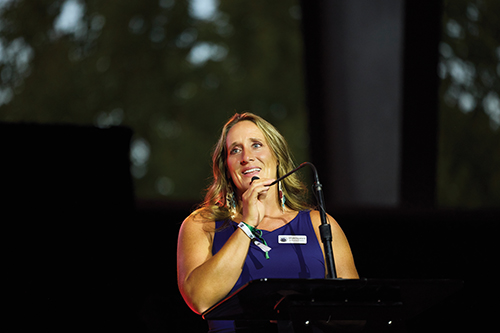
Defender 130 SUV and $30,000. Photo submitted
“Winning this award truly feels like a win for our entire community. The incredible support we saw throughout the voting period was a wonderful reminder of how many people care deeply about wildlife here on the Central Coast.”
The winner of the big award was based strictly on the number of votes the organization received. Although PCW doesn’t know the number of votes cast in favor of their work, the total number of votes across all six categories was 250,000. That said, the 3-minute video PWC submitted video highlighting its work was picked to be a finalist based on criteria weighed by judges.
Additional to the prize winnings, PCW also got one of the most important things a non-profit organization can receive, visibility.
“It was such an amazing process to be a part of,” said Howland. “People from all over North America were introduced to our organization and what we do.
The Defender 130 will be PWC’s first organizational vehicle and is expected to arrive in early 2027. The vehicle will help PWC expand its educational outreach, transport equipment and supplies, participate in community events and take its wildlife conservation message across San Luis Obispo County and other areas on the Central Coast.
“We will be working with the Defender team to design the wrap and choose how we want the vehicle outfitted,” Howland said. “Two of our staff will attend a weekend training to learn about this capable vehicle. Once the funds are received, they will likely go into a reserves account to cover maintenance and ongoing vehicle expenses. This is our first organizational vehicle, so the first order of business is creating an Organizational Vehicle and Driver Policy.”
This award comes during one of the most significant milestones in the organization’s history. Pacific Wildlife Care is currently constructing a new home, the Kim & Derrel Ridenour Wildlife Rehabilitation Center in San Luis Obispo County that will dramatically expand its ability to care for wildlife and serve the community for decades to come.
“Between our new rehabilitation center and now our first organizational vehicle, we are entering an exciting new chapter for Pacific Wildlife Care,” said Howland. “This recognition is a wonderful reminder of how much our community believes in the work we do.”
The new 10-acre site will include a main building with treatment areas and staff/volunteer spaces, specialized animal enclosures, pools, and flight aviaries and other necessary site improvements and solar power infrastructure.
Key highlights include a centralized location in San Luis Obispo County allowing for quicker response times and increased accessibility, a floor plan that minimizes occurrence of human interaction and imprinting on wildlife for best chances of successful release after care, the ability to adequately separate prey and predator species to minimize stress for best chances of rehabilitation, and an increased capacity and updated facilities improve operational efficiency and create safer working conditions for staff and volunteers.
Construction is expected to be complete by the end of 2026.
“Construction continues to move forward, and we remain on track to complete the new Wildlife Rehabilitation Center later this year,” Howland said in a previous interview. “It’s an exciting milestone for our organization as we prepare to transition into a state-of-the-art facility that will significantly expand our ability to care for injured and orphaned wildlife while serving our community for decades to come.”
Founded in 1984, Pacific Wildlife Care, the only licensed wildlife rehabilitation organization in the county, provides year-round rehabilitation for injured, orphaned and sick wildlife. In 2025, PWC cared for a record 3,144 wild animals and responded to more than 6,100 wildlife-related calls through its hotline. The organization is supported by professional staff and hundreds of dedicated volunteers who contribute tens of thousands of hours each year.
The non-profit also receives support from community members who are on the lookout for and report injured animals. With fall rapidly approaching, Howland offered some things we all can do to help.
“As fall approaches and nights become longer, community members can help protect local wildlife by driving carefully, making windows safer for birds, and keeping trash and fishing line out of the environment,” Howland said. “This is also a season when we see more seabirds on local beaches. If you see a beached seabird that appears to need help, give us a call. Small changes that make your home, yard and neighborhood more wildlife-friendly can go a long way.”
Anyone who finds an injured or orphaned wild animal in San Luis Obispo County can call the Pacific Wildlife Care hotline at 805-543-WILD (9453) for guidance. PWC encourages the public to call before attempting to care for wildlife, as the appropriate response can vary considerably by species and situation.
Over the last four decades, PWC has grown from a small group of dedicated home rehabilitators into a successful non-profit organization with a well-equipped rehabilitation center, a full-time wildlife veterinarian, a small paid staff, and nearly 200 volunteers.
Most of the animals PCW treats are impacted by human activity: tree trimming that disrupts nests, attacks by domestic pets, vehicle collisions that leave young animals orphaned, well-meaning but improper care, and more. In many cases, these animals are suffering because of human actions, not natural causes, the PCW website says.