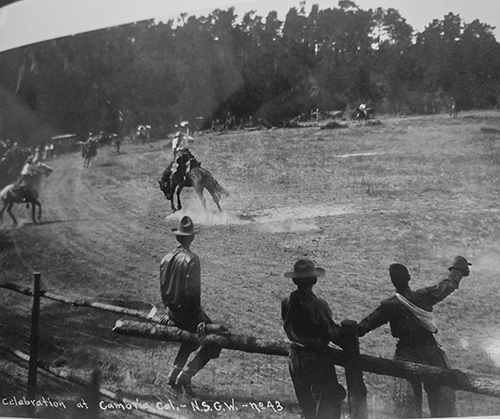

A bucking bronco at the Native Sons of the Golden West Rodeo. Photo submitted
By Consuelo Macedo
The Cambria Historical Society’s mission is to preserve and convey information about the fascinating history of the Central Coast area as well as the town. Each year they are the focal point for community celebrations such as Heritage Day and the upcoming Harvest Festival. The free event will be held Saturday, October 10 on the grounds of the Historical Museum at the corner of Burton Drive and Center Street from 11- 3 p.m. The gardens will be filled with booths by creative vendors, live music by Bob and Joey Benjamin and friends, adult beverages, and fun for the kids.
A special feature is a benefit Sampling of a flight of Six Soups served by local restaurants.
Though the site is famous for the pit barbecue of the last resident of the restored 1870s home, Eugenio Bianchini, there will be no barbecue this year.
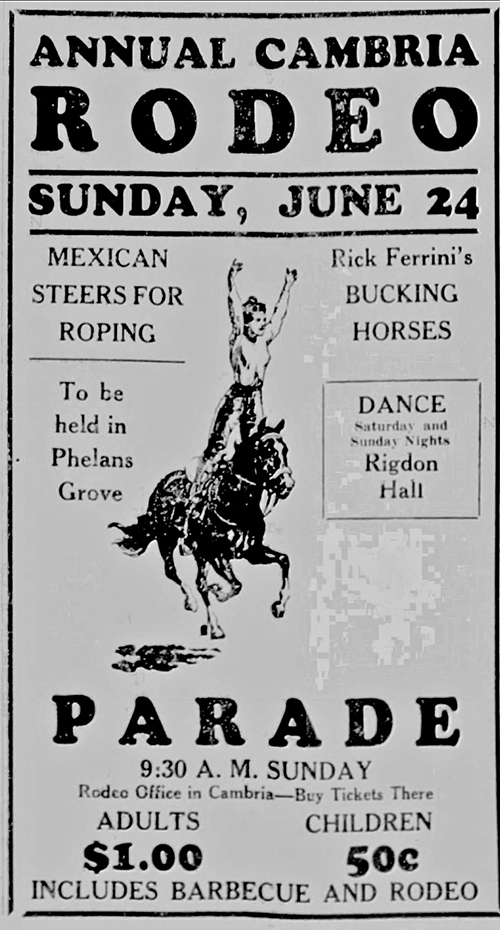
Photo submitted
After the Gold Rush and Civil War, settlers began establishing small pine homes and businesses near the intersection of the county road and the old Coast road out of the Santa Lucias to Cayucos. Conditions were ripe to officially establish the town in 1866. It grew so rapidly it became the second largest one in San Luis Obispo County, the larger one was built up around the Mission.
By the 1880s, descendants of California’s, rancheros, Spanish settlers, and immigrants from Ireland, the border of Switzerland and Italy, and China joined folks moving west. They established two churches and several fraternal organizations and celebrated mightily on Swiss Independence Day and the Fourth of July with festivities attracting folks to its central location. Early-on there were also several two-story hotels and five saloons.
The biggest events in the 1880s were held up Bridge Street at the Phelan Grove where the present Covell Ranch is located. Goods and people were hauled up in horse and buggies, and in later years, cattle were run down Bridge and Center Streets in such great numbers that residents had to erect white picket fences to protect their little homes.
The celebrations included Bianchini’s open pit barbecue, a queen contest, parade, and dances. The Native Sons of the Golden West began a huge Rodeo as a “Tribute to the American Cowboy “ complete with draft horses, roping horses, and bucking broncos.
By 1928 the Rodeo had grown so large it was then internationally known, and participants could win $300 prizes from the sponsoring Cattleman’s Association. That was big money in the days when admission was $1 for adults and 50 cents for kids, including the complete BBQ Dinner.
In the 1930s, women joined in while riding side saddle, the Hearst Corporation introduced Arabian horses, and the Jones Brothers of Hollywood began to market their development in the west end of the village as “Cambria Pines by the Sea,” yet the census of 1950 listed only 800 residents in the entire town. In 1933, the American Legion joined in, and as the event outgrew Phelan Grove, it was moved to Rigdon Flats at the base of Lodge Hill; the Rodeo Grounds are now known as the east Fiscalini Ranch Preserve.
According to the 1934 headlines in The Cambrian News, the high point occurred when10,000 people came by car —
101 competitors vied for $150-$200 prizes for bronco busting, bull riding, steer wrestling, and the women’s quarter mile race; 200 folks marched in the parade. And yes, Eugenio’s barbecue with his daughter Palmyra officiated as queen.
By 1947, the era of the Rodeos ended, and was succeeded by the Lions’ Club’s Pinedorado near the new Veterans Memorial Building on Main Street. It was initiated as a fun time for students as they returned to school right after Labor Day with a big parade and the famous barbecued top sirloin steak and chicken. But that’s another story.
Thanks to Melody Coe, we benefited for this article from her research as the CHS Museum Curator and principal presenter at this summer’s Speaker Series, which sold out. Stay tuned for news of the fall event, the presentation about Cambria’s three cemeteries on October 30, followed by a walk through the Community Cemetery up at the end of Bridge Street on October 31, with docents telling tales about some of Cambria’s earliest residents. For information and reservations, go to cambriahistoricalsociety.com for information.