
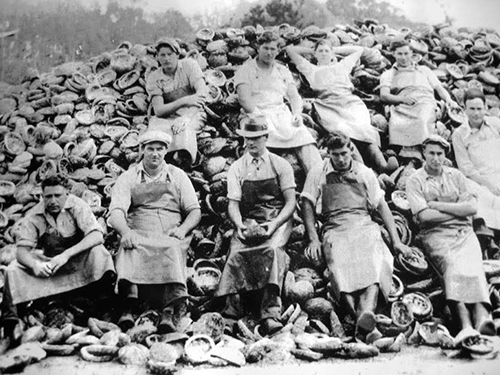

By the middle of the twentieth century, Morro Bay was the biggest source of abalone destined for dinner plates on the West Coast. Its outsized role in the industry showed up in ads like the one for Tony’s Original Fisherman’s Wharf in Hermosa Beach that promoted “Special Feature: Fresh Morro Bay Abalone.”
The abalone divers of Morro Bay landed millions of pounds of abalone from 1916 through the mid-1960s, mostly red abalone (haliotis rufescens). They helped define the character of the local fishing industry in the 50s and 60s, with abalone landings on a par with the other commercial fisheries and the rapidly growing sport fishing industry. These thriving businesses still echo in the names of the families whose members’ dangerous work helped the city to prosper.
Yet by 1975 the abalone fishery landings declined sharply, and the last commercial landings in Morro Bay were tiny in comparison to the peak. Abalone sport fishing continued at a much lower level until 1997, when the State of California closed the fishery to both commercial and sport south of San Francisco.
What caused the abalone fishery to decline so rapidly has been disputed. Among the many causes people have identified are overfishing, withering foot disease and the impacts of a warming ocean (El Nino) on the kelp abalone need to survive.
More controversially, there is evidence that the increase in Southern sea otters is correlated with the rapid decline of red abalone. A California Department of Fish and Game employee named Fred Wendell published in the DFW journal research that showed “A decline in abalone density…[was] associated with the reoccupation of the area by sea otters (CA DFW (802)2:45-64, 1994). Wendell presented data showing a decline in red abalone landings at Morro Bay from well over 1,000,000 pounds per year in the mid-1960s to almost nothing after 1980.
For all practical (economic) purposes, the commercial abalone industry which had once been intrinsic to the character of Morro Bay came to an end in the mid-1970s. Creative efforts to revive abalone through mariculture, led by pioneers like Morro Bay’s Frank Brebes, have had some success locally, with The Abalone Farm that was started in 1968 near Cayucos being the largest “farm” on the Pacific coast at one time. Mariculture has successfully raised abalone, but not nearly enough to supplant the natural fishery that had existed. Commercial abalone fishing is not coming back to Morro Bay anytime soon.
For a half century abalone was one of the prime economic drivers of Morro Bay. During that short time, the city played a leading role in this unique industry that has left an indelible mark on the local community.
Photo source: Steve Rebuck via the Historical Society of Morro Bay. If you have an intriguing photo of an Estero Bay place, event or person please let us know. These images contain fun and important stories. Contact info@historicalmorrobay.org.