
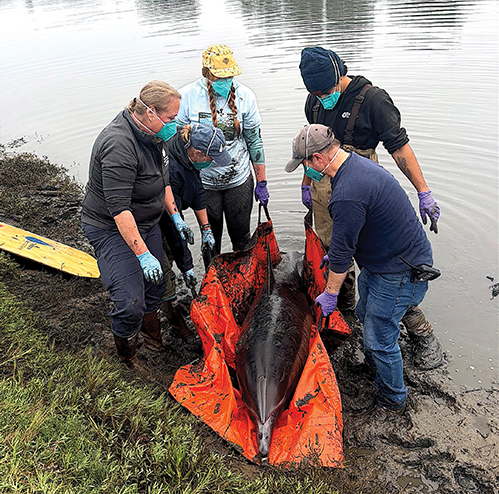

A team of trained responders from The Marine Mammal Center use a tarp at Cuesta Inlet to carry a stranded dolphin to a response vehicle for transport to Morro Bay where it, along with two others, were released into Estero Bay, with help from the Harbor Patrol. Photo © The Marine Mammal Center, NOAA MMHSRP #24359
Everyone is celebrating the rescue of a trio of stranded wayward dolphins that got stuck in the Back Bay mud at low tide last week, and one dolphin that didn’t make it, will be studied to see if they can figure out why the animals were so far from their normal environs.
It all started in the early morning of Tuesday, Sept. 29 when someone spotted several dolphins swimming and foraging near Cuesta Inlet, a small tidal inlet south of Baywood Park in the far southern end of Morro Bay.
“At least five dolphins were initially seen swimming freely and actively foraging in the bay throughout the day,” said Giancarlo Rulli, the associate director of public relations for The Marine Mammal Center, “before several animals became stranded on mudflats as the tide receded in the late afternoon.”
Of the five dolphins that were spotted, four were at Cuesta Inlet and one at Shark Inlet, which is at the extreme south end of the Bay Back by Sea Pines Golf Resort.
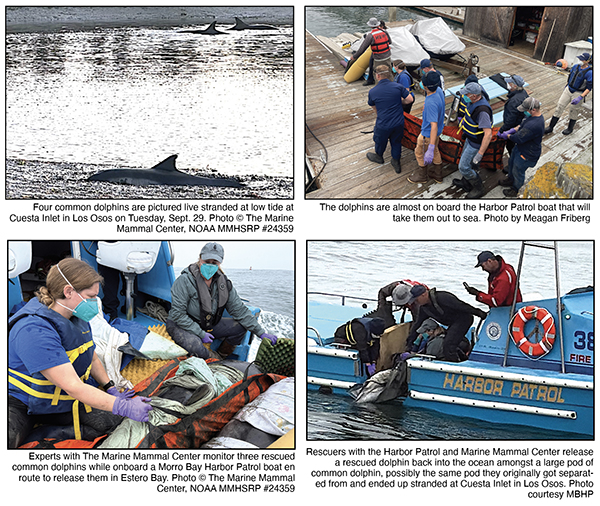
The MMC was called about the dolphins and sent volunteers to monitor what they positively identified were common dolphins.
That species of dolphin isn’t supposed to be in an inlet miles from the ocean. Normally the black and white marine mammals are found in open water, fairly close to shore but still in the open ocean. They aren’t supposed to be at Cuesta Inlet.
Rulli said they more often encounter California bottlenose dolphin or harbor porpoises in bay waters like this. Seeing common dolphin there was, “A bit of a mystery.”
The dolphins were swimming around just fine until the tide turned around. “Unfortunately,” Rulli said, “as tidal conditions worsened Tuesday afternoon, four dolphins at Cuesta Inlet became stuck in the mudflats and were unable to navigate back to deeper water.”
They don’t know what became of the one seen at Shark Inlet.
Normally, in these situations they would try and shoo the dolphins back into deeper water, but that didn’t work this time.
“Conditions late Tuesday,” Rulli said, “were too poor and unsafe for trained response personnel to attempt to haze the animals toward open water.”
The animals were stranded and spent the night stuck in the sticky, oozing Back Bay mud.
By morning, three of the dolphins had managed to struggle close enough to shore for rescuers to get them. One was already dead.
“On Wednesday morning (Sept. 30),” Rulli said, “Center experts safely responded to three of the four dolphins at Cuesta Inlet.”
They were gathered into canvas slings and carried to an MMC rescue truck and then driven to Morro Bay and loaded onto a Harbor Patrol boat docked at the North T-pier.
MMC personnel monitored the animals, which were wrapped in blankets and watered down to keep them hydrated, and motored them out of the harbor for release.
Harbor Patrolman Dana Stein told Estero Bay News that they took the animals north of Morro Rock and were about a mile offshore, when they came across a feeding frenzy of whales and a large pod of common dolphins.
That’s where the rescued animals were released back into the water. Rulli said it’s possible that dolphin pod is the same one these three may have been separated from in the first place.
The dolphin that didn’t make it through the night was collected and taken to MMC’s hospital for a necropsy to see if they can determine whether any illnesses or environmental conditions might have caused them to wander so far from their normal habitat.
One issue that most marine mammals — especially seals and sea lions — have been dealing with is domoic acid poisoning, a naturally occurring disease from red tides (algae blooms) that gets concentrated in bait fish and passes up the food chain.
Rulli said none of the dolphins they rescued showed the typical symptoms of domoic acid poisoning, like abnormal behavior and severe twitching. That’s good because, unlike with seals and sea lions, the MMC isn’t equipped to treat dolphins for the disease.
Seals and sea lions they can take in for treatment, but when they take in a dolphin with domoic acid poisoning, it usually gets euthanized.
“It’s quite a different approach [to treatment] with porpoises and dolphins,” he explained. “Our belief is that they were foraging but had gone in the wrong direction. The condition of the three this morning [Sept. 30] was actually quite good.”
Initial reports said one of the stranded dolphins was a calf [a baby] and the others were “older individuals of unknown sex.” Rulli said they don’t know what happened to the baby.
“The calf that was sighted yesterday swimming with its mother in the small pod of common dolphins,” Rulli said, “was not found today and was not part of the three released individuals or the lone carcass collected.”
The hope is that it found its own way out.
“It’s unclear,” he said, “whether it swam out on its own prior to low tide late Tuesday or was the unidentified individual at Shark Inlet that was not found today [Wednesday]. It’s also unclear at this point, which of the four other individuals was its mother. A bit of a mystery on that front.”
The MMC is praising all the folks that reported the matter and stayed around out of concern, with no doubt a bit of awe and wonder at the rare sighting, until the tide went out.
Sarah Pattison, director of hospital operations at The Marine Mammal Center said, “Seeing an animal in distress is emotionally difficult, and our team feels that too.
“This has been a heroic effort by many partners, including Harbor Patrol and the community, to give these animals a second chance. We’re grateful that three of these dolphins were able to be safely returned to the ocean, and we continue to monitor the situation closely.”
The MMC awaits the results of the necropsy to see if they can determine why the animals were in the Back Bay to begin with.
“The cause of these strandings remains unclear,” Rulli said. “Domoic acid toxicosis levels are currently quite low off the immediate San Luis Obispo County Coast, according to experts at Cal Poly, and it is not known whether the disease is impacting any of the stranded animals.
“It is also important to note that dolphins, like other marine mammals, can travel long distances in a short period of time.”
They have a lot of people to thank. “The Center,” he said, “is incredibly thankful to our partners at Harbor Patrol, Morro Bay Police Department, California Department of Fish and Wildlife (warden) and the local community for their assistance in the effort.”
He added that the last time they responded to a report of a stranded dolphin in the Back Bay was in October 2013.
Retired Harbor Patrol Officer, Jim Kroll, contacted EBN after this latest stranding incident. He reminded us that back in October 1994, a dolphin was swimming in Cuesta Inlet, a story that ran in the old Sun Bulletin newspaper.
His three sons (now all adults) went into the water and swam with the dolphin. He said it was very tame and towed the boys around the water seemingly having fun.
That animal also got stranded by the tide and stuck in the mud. One son, Kyle, stayed out there with the animal to help it through what must have been a terrifying ordeal.
Marine mammals like dolphins, even though they breathe air, are not built to lie flat on the solid ground and will die if they stay like that for too long.
Kroll said his boy held it up to allow it to breathe. That dolphin swam out with the next high tide, and Kyle returned home after midnight, covered from head to toe in mud. Kroll said he hosed him off with the garden hose out in the yard.
Other animals have been caught in the mud, too. Kroll once helped rescue a horse that got stuck in the mud, during his long career with the Harbor Patrol.