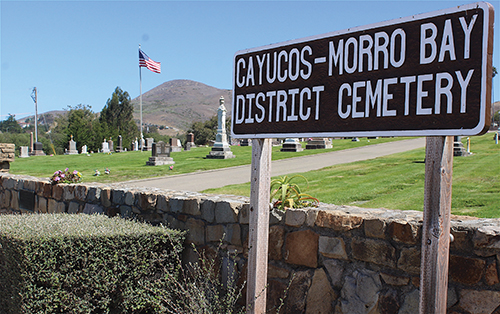

The Cayucos-Morro Bay Cemetery District continues attempts to build a new location to meet needs. Photo submitted
If you think it took a long time to get your project through the County’s planning process, the Cayucos-Morro Bay Cemetery District has been trying for 14 years to get permission to build a new cemetery.
And the time constraints are starting to put the squeeze on the District.
“We have six-and-a-half to seven years of sales left,” said the Cemetery District Manager, Dale Guerra. A cemetery’s plot sales outpace its actual burials, and Guerra said it would be a few years after that when there’d be no room left in a cemetery that was founded in 1883. The Cemetery District was formed in 1940.
It’s one of just a dozen cemeteries in all of San Luis Obispo County a ratio that equates to one cemetery for every 23,343 citizens, according to a report by Oasis Associates, the consultant that represents the District in the matter.
The District looked for a new property adjacent to the existing cemetery, which is at the north end of Ocean Boulevard in the shadow of Whale Rock Dam, but hasn’t had any luck.
In January 2017 the District Board, which is appointed by County Supervisors, had a breakthrough when the Cayucos Sanitary District approached them about property the CSD owns on Toro Creek Road.
That’s where the Sanitary District built its new water recycling facility after divorcing itself from Morro Bay. The CSD purchased parcels totaling over 83 acres that were owned by Chevron as part of its Estero Marine Terminal, an oil shipping facility that operated from 1929 to 1999 when it closed.
Chevron owned about 12 parcels fronting Hwy 1 and running down Toro Creek Road, including Dog Beach and vast ranchlands east of Morro Bay’s Del Mar Park.
Those ranchlands are in the process of being purchased for open space by land conservation organizations in Cayucos and Morro Bay.
Chevron had been leasing its parcels out for various farming and ranching operations until about 10-years ago when the company put all of them up for sale.
The CSD bought several and turned one over to the County for a future regional park. It gave Dog Beach to the City of Morro Bay to manage as an off-leash, dog-friendly beach.
The CSD also recently leased part of its holdings to the Marine Mammal Center for a new triage facility; a project that is being reviewed now by the County.
“Unable to secure properties directly adjacent to the current site,” the Oasis report said, “in January 2017 the CMBCD Board was initially approached by the Cayucos Sanitary District about the opportunity to purchase a portion of their property.”
In response the Cemetery District Board conducted a study of some 290 potential sites but it came back down to the CSD’s property.
“In February 2020,” Oasis reported, “the CSD again approached the CMBCD Board with an offer to purchase the CSD property located on Toro Creek Road.”
Those talks led the two agencies to sign a Memorandum of Understanding (MOU) with the intent for the Cemetery District to buy a portion of the CSD’s treatment plant property.
That MOU was followed by a period of due diligence and study of the CSD’s property and finally settling on a 12-acre portion that’s west of the CSD’s treatment plant. But there is of course a catch.
That property is zoned agricultural (AG) and while the law allows a sewer treatment plant to be built on AG lands; a cemetery isn’t an allowed use.
“While the CMBDC is a public-owned and operated facility,” Oasis’ report said, “cemeteries are not an allowed use in the Agriculture zone, therefore, the need to request the general plan amendment/rezone to Public Facilities to accommodate the cemetery expansion.”
Further complicating the issue is the Coastal Commission, which frowns on rezoning of agricultural lands in the Coastal Zone, where its authority lies. The Commission commented on this, and that led to this stalemate that has now lasted over a decade.
“A portion of the proposed project site is within the Coastal Zone,” Oasis said, “while the balance is outside the Coastal Zone.”
County Supervisors were asked at their July 7 meeting to approve an item that would instruct the County planning staff whether to start the process for amending the General Plan, a process that has to go through the Coastal Commission anyway, or to pick another way forward.
But the scheduling was a surprise to the Cemetery District. Guerra said they expected it to be on the Supervisor’s July 28 agenda. So too was Dist. 2 Supervisor Bruce Gibson surprised by the scheduling and asked that the matter be pulled from the agenda and rescheduled, which it was.
So now the Cemetery District’s request for a zoning change and General Plan Amendment will likely be heard on the 28th. It was scheduled as a public hearing item on the July 7 agenda.
The County’s report said the Cemetery District wants to establish a new cemetery with in-ground burials and a columbarium, and irrigate the new grass with reclaimed water from the CSD’s treatment plant just down the road.
A columbarium is a structure where cremated remains are kept. It’s similar to a mausoleum, but with urns instead of vaults with caskets inside.
One hurdle has already been cleared.
“To develop a cemetery and columbarium in the PF [public facilities] land use category,” the County’s report said, “approval of a Development Plan and Conditional Use Permit would be required.
“On Dec. 13, 2022, the Applicant-requested Fee Waiver for the General Plan Amendment Application (for up to $100,000) was approved by the Board for the purpose of amending the land use category designation from AG to PF, so that the cemetery and columbarium use can be established on the Project Site.”
The County’s work on the matter has already cost more than $21,000, according to the County report.
The report discusses various options including simply changing the zoning from AG to public facilities, but even that has potential problems.
“PF would be the most appropriate land use category designation for the purpose of the Cayucos-Morro Bay Cemetery District establishing a cemetery and columbarium use,” the County said. “However, the applicant has encountered issues relating to Coastal Commission comments that may discourage “rezoning” lands primarily for agriculture uses to lands primarily for non-agriculture uses.
“The other issue is the applicant meeting Fire Code access requirements (dead-end road standards implications that may impact other properties beyond the Project Site).”
According to the County report, the Cemetery District has proposed amending the planning documents specifically to allow the cemetery use on this one property, “to establish site-specific standards.”
“This approach could avoid the issues relating to Coastal Commission comments on ‘rezoning’ and meeting Fire Code access requirements for neighboring properties.
“However, this approach would make standards applying to a site-specific area inconsistent with the allowable land uses for lands under the AG land use category by making allowable land use that is explicitly not allowable in that land use category. This practice is not recommended to remedy inconsistent land use category designations.”
The County staff would rather change the allowable uses within the AG zoning for the entire county.
“The objective,” the County report said, “would be to amend Coastal Zone and Inland Land Use Ordinances to allow cemetery and columbarium land use in the AG land use category if certain standards are satisfied, and those standards would be established through this process via public and stakeholder engagement.”
Another alternative is to have County staff work with the Cemetery District on finding another site for their new cemetery.
“This option could mean avoiding the need for a General Plan Amendment and changes to land use policies, as the goal would be to identify potential sites where such land use is currently allowable. Additionally, if successful, this would reduce impacts on staff capacity and costs.”
Assuming the staff report is simply carried over to the next Supervisors’ meeting and not revised, the Board will be asked to give direction on which of these alternative paths should be taken.