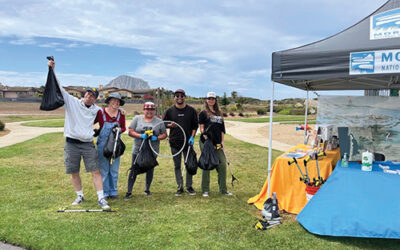
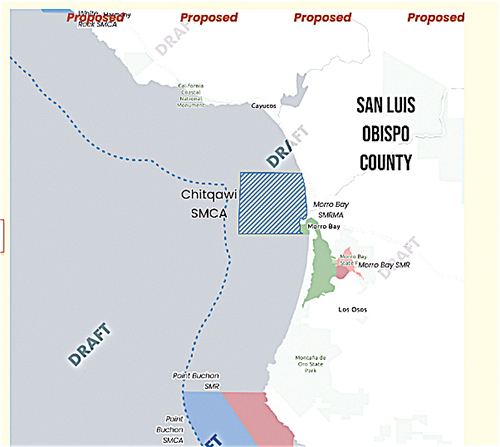

The State Fish and Wildlife Department is contemplating the establishment of a new Marine Protected Area in Estero Bay that could place a large segment of the bay off limits to fishing, except for members of the Santa Ynez Chumash Tribe who would be exempt from the ban. Map by CDFW
A huge section of Estero Bay could soon be placed off limits to all fishing except by certain Native Americans, if the California Fish and Wildlife Commission agrees to create another protected area in local waters.
The Commission is expected to hear a proposal by the Santa Ynez Band of Chumash Mission Indians to establish the “Chitqawi” State Marine Protected Area over a large square of ocean that stretches from just south of Morro Rock up to about Toro Creek and out a couple of miles from the beach.
If it is approved, it would be the second such MPA in local waters after another chunk of ocean was so designated off Point Buchon and Montana de Oro many years ago.
The tribe also proposed changes to three other MPAs — one off Point Sal south of the Oceano Dunes and another off Point Buchon.
Under the MPA program, various marine activities including the taking of so-called finfish is prohibited.
The proposal was first made in 2023 after the Fish and Wildlife Department put out a request for proposals for other MPA sites up and down the California Coast. The agency received over 20 proposals including the ones from the Chumash in Santa Ynez.
Then a year later, the proposal here was amended to exclude members of the Santa Ynez Chumash Tribe from the fishing ban, meaning if someone can show they belong to the tribe, they would be allowed to fish in the protected waters subject to the normal fishing regulations everyone has to adhere to.
Why is this needed? According to the proposal submitted by Sam Cohen a lawyer representing the Tribe, “To ensure 30% of California waters are fully protected by 2030 and to foster Tribal engagement and co-management of MPAs, this Petition submitted by the Santa Ynez Band of Chumash Indians (SYBCI) recommends an additional MPA for the Central Coast Region MPA network. There is no Tribal MPA for co-management within this regional network.
“The SYBCI are co-managers of four south coast SMCAs. The Tribe is recommending the adoption of a new MPA between Morro Bay and Cambria for the Central Coast Region.”
(SMCA stands for State Marine Conservation Area, another designation under the umbrella of the Marine Life Protection Act. The inner harbor and back bay in Morro Bay are also protected under the law as marine reserves.)
Fish and Wildlife has been working on the various proposals they received back in November 2023 and divided them into two categories relating to the difficulty of getting them approved.
The one off Morro Bay meets most of the criteria except that it is expected to meet with a lot of opposition, as a ban on fishing for everyone but a true Chumash, would greatly effect the local commercial and sport fishing industries, as well as the recreational fishermen who visit town almost daily when its fishing season.
The agency held a public meeting recently that apparently took most people by surprise and prompted the Moro Bay City Council to send a letter to Fish and Wildlife Director Meghan Hertel and Eric Sklar the President of the Fish & Wildlife Commission.
In the letter signed by Mayor Carla Wixom and Harbor Vitality Director Chris Munson, the City Council criticized the department for inadequate noticing of the issue and specifically a “public meeting” that was held, which the City only learned about hours before it happened.
“To our knowledge,” the letter said, “the City of Morro Bay was not notified, consulted, or invited to participate in the petition review proceedings conducted to date, including the Tribal Committee meetings of August 2025 and April 2026, or the Fish and Game Commission meetings of April 21, May 5-6, and May 19, 2026.”
The letter goes on to state the City has a strong interest in this issue as the ocean plays a vital part in the town’s economy.
“We believe that the communities living and working along the coast, including our commercial fishermen, recreational users, and harbor businesses, bring essential local knowledge and a legitimate stake in these decisions.
“A process that excludes local municipalities risks overlooking real-world impacts and undermining the public trust that is essential to successful, long-term marine stewardship.”
The letter demands that Fish and Wildlife include the City in any further meetings or discussions regarding the MPA proposed for here, as well as the expansions proposed off Point Buchon and the others further south.
The letter requests that the City be formally recognized as an affected local stakeholder in the review,
They City also wants “advance notice of, and an opportunity to provide public testimony at, all future Commission meetings, Tribal Committee meetings, and Marine Resources Committee meetings at which these petitions are discussed or acted upon.”
They called for the agency to conduct a briefing with City representatives and harbor stakeholders “to explain the current status, proposed regulatory changes, and potential impacts.”
And, “That the City be afforded a meaningful opportunity to submit written comment and participate in any environmental or economic review process conducted prior to a final decision on any of these petitions.”
The Fish and Wildlife Commission website has a section dedicated to the Marine Protected Areas program and the dos and don’t associated with them.
What’s the impact to people’s ability to legally fish if this gets approved? According to the agency’s website: “MPAs and the Marine Life Protection Act are intended to complement existing fishery regulations and are not intended to replace existing regulations. MPAs address a broad array of ecosystem concerns and, in particular, allow for interactions between both fished and un-fished species to occur in a more natural setting.
“If any changes to fisheries regulations were required in response to MPAs, this would occur through existing systems established in fisheries management plans and other regulatory frameworks.”
So it seems any fishing regulations stemming from this process would be piled on top of regulations out of the regular Fish and Wildlife Commission’s actions, as well as the federal Pacific Fisheries Management Council, and the National Marine Fisheries Service, as well as other governmental agencies.
See: wildlife.ca.gov/Conservation/Marine/MPAs#news for information on the overall MLPA program.
To get general information about the proposed new MPA petitions, see: https://storymaps.arcgis.com/collections/27e78c677dca484ebfb37120abc59d10.
And if readers want to submit a comment about the proposal go to: https://fgc.ca.gov/Regulations/Submit-Comments.
Be sure to reference MPA No. 2023-19MPA with any correspondence.