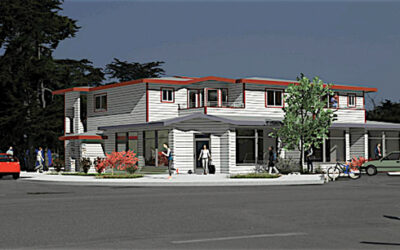
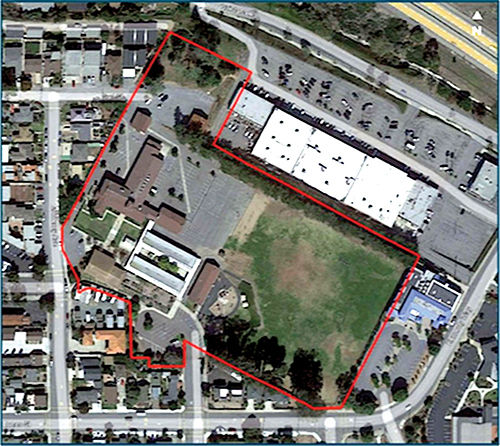

Satellite photo of Morro Elementary outlined in red. Submitted photo
In the first of two public meetings on the possible purchase of Morro Elementary School, Morro Bay citizens seemed to agree on at least two things — the City Council should complete the purchase from the school district, and the old school should become the “new” City Hall.
City Manager John Craig and Community Development Director, Airlin Singewald led the April 29 meeting that was attended by about 50 residents.
They’d come to give their thoughts on the $5.3 million purchase of Morro Elementary School, which has been closed since 2001 and was declared surplus property and put up for sale by the San Luis Coastal Unified School District.
Craig, in his opening remarks, said the City and school district had reached agreement on the sale, so, “The purchase has been completed.”
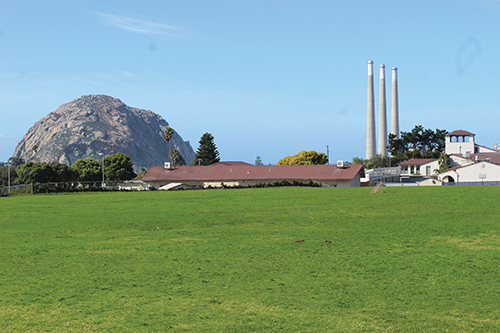
He explained that the deal includes a six-month “due diligence” period underway now, and during which the City will investigate the whole school looking for issues that might affect the decision to move forward and finish out the sale.
The due diligence involves investigating the campus inside and out, Craig said, and seeing what’s there.
The due diligence studies planned or already underway were broken down into six categories — an environmental analysis; a site survey and boundary review; architectural and structural analysis; a consideration of historic resources; title and escrow; and revenue and cost estimating.
“We will evaluate, study and figure out the components of the site,” Craig said. “It just likes what you would do when buying a house.”
He added that the City could go back to the school board with any concerns the studies might uncover, and there are several that could come up.
He noted they need to determine how much asbestos was used at the school. Asbestos is a fire resistant mineral that was used in untold numbers of products up until the 1970s when it was determined to cause cancer with airborne exposure. Most older buildings in the U.S. contain at least some asbestos, which must be removed by certified contractors using specialized methods and safety equipment.
There’s also the possibility of lead-based paints, lead plumbing pipes and an underground fuel tank that could still be in the ground, left over from when the school had its own buses and a maintenance garage on site.
Originally called the Morro Bay Union Grammar School, Morro Elementary was established in 1936, and the original school building was designed by famed architect Louis Crawford in a Spanish style of architecture.
Crawford also designed the Santa Maria City Hall, Cayucos School’s old gym, as well as numerous other public buildings across the state.
Located at 1130 Napa Ave., the Morro Elementary campus covers some 9.7 acres with over 4 acres consisting of a large expanse of grass, part of the school’s playground and used by the City and various other youth sports.
There are eight total buildings — the main building with an auditorium, school kitchen, office and several classrooms and built in 1936; an addition to the main building built in 1949; a music building built sometime between 1938 and 1947; a classroom building built in 1954; a garage c. 1959; a kindergarten building built in 1964; and a modern library (leased by a Montessori School) around 2000.
The original building covers some 14,700 square feet and is the basis for possible recognition as a historic site being pursued by the Friends of Morro Elementary, a citizen’s group that formed to lobby the City to buy the old school.
Craig said they had a hearing set for this month at the State to see about having the school listed as a historic site, a designation that could open up grant monies to help with the purchase.
And the City could need help, as after making an initial $500,000 down payment to the school district, the remainder — $4.8 million — is due at the close of escrow, schedule now for Halloween (Oct. 31).
While most agree the school would be the treat, the trick for the City will be paying for it. Craig said the staff is working on a funding plan that could include selling off some of the properties owned by the City.
For example, the City Council voted to surplus the former teen center on Atascadero Road that was appraised at $2.1 million. The City is out for bids now to find someone to buy the site, at 231 Atascadero Rd., and develop an affordable housing project, which is required under State Law for surplus government properties.
If they don’t get any bites after a 60-day period, they can petition the State Housing and Community Development agency (HCD) to release it from the affordable housing requirement and open it up for anyone to buy.
Given its location, about 250-yards from the beach, that could make the site attractive to commercial developers that might want to build a motel or some other commercial project. The site is zoned Commercial/Visitor-Serving.
In any event, the City is looking at how to pay the district. “We haven’t identified funding yet,” Craig said. The Council sees it [Morro Elementary] as an investment in our past and our future.”
The clock is ticking for the City as the first big deadline looming in the sale is Aug. 31, after that date the City would have to forfeit its $500,000 down payment.
But before that, the staff is planning to bring the City Council its due diligence report with a recommendation on funding, and ultimately whether to move forward with escrow and close the sale or pull out.
But that April 29 meeting was more of a brainstorming session with City officials — including all five council members — in attendance.
Much was made about the need for both a true civic center and affordable housing, and according to Craig and the Friends of Morro Elementary’s research, there is room on the campus for both.
Singewald ran down the school’s zoning and what that means. He said the school is zoned “high-density residential” which means there could be from 15 to 27 units per acre. So if you took five acres at the minimum density of 15 units per acre, Singewald said there could be 75 units built on the site under the current zoning.
Many in the audience spoke of the need for affordable housing in town, especially for seniors and young couples, who find it hard to live here because of the high cost of housing.
One resident urged the City to speak to the children in town and keep their wishes for the property in mind going forward.
Another person asked why the City Council would zone it different than what it’s used for by the community, i.e. the playing fields. “It would be sad to lose that.”
Singewald explained that the H-D zoning goes way back into the 1980s. Of note, the site is outside the appeal zone of the Coastal Commission.
Several people spoke of the importance of the City buying the old school to maintain local control over what gets developed, with some concerned what would happen if the State took it over for planning purposes.
As for a City use, Craig pointed out that city offices are spread across several buildings — public works, City Hall and the City Hall Annex — and bringing them together under in one place would be good.
However, “We are not in a position to build a new City Hall,” Craig said.
But that begs the question — how would the City pay for everything, including whatever remediation and remodeling is needed for City use?
All of this is a dream, one resident said, unless you can write the checks.
A member of the Chamber of Commerce board, which submitted a letter to the City on the purchase, emphasized the need for housing, pointing out that the City’s population continues to age, and soon the people aged 75-84 could increase by 43% according to some predictions.
That’s why the Chamber of Commerce is advocating for housing to some degree, he said.
Another resident commented that if the City gets rid of the playing field, “we won’t get it back.”
A neighbor of the school, whose family has lived there three generations said she would like to see the school become the new City Hall. “I think our town deserves a really nice City Hall,” she said.
Her husband cautioned about “high-density housing,” warning that in his experience as a former police officer, he’s seen such developments bring in “some problems.”
“Is it going to be horizontal,” he asked, “or vertical? How many people are we going to put in there?”
Commenting on the money issue, Craig said among the options is selling city-owned properties, putting in a special tax (that would require a vote of the residents), or borrowing the money and paying it back with City funds. There’s no money in the City coffers now to pay for this, he said.
Another resident then commented, “What you’re saying is the City is property rich and cash poor.”
Craig said their next public meeting in the due diligence work will be either June 17 or 24 and he expects they will have a lot more information from the various studies at that time.
If readers want to know more about the school and the work that’s been done by the Friends group, see: www.friendsofmorroelementary.org.