
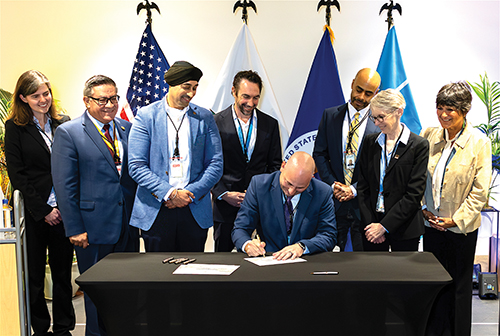

Acting Director of the NRC’s Office of Nuclear Reactor Regulation, Jeremy Groom (seated), signs the 20-year license renewal for PG&E’s Diablo Canyon Nuclear Power Plant, as dignitaries look on. Among those in attendance at the April 2 news conference were: Dist. 3 SLO County Supervisor Dawn Ortiz-Legg (far right); Congressman Salud Carbajal (second from left) and PG&E CEO Sumeet Singh (third from left). Submitted photo
Another major hurdle has been cleared in the continuing saga over whether a local nuclear power plant can continue to operate years into the future.
Pacific Gas & Electric announced last week that the Nuclear Regulatory Commission (NRC) has approved a 20-year license renewal for the Diablo Canyon Power Plant. But it’s not the final hurdle in this seemingly never-ending race.
“The NRC’s approval,” PG&E said in a news release, “follows a transparent and public process through which the agency determined that Diablo Canyon is safe and environmentally sound to operate for
another 20 years.”
However, “Extending operations past 2030 would require action from the California State Legislature.”
Diablo Canyon had been slated to close its two reactors in 2024 and 2025 when the initial 50-year licenses to operate expired.
In anticipation, over 20-years ago, PG&E applied to the NRC for licenses to continue to operate the reactors for another 50 years. That move was met with overwhelming opposition by anti-nuclear, anti-Diablo Canyon and environmental activists who argued the plant was too old, not in good condition, and in danger from nearby earthquake faults discovered offshore from the plant, among other claims.
Nevertheless, PG&E was pushing ahead with its license renewal until 2016, when it announced a settlement with opponents and labor unions, and declared it would drop the renewal efforts and shut down the two reactors when their licenses expired.
That started the company on another path to plan for decommissioning and the ultimate disposition of the 12,000 acres of coastal lands surrounding the plant’s relatively small footprint.
Then starting in 2020 the State experienced rolling brownouts in summer due to demand exceeding supply from the power grid. The cause was blamed on solar and wind energy and the inadequacy of these sustainable energy producers. It became apparent that the state was not yet ready to switch over full time to these green, carbon-free, sustainable and renewable energy sources.
In 2022 the State asked PG&E to extend the life of Diablo Canyon, which produces some 2,200 megawatts of power — about 10% of the entire power grid — when both reactors are running full blast, to help with the reliability of the power grid to satisfy demand and to help the State meet its ambitious climate goals. Diablo Canyon is considered a carbon-free energy source, so its output could be counted as helping to fight climate change.
The State asked for five more years of operations, setting a deadline of 2030 for the state’s last nuclear plant to close.
PG&E agreed and asked the NRC for an extension of the old license. But the federal agency said “No” it would only award a 20-year license renewal, and PG&E would have to undergo a full licensing process.
That process has been ongoing for over three years now and appears to have been completed last week with the granting of the 20-year license.
“The NRC’s approval of Diablo Canyon’s license renewal application,” PG&E CEO Sumeet Singh said, “marks an important milestone for California’s energy future. Diablo Canyon is the state’s largest source of clean energy and a cornerstone of reliability. Every day, we maintain an unwavering focus on operating a safe, reliable, affordable and clean energy system that can meet growing demand in a changing climate.
“The NRC’s thorough and thoughtful review underscores the strength of our commitment, and we are proud of Diablo Canyon’s continued role in supporting California’s focus on net-zero energy.”
According to PG&E, the NRC’s license renewal process “also included approvals from State and Regional agencies including the California Public Utilities Commission, the State Lands Commission, the California Coastal Commission and the Central Coast Regional Water Quality Control Board.”
It should also be noted that the Trump Administration’s Department of Energy also called for the plant to remain open.
Jeremy Groom, the Acting Director of the NRC’s Office of Nuclear Reactor Regulation, said, “Today’s milestone reminds us that when discipline, science, responsibility and vision all come together, we can build an energy future that is both sustainable and secure.”
Groom added, “Diablo Canyon’s procedures and oversight have evolved throughout the years and through rigorous review, continuous inspection and technical refinement. This license renewal reflects that strength of commitment and confidence earned through a thorough and transparent NRC review.”
Diablo Canyon marks the 100th license renewal for nuclear power plants by the NRC.
But of course, the story doesn’t end there, as the State Legislature and, in turn, the Governor have still only approved a five-year extension.
Support for the 20-year deal has been strong locally, as almost every local government agency has signed on to a letter from the Board of Supervisors to the State Legislature urging it to increase its extension to 20 years.
Another issue remains unsolved. When PG&E agreed to close a decade ago, it was granted the ability to depreciate the plant’s value for tax purposes to zero. This means the company no longer pays millions in property taxes specifically for the plant.
The County and San Luis Coastal Unified School District were the big losers with that move, as both received millions in property taxes annually from Diablo Canyon, and the depreciation left ever-growing holes in their budgets.
PG&E did pay tens of millions in upfront payments to all the agencies that were going to lose these revenues, but those payments are now over and done with.
With a 20-year renewal now becoming a reality, the various agencies have sought to restart Diablo’s tax flow, an argument that was included in the letter the County and cities sent to the State.
Diablo Canyon has nearly 1,300 employees and is one of the largest private employers in SLO County.