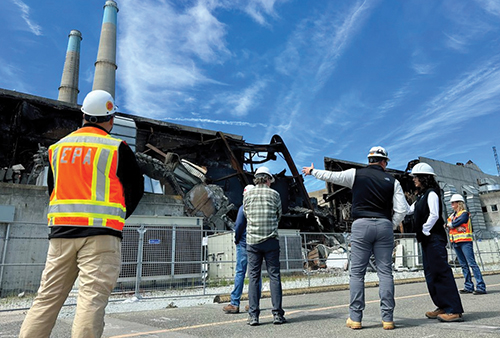

In the photo dated July, 31, EPA Deputy Regional Administrator Cheree Peterson (second from right) tours the site of the 2025 battery fire in Moss Landing with members of EPA’s emergency response team and officials from Vistra. Photo courtesy USEPA
Clean up continues at the fire-destroyed Battery Energy Storage System (BESS) facility in Moss Landing and the Federal Government has given the OK to begin the final stage of the mop up.
The U.S. Environmental Protection Agency (EPA) announced Sept. 8 the start of the final phase of the clean-up at Vistra Energy’s Moss Landing plant, which caught fire and was destroyed in a spectacular blaze in January 2025.
Vistra is also the owner of the closed Morro Bay Power Plant and had been proposing to build a BESS plant here but decided to drop the proposal after the Moss Landing fire.

“EPA,” reads the agency’s announcement, “will now oversee the removal and processing of all remaining, severely damaged batteries and remnant material for transport to off-site disposal facilities. The burnt battery storage building is being demolished to allow crews to reach the remaining material.”
EPA’s Pacific Southwest Regional Administrator, Mike Martucci, said, “The beginning of the final phase of battery removal at Moss Landing is a huge milestone in this unprecedented lithium-ion battery cleanup.”
He added that this brings the matter a “step closer to safely eliminating the threat of these potentially dangerous batteries once and for all.”
Vistra has been hard at work cleaning up the fire’s aftermath, starting with the batteries that were easiest to get to and remove.
“Vistra, under EPA’s oversight,” the release said, “has now begun removing all remaining, previously inaccessible battery material. To safely transport this material off-site for disposal at specialized facilities, severely damaged batteries will first be treated on-site at Moss Landing.”
The remaining batteries and fire debris is being tested for “waste characterization purposes,” the EPA said. It will all be sent to a special EPA approved disposal site. The agency will post the testing results on a special website for the disaster, see: www.epa.gov/ca/moss-landing-vistra-battery-fire. The materials that test out safe and can be recycled will be recycled, EPA said.
It should be noted that Vistra is doing the work, including demolition of the burned-out building and batteries, under EPA oversight.
“Air monitoring and air sampling activities,” EPA said, “fire and smoke watch, water collection and testing, battery temperature monitoring, and dust mitigation and suppression activities — such as the application of encapsulants — will continue throughout the process as necessary to immediately detect any safety risks and protect workers and the surrounding community.”
EPA said they are working with local agencies on the clean-up and Vistra is responsible for following an EPA-approved plan. The company will also be notifying all agencies involved if something comes up, like another fire.
Meanwhile, EPA is predicting the project to last well into next year.
“Based on current projections,” the agency said, “EPA anticipates the battery removal process and building demolition will be completed in mid-2027.”
Though it’s now been over a year-and-a-half since the fire, the danger has not yet passed. “Damaged lithium-ion batteries pose an ongoing risk of fire,” EPA said. “Lithium-ion battery fires can produce hydrogen fluoride and other flammable or toxic gases.”
EPA oversaw the aftermath of the fire, and first stabilized the building and disconnected all “accessible” batteries from each other. They were also de-energized for safe transport to EPA-approved recycling facilities in Nevada and Ohio.
During the first phases of the cleanup EPA said they removed the batteries they could access, some 40,000 modules.
Who’s paying for all this? Vistra is, according to EPA. “Vistra is considered a potentially responsible party under the Comprehensive Environmental Response, Compensation, and Liability Act (CERCLA). In July 2025, the company entered into an Administrative Settlement Agreement and Order on Consent, in which “Vistra agreed to perform and pay for the costs of battery removal and disposal under EPA’s oversight,” the agency said.
The BESS facility that burned is one of two Vistra has at the Moss Landing Power Plant property, which Vistra also owns. It had been built inside an old power plant building that has been closed for decades.
A second BESS was built outside the old power plant building and did not catch fire in the blaze. Vistra also owns a natural gas-powered power plant on site and Pacific Gas & Electric has a battery facility on the property, too. That BESS has also had fire issues over the years.
Vistra’s 300-megawatt plant caught fire on Jan. 15, 2025, and burned out of control for three days, briefly reigniting on the third day.
It had some 100,000 lithium-ion battery modules and EPA said about 55% of them were burned in the blaze that broke through the roof and shot hundreds of feet into the air.
A plume of thick, black, toxic smoke was emitted and rose high into the air, spreading across the surrounding area including the protected Elkhorn Slough, which is adjacent to the property.
Surrounding towns — Castroville and Watsonville, as well as Moss Landing Harbor — were evacuated during the fire. Firefighters fought to contain the blaze, which eventually burned itself out.
Fallout from the fire was extensive and included a softening of the positions of political leaders like Dist. 17 State Sen. John Laird (D-Santa Cruz) and Dist. 30 Assemblywoman Dawn Addis (D-Morro Bay). Both had been strong supporters of battery facilities to support renewable energy.
Laird called for increased scrutiny over large battery facilities and Addis withdrew her support for siting such plants in urban areas, such as the proposed Morro Bay plant, which sits nearly in the center of the community.
A local citizen’s group in 2024, pushed through a ballot measure that requires voter approval to change the zoning on the property. Meas. A-24 essentially gives the voters veto power over that decision. The fire, which happened just a couple of months after the November 2024 Election, only served to strengthen the opposition group’s stance and further the town’s opposition to Vistra’s project.
A month before the election, Vistra had informed the City it was placing the BESS Project in Morro Bay on hold and withdrew its proposal from consideration after the fire.
The City of Morro Bay also acted after the fire, and the City Council approved a new municipal ordinance banning all large-scale battery storage facilities within the City Limits.
The BESS Project here has all this and more to overcome, but the project may not be totally dead, as the company hasn’t publicly informed the City what it wants to do with the over 100-acre property.
The City and Vistra have an agreement that sets a Dec. 31, 2027, deadline for the company to either remove the old power plant’s structures — the three, 450-foot tall smokestacks and 165-foot tall power generating building — or pay the City $3 million.
Various estimates for this removal — put out by Duke Energy and Vistra — have ranged from $80 million to about $35 million respectively.
There’s been no word from Vistra as to their intentions, according to a City official.
City Manager, John Craig told Estero Bay News, “We have been in contact with various executives there regarding ongoing property issues, like requesting and negotiating easements from them for injection wells, creek bed remediation, etc., but I don’t believe we’ve had any correspondence regarding the demolition.”
Though the location of the property, adjacent to the bay, would seemingly make it highly valuable, it’s a troublesome situation.
Despite its extensive history as an industrial site, the majority of the property has been given a relatively clean bill of health by the State’s Department of Toxic Substances Control (DTSC), however, the agency has cautioned that it has not tested the soil or groundwater from directly underneath the power building or the smokestacks.
The Coastal Commission has said the property could come under its coastal hazard avoidance policies and possibly other Coastal Act restrictions.
And, former plant owner, PG&E, also placed a deed restriction on the property that makes redevelopment for any use besides industrial difficult to accomplish.
Nevertheless, the City rezoned the property “commercial visitor-serving” when it updated the General Plan and the Local Coastal Program (LCP) a few years ago.
Battery Plant Catches Fire Again
In what could be called a prophetic turn of events, the burned out Battery Energy Storage System plant in Moss Landing caught fire once again, Sept. 18, just as it was about to enter the final stage of cleanup.
The Environmental Protection Agency had last Thursday, announced it would start the final stage of cleaning up the January 2025 fire that destroyed a 300-megawatt BESS plant at the Moss Landing Power Plant property, and owned by Vistra Energy.
According to Monterey County’s Office of Emergency Services, “Firefighters from the North Monterey County Fire District were dispatched to the Moss Landing Power Plant just after 6:15 a.m. for a reported structure fire.
“Crews arrived to find smoke and fire coming from the north side of the facility.”
The fire erupted in some 1,500 damaged battery modules that were still charged with power and had apparently survived the 2025 fire.
“The fire is occurring within an existing structure that sustained significant damage during the January 2025 Vistra battery fire and involves batteries that were previously damaged during that incident,” Monterey OES said. “The current incident is not comparable to the January 2025 fire in terms of its scale or complexity. Based on current conditions, officials anticipate the fire may burn itself out over the next 24 hours.”
The department added that no one was hurt in the latest blaze and firefighters from several agencies responded to the fire and the surrounding area at Moss Landing had to be evacuated.
The fire happened just days before the EPA planned to begin the final cleanup of the tens of thousands of battery modules left inside the burned out building. EPA had warned that fire was still possible in the plant’s damaged modules.
— Neil Farrell