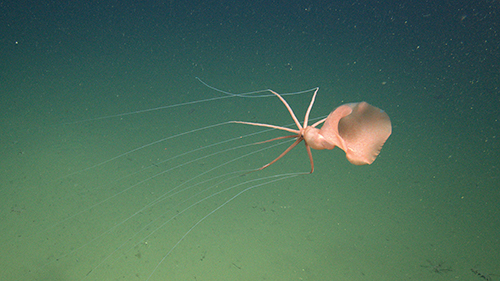

A rare bigfin squid was discovered two miles deep in the protected area off the Central Coast, Monterey Bay National Marine Sanctuary.Photo by MBARI
By Christine Heinrichs
Central Coast residents greet all kinds of visitors along the coastline! In September, an endurance swimmer swam through on her way from Oregon to Mexico, and a rare deep-sea squid swished through far below her.
900-Mile Swim
Endurance swimmer Catherine Breed set out to swim the length of California’s coast, 900 miles, from Oregon to Mexico, in July. She passed through San Simeon and Morro Bay the first week of September.
She holds records for swimming across Monterey Bay (25 miles in 12 hours, 53 minutes) and the Farallon Islands to the Golden Gate Bridge (29.7 miles in 13 hours 54 minutes).
One of the goals of her endurance swimming is to “challenge conventional ideas of endurance, shifting the focus from records alone toward purpose-driven adventure that leaves lasting impact.”
“It was never just about swimming,” she says on her website.
She swims about a mile offshore, about five hours each day, covering roughly 10 to 15 miles daily. Lighter winds in the early morning hours make the swim easier.
Her support team accompanies her on a 52-foot Beneteau sailboat. Check out more at swimcalifornia.com.
Two Miles Deep

Breed won’t see the creatures that live deep below her in the ocean, in the protected area off the Central Coast, Monterey Bay National Marine Sanctuary. But Monterey Bay Aquarium Research Institute’s (MBARI) remotely operated vehicle documented a rare creature, two miles deep.
It happened during the MBARI’s flagship research vessel David Packard’s August 3-12 Seamount Hotspot expedition to Sur Ridge and Davidson Seamount. A rare bigfin squid (Magnapinna sp.) floated into the screen from the camera on the ship’s remotely operated vehicle (ROV) Doc Ricketts. Its two large fins waved in the water, amidst its eight trailing arms and two tentacles. They used the Doc Ricketts’ laser measuring system to estimate that the squid’s size, approximately 1.25 meters (4.1 feet) long from the top of the body to the ends of the arms.
The expedition was surveying the abyssal seafloor near Davidson Seamount when the team was surprised to see the bigfin squid hovering over the seafloor. They were studying unexplained furrows in the mud, trying to determine whether they were created by beaked whales feeding in the waters around the seamount.
“I was focused on the seafloor and all of a sudden an elegant creature with undulating, angel-like ‘wings’ swam into view,” recalled Andrew DeVogelaere, a research ecologist with NOAA’s Monterey Bay National Marine Sanctuary and a longtime MBARI collaborator. “I was stunned — this is the first confirmed bigfin squid sighting in Monterey Bay National Marine Sanctuary and a powerful reminder of what we still have to discover in the ocean’s depths. We live next door to a magical place.”
Bigfin squid have been documented only 70 times before, worldwide. In 2001, MBARI geologists observed a bigfin squid during an expedition to Hawaii.
On board the David Packard, team member Olívia Soares Pereira, MBARI postdoctoral fellow, immediately recognized the squid. She’d seen several during a summer Schmidt Ocean Institute expedition to the Doldrums Megatransform and Fracture Zone in the Atlantic Ocean that observed several bigfin squid.
“After this recent sighting, I texted another MBARI scientist from the Doldrums expedition, ‘How many Magnapinna will I see this year?’ I never thought I’d see enough of them to actually make that joke!” she said. “Each sighting is such a privilege and highlights the incredible diversity of life that thrives in the unknown deep underwater and needs our protection.”
Soares Pereira specializes in benthic organisms, the critters that live on the sea floor in the deep sea, 200 meters (600 feet) and deeper, such as crabs, clams, marine worms, and sea urchins. She’s always been curious about the animals that live down there, in the dark and cold, and years ago made an Instagram video about Magnapinna, just because she thought it was interesting. She wants those of us living on land to understand that although animals like Magnapinna look eerie, they aren’t aliens. They live on earth with us. They pose no danger.
“I never expected I would see one,” she said. “They are so rare, how little we know about them.”
Some of the other scientists in the control room had never heard of bigfin squid. Now that Soares Pereira has seen several, her friend called her the Magnapinna Whisperer.
Davidson Seamount is included in the Monterey Bay National Marine Sanctuary, even though it is separated from the main coastal section of the sanctuary, 80 miles southwest of Monterey. It’s 26 miles long, 8 miles wide, 4,101 feet deep at the summit, and 11,581 feet deep at the base. Davidson Seamount was added to Monterey Bay National Marine Sanctuary in 2008. MBARI began exploring it in 2002 as a biological hotspot. It’s an oblong series of volcanic cones, last actively volcanic nearly ten million years ago.
The near-freezing temperature of the water there supports ancient deep-sea corals and an octopus nursery where thousands of octopuses brood their eggs. It takes years to hatch octopus.
Large whales and seabirds (including world-record abundance of the seabird Cook’s petrel) also visit the seamount, although its peak doesn’t break the surface. The seamount directs deep-sea currents toward the sea surface, concentrating nutrients and food to support wildlife communities above the summit.
“Every dive into the deep brings an opportunity to see something new. You never know what you’ll encounter,” said Soares Pereira. “I was sitting right next to the screens in the control room when I saw what looked like tentacles coming into the top corner of the video. I thought it might be a cool jelly, but as soon as the little ‘elbows’ appeared, I knew exactly who this was and immediately screamed ‘Magnapinna!’ before the rest of the squid even came into the screen. It was incredibly exciting!”
The Seamount Hotspots expedition was supported by the David and Lucile Packard Foundation, a longtime supporter of MBARI’s work.
See video of the bigfin squid the researchers saw at mbari.org/animal/bigfin-squid.