
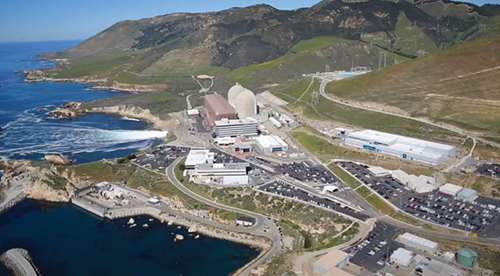

Pacific Gas & Electric has made the first of two payments to SLO County to backfill lost unitary taxes from the Diablo Canyon Power Plant. Photo courtesy PG&E
Pacific Gas & Electric recently announced that it had made the first of two large payments to the County to be shared with various agencies that lost property tax monies from a backfired deal to close Diablo Canyon Power Plant.
PG&E issued payment of $8.33 million that will mainly go to SLO County, the San Luis Coastal Unified School District, and Port San Luis Harbor District, as well as other agencies that used to get a share of the taxes from Diablo Canyon.
The payment was a voluntary agreement the company made to stave off passage of Senate Bill 931 authored by Dist. 17 State Sen. John Laird. Sen. Laird’s District includes SLO County and Diablo Canyon.
PG&E said the second payment — for a total of $16 million between the two — would be made sometime in 2027.
Sen. Laird had submitted SB 931 earlier this year meant to make up millions in lost taxes after a settlement agreement was made a decade ago to close Diablo rather than seek new operating licenses.
PG&E and several anti-nuclear activist groups reached the agreement in 2016 and PG&E dropped its efforts to renew its two reactor operating licenses. The licenses were due to expire in 2024 and 2025.
At the time, it was expected that renewable energy sources — mainly wind and solar — would be built to replace Diablo Canyon’s 2,200 megawatts of nuclear energy.
That deal was followed up by a State Law that allowed PG&E to devalue Diablo Canyon for tax purposes, timed to coincide with the plant’s final closure in 2025.
Facing the immediate loss of many millions a year in taxes, another agreement was reached that provided between $122.5 million to over $147M “to address impacts to essential public services, the local economy, and offsite emergency planning efforts until the plant is fully decommissioned,” reads a news release from the County Administration at the time.
That agreement was split into for parts:
• Essential Services Mitigation Fund — $75 million at $8.33M a year — was split between 71 of 80 governmental agencies that got unitary taxes, with the school district getting $4M a year for 9 years and SLO County $3.1M;
• Economic Development Fund — $10M for “regional economic development and job creation;”
• Emergency Preparedness and Response Emergency Management — an undetermined amount that was to be decided through decommissioning, including an estimated $2.5M a year for the warning siren system;
• Future Use of the Land — cost unknown, but tied into the decommissioning and future uses of the 12,000-acre property. (PG&E set up a decommissioning panel and continues to work on this effort.)
This agreement had seemingly eased the pending blow to the budgets and settled the tax matters, as well as beginning to address future issues with decommissioning.
However, the State, facing rolling blackouts and energy shortages, asked PG&E to keep the plant running for an additional 5 years, until 2030.
So operations have continued but the depreciation mandated by the State also continued, with the mitigation settlement covering the expected losses.
Now, with the plant’s tax value at essentially zero, but operations continuing, the same government agencies have cried foul and sought to restart the cash flow.
SB 931 was a way to reinstate the taxes lost so far, but stops short of paying up in full until the State’s operating permission ends in 2030.
When PG&E applied to the Federal Nuclear Regulatory Commission to extend its old operating licenses, the NRC denied an extension or a 5-year license and instead required PG&E to apply for a 20-year license, starting over again with environmental studies and more.
And while the federal government has essentially approved the new licenses, the State’s continued operating deadline remains 2030.
Most local government agencies have approved a letter, penned by SLO County, asking that the State’s permits be extended to match the NRC’s 20-year decision. But Gov. Gavin Newsom recently declined to sign off on extending the State’s permitting to match the NRC licenses, announcing he would leave that decision for the next Governor to make.
This most recent actions by the State appear to stick to that 2030 deadline.
In an Aug. 17 news release, Sen. Laird said, “I authored SB 931 to make sure that the local community, including SLO County, cities, and schools, is adequately compensated for impacts associated with Diablo Canyon Power Plant’s extended operations until 2030.
“The bill was passed by the State Senate, as well as Assembly committees, and was positioned to go before the State Assembly floor this month. PG&E has now volunteered to provide the payments that would be required under SB 931.”
As for the remaining operating schedule, Sen. Laird said, “There are still three years left (2027-2030) for which the community is still owed payments. I will be addressing the remaining shortfall in the future; but in the meantime, let’s celebrate this good news, while remaining focused on ensuring full payment for all five years of Diablo Canyon’s extension.”
The County’s top man also thanked PG&E for its cooperation with restoring funding. Matt Pontes, CEO of SLO County said, “Securing two years of unitary tax revenue provides critical stability for our schools, public safety agencies, local governments and the essential services our residents rely on every day.
“We are especially grateful to Sen. Laird for his leadership and commitment to our local communities. This agreement gives us an important bridge for the next two years, and we look forward to continuing the conversation with Senator Laird, PG&E and our State partners on a fair path forward for the years that follow.”
He added, “I want to personally thank Sen. Laird and his team, along with PG&E, for working hard to reach a solution that recognizes the importance of Diablo Canyon and the communities that host it.”
Dist. 30 Assemblywoman Dawn Addis, who has Diablo Canyon in her District, also commented on the deal. “PG&E’s agreement to pay two of five years of the Essential Services Mitigation Fund,” Addis said, “is an important step forward in supporting our local communities who bear the responsibility of hosting California’s only operating nuclear power plant. This is critical for our students and the public agencies who serve the most vulnerable throughout San Luis Obispo County.”
It should be noted that PG&E said these payments are coming from stockholders and not its customers. Also, with the voluntary agreement, Sen. Laird said SB 931 “is no longer needed.”
The school district was hit hardest by the depreciation of Diablo Canyon and for the past couple of years has faced budget shortfalls.
A sizeable portion of the unitary taxes paid by PG&E on Diablo Canyon’s 12,000-acre property went directly to the school district, which still receives the majority of its funding through property taxes, as a so-called “basic aid” district.
That loss of tax monies was one of the driving forces for the school board putting two of its old elementary school properties — Morro Elementary in Morro Bay and Sunnyside School in Los Osos — up for surplus sale. Both schools were closed decades ago with some of the buildings leased to various agencies, churches and private schools.
Morro Elementary was sold to the City of Morro Bay for $5.3 million and the sale price for Sunnyside is being negotiated with the Los Osos Community Services District.
Los Osos voters in June agreed to increase their property taxes to pay for the Sunnyside School purchase.