
Our previous story detailed how the Central Coast was built up militarily to defend the West Coast and support a possible war in the Pacific. On Sunday, December 7, 1941, it happened: President Roosevelt told the nation that the Japanese had attacked Pearl Harbor, Hawaii, from the air: “The attack … was made on all naval and military ‘activities’ on the Island of Oahu.” (SLO County Telegram-Tribune).
Although initial details were sketchy, the impact was immediate on the Central Coast. Radio stations went off the air to prevent their use as guide beacons for Japanese airplanes. The General of the 4th Interceptor Command ordered all 50 aircraft observation posts in San Luis Obispo County manned on a 24-hour basis. He placed guards at critical infrastructure and instituted black-out conditions.
Citizens living along the coast were instructed to drive with the vehicle’s lights turned off. Coast Guard trucks patrolled the coastline to enforce the rules. Trenches were dug at strategic points overlooking potential beach landing sites. People gathered outside the fence at Camp San Luis Obispo to say goodbye to their soldier loved ones who they might never see again.
The sheriff’s and district attorney’s offices had met with the oil companies to plan security measures before the Pearl Harbor attack. The oil companies also took their own security precautions at Avila Beach and Estero Bay. For several months Japanese tankers had been loading oil here. The companies were concerned they would be targets of saboteurs who would know about the location, size and value of the oil lines, and storage and pumping facilities in the county.
Soon after Pearl Harbor and before the end of 1941, the Japanese attacked ten American ships along the California coast, two of which occurred off our coast. On December 23, 1941, one Japanese submarine chased the Richfield Oil ship Larry Doheny just off Morro Bay and fired two torpedoes that missed. One exploded prematurely, and its concussion broke the cabin doors on the wheelhouse. A second sub pursued and sank the 800-ton Union Oil tanker Montebello near San Simeon and fired on the men as they left the sinking ship in lifeboats. Miraculously, all 36 members of the crew were uninjured and rescued. The Standard Oil tugboat Alma (on display at the Morro Bay Maritime Museum) rescued 22 crew members.
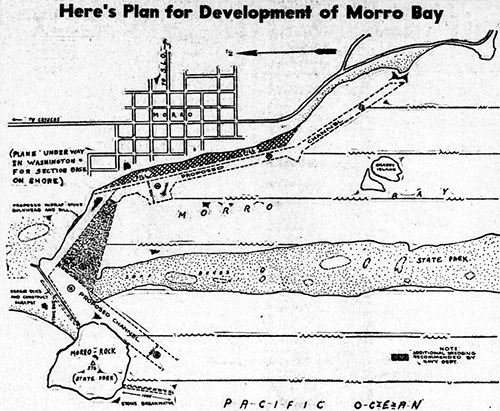
The biggest change that came to Morro Bay was the Navy section base that totally redefined the city. The base was dedicated on November 16, 1941, in a ceremony near the site of the new base. The ceremony included a parade, the unveiling of a dedicatory stone, the cutting of a ribbon to put a dredger to work, a flag-raising, a concert by the 40th Division’s 270-piece band, and short talks by officials. The plan, shown in the picture, eventually transformed the Morro Bay harbor into what it is today, and it is the subject of our next story in this series. The 85th anniversary of this event will be celebrated November 7 at 3 p.m. in the Vets Hall of Morro Bay. All are invited.
Image source: SLO County Telegram-Tribune, August 21, 1941. Do you have a photo or story about Estero Bay to share? Contact HSMB at info@historicalmorrobay.org.