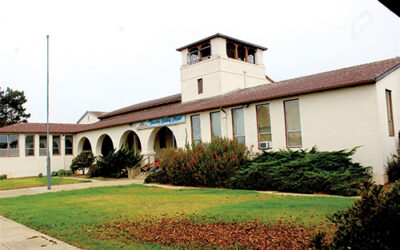
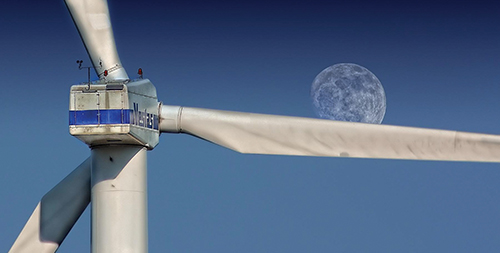

Offshore Wind Energy support is still a viable, yet expensive, option in Morro Bay Harbor. Photo by Peter Dargatz
Despite numerous constraints having to do with zoning problems, City ordinances and costs, among others, using Morro Bay Harbor as a port to support offshore wind energy is still potentially viable.
But it will not be smooth sailing to overcome the sea of red tape and will cost a boatload of money.
The Morro Bay City Council recently received a report, commissioned by County Supervisors and paid for with a $1 million State grant, looking into what it would take to turn Morro Bay and Port San Luis into workable facilities to support the proposed floating offshore wind farms that are planned for a large patch of ocean off the Coast of San Simeon.
The so-called Morro Bay Wind Energy Area covers an area of ocean from 20-30 miles due west of San Simeon, and about 57 miles north of Morro Bay, which is the nearest safe harbor to the site.
Three companies purchased leases, each about 180,000 acres, and plans are to install 3 gigawatts and potentially up to 6 GW of wind energy turbines, floating on the surface of the sea.
Water depth in the wind area is from 800 to 1,300 meters deep (from about 2,400 feet to over 4,200 feet).
When this all started in 2016, the standard turbine was just 8 MW capacity, and the hope was that 10 MW turbines would be available by the time they got around to building the wind farm.
Now the standard is 14 MW, and the expectation is 20 MW wind turbines would be eventually installed. So, to get to 3 GW of power, there needs to be 150 turbines and at 6 GW, the number jumps to 300.
The County’s harbor study, entitled “Central Coast Offshore Wind O&M Infrastructure Study,” was written by the global engineering firm, Mott MacDonald using the results from various other studies as well as original work.
Mott MacDonald’s contract was for $684,000 and covered the individual studies for Morro Bay and PSL.
The City, PSL and Cal Poly split the remaining $315,000 to cover their work in supporting the study.
Though seemingly pretty involved, Mott MacDonald acknowledged that it isn’t the end-all definitive word on offshore wind and actually takes from a previous study done for the State Lands Commission as ordered by Assembly Bill 525.
That study looked at every port and harbor in California and judged their suitability for supporting offshore wind (OSW) facilities. Called the AB 525 Port Readiness Plan, it concluded that Morro Bay could become a port for crew vessels, the smallest of the three types of vessels that will be needed to build, service and maintain OSW. But it could need up to $50 million or more in harbor repairs and improvements to do it.
The Mott MacDonald study upped that astronomical figure considerably.
“Construction cost estimates,” Mott MacDonald’s report said, “for the least constrained concept designs were estimated to be approximately $130-$140 million, however may be in the range of $90-$210 million according to the Advancement of Cost Estimating’s Class V cost estimate scheme (-50% to +100%) for concept-level assessments.”
That least constrained model would be O&M facilities for all three wind energy companies, and doesn’t consider all the extra costs associated with doing anything in California, especially within the Coastal Zone.
“Costs were estimated for the waterfront infrastructure only and excluded any potential costs for environmental mitigation, upland development, or costs to relocate or compensate businesses,” Mott MacDonald’s report said.
They also looked at costs if the O&M facilities were split up but the numbers didn’t get much better.
“Construction cost estimates for the Split-Location concept design [one developer at Morro Bay, one developer at San Luis Obispo Bay, and one developer located out of the area] were estimated to be approximately $114-$122 million, but may be in the range of $80-$183 million according to the Advancement of Cost Estimating’s Class V cost estimate scheme (-50% to +100%) for concept-level assessments.”
The study assumed the North T-Pier would be the logical place for the 90-foot crew boats to tie up. That pier is also where the Coast Guard and State Fish & Wildlife as well as Harbor Patrol have their boats. Some of the larger commercial fishing boats also tie up at the North T-pier as do visiting super yachts on the rare occasions they pull into Morro Bay.
It should also be noted that currently the City is seeking bids on a major overhaul and repair to the structural supports of the North T-pier which dates to the World War II Navy training base.
Indeed, many of the major piles that hold up the pier’s deck are rotted through, and some are not even attached anymore.
The study pretty much writes off using the North T-pier.
“Due to the expected size of vessels and loading required for O&M activities, the existing T-Piers at Morro Bay were found to be likely unsuitable for reuse or modification for O&M requirements.
“As such, an O&M facility would likely require a new marine structure, sized to support the required number of SOV(s) and CTVs.”
An O&M facility isn’t the same as the much-reported staging and integration (S&I) facility that requires a deep-water port and about 50-acres of adjacent land for a manufacturing/assembly yard. That’s what will be needed to assemble and launch the wind turbines to be towed to the wind area, which at 20 MW would stand about 1,000 feet tall with up to 300-foot fan blades.
As a comparison, Morro Rock stands some 575-feet high, and the power plant stacks are 450 feet.
As it stands, the location of this S&I facility is another of the many unknowns with OSW, but Long Beach in Orange County has expressed a desire to build such a facility. Port Hueneme in Ventura County has also been talked about as a potential S&I Port location.
“Unlike a Staging and Integration (S&I) facility,” Mott MacDonald said, “an O&M facility is typically limited to a dock and loading space for support vessels, as well as nearby offices and warehousing for maintenance activities and storage of weather sensitive components.
“Based on similar facilities and initial conversations with the Morro Bay Wind Energy Area (MBWEA) offshore wind developers, an OSW O&M fleet for a single lease area in the MBWEA would be anticipated to include one large offshore Service Operations Vessel (SOV) and optionally one small Crew Transfer Vessel (CTV).”
The crew boats are 65-90-feet long and used to shuttle crews out to work areas, such as is done in the Santa Barbara Channel with the offshore oil platforms.
A 90-foot boat would be among the largest vessels in the harbor today, though there have been other 90-foot vessels — tugboats servicing Chevron’s oil tankers at Cayucos and Coast Guard cutters — in the past. The current Coast Guard patrol boats in the harbor are 47-feet long.
In the State Lands Commissions previous study, it was proposed that the larger SOV boats would likely have to moor outside the harbor in Estero Bay.
Mott MacDonald said, “SOVs are assumed to be up to 300-feet in length and typically remain offshore for extended periods of time (assumed 1-2 weeks) performing inspections and maintenance activities before returning to the O&M facility for a short turnaround (assumed 24 hours).
“Exact schedule would be subject to the OSW developers’ O&M model. Whilst the berths are vacant, developers would be expected to utilize the wharf to stage equipment for the next scheduled vessel call.”
Currently, the largest vessel that enters the harbor is the dredge ship, Yaquina at just 200-feet long. Yaquina needs special arrangements just to fill up its fuel tanks.
“The largest vessel served at the facility is the Yaquina dredger with a length of 200 feet,” Mott MacDonald said. “These infrequent fueling events require special berthing arrangements, blocking adjacent docks. Due to the large capacity of the vessel fuel tanks, it needs to be fueled directly from fuel tankers.
“This fueling arrangement would not satisfy design standards for the O&M facility and would be unsuitable for fueling SOVs (up to 300 ft. in length). However, fueling is not addressed in the study due to uncertainty of vessel fueling methods and potential for vessel electrification.”
And, for there to be SOVs and the facilities needed to support their activities, each company would need about four total acres of land — three acres for a storage/maintenance yard, and two, half-acre sites for intermediate staging and a waterside quay for loading.
Mott MacDonald’s study looked into the environmental and permitting constraints and found several, including some that would need Morro Bay voters to approve.
They cited a study by Rincon Consultants, Inc., that looked at environmental planning, resources, land use and permitting.
“A primary constraint of an O&M facility from a permitting standpoint is the potential for such a project to be inconsistent with the City’s General Plan and Zoning Code,” Mott MacDonald said.
“The City’s recently updated 2021 General Plan envisions a sustainable, vibrant. and accessible waterfront.”
Two voter approved zoning laws also come into play — Measure D and Measure A-24.
Meas. D requires all new development north of Beach Street to be related to commercial or sport fishing. It was passed to protect fishing facilities and insure a continuing working waterfront.
Meas. A-24 requires a vote of the people before the City can approve any zoning changes from Beach Street north to Morro Rock and down Embarcadero to Atascadero Road.
It was passed with the intentions of throwing up a roadblock on a proposed Battery Energy Storage System (BESS) on the old power plant property but would also apply to zoning changes needed to accommodate OSW facilities.
That 2021 General Plan Update also rezoned the closed power plant from industrial to commercial/visitor-serving.
Attitudes on OSW among citizens could be considered somewhat split, though it seems opposition to it is stronger than support or perhaps just more vocal in their beliefs.
The City Council was asked only to accept and file the Mott MacDonald study.
No applications have been made at this time by any of the OSW companies holding leases from the Federal Bureau of Ocean Energy Management or BOEM for any sort of OSW support facility in Morro Bay.
Also, the Trump Administration is adamantly opposed to offshore wind energy off the California Coast, even as the State Government in Sacramento has been staunchly supportive of it.
All funding of OSW by the Federal Government has either been halted or canceled, including a sizable grant from the Transportation Department to Humboldt Harbor District, which wants to build port facilities for two OSW lease sites BOEM sold off its coast.
But Sacramento seems willing to invest money into it, evidenced by the $1 million Mott MacDonald study and the millions spent by the California Energy Commission and the Coastal Commission on various studies.
The Coastal Commission recently came out with a study that purports to show how OSW can be beneficial to commercial fishing, even though commercial fishers in Morro Bay and Port San Luis are suing to stop it.
But despite all these issues with the concept of turning Morro Bay Harbor into an O&M port, the study doesn’t rule out it potentially happening, it will however, take a lot of effort and money to get it done.