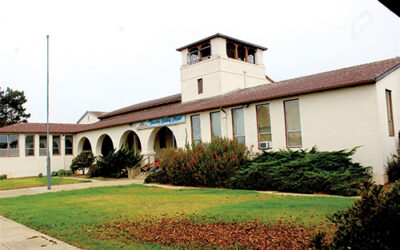
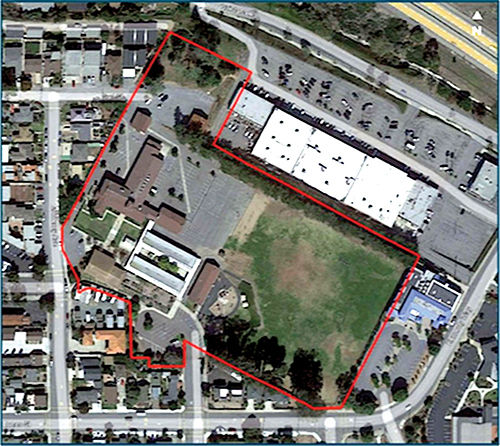

Satellite image shows Morro Elementary School outlined in red. Submitted photo.
Morro Bay City Officials laid out the current status of their investigations into the purchase of Morro Elementary School, and while the exact scheme of how they will pay for it hasn’t been finalized, they did talk about possible money sources and announced some important dates coming up in August when all will have to be decided.
The Staff Working Group that was put together for the purchase consists of City Manager, John Craig, Community Development Director, Airlin Singewald, Finance Director Emily Conrad, City Attorney Brian Stack, and consultant, Michael Codron.
City Council members who make up a subcommittee on the matter are Councilwoman Zara Landrum and Councilman Bill Luffee. All were there June 24 for the second public meeting on Morro Elementary.
City Manager Craig led the meeting, attended by about 50 interested residents. The agenda was an update on their ongoing due diligence work for the $5.3 million purchase of the old school.
The City has already put $500,000 down with the San Luis Coastal Unified School District to hold the property and Craig said the deadline for pulling out of the deal without penalty is Aug. 31.
The District is not willing to let the $500,000 be refunded after Aug. 31, Craig said.
If the City pulls out of the deal after Aug. 31, they forfeit the down payment. The purchase is scheduled to finish escrow on Oct. 31, when the remaining $4.8 million is due.
The team of City staffers working on the sale plans to bring their findings from the various due diligence investigations to the City Council as a new business item on Aug. 25.
How that vote falls will determine whether the City buys the 9-acre school site, with its historic buildings and deep history in the community.
This was the second public meeting the City has held on the subject and Craig said the clear message from the first meeting was that the citizens want the City to buy the old school.
Craig said 25 people spoke up at that first meeting in April and what stood out was strong support to buy it. He added that there were different views expressed on future reuses for the school, which has about a 5-acre grassy field used by different groups mainly for youth activities like soccer matches.
There are eight buildings on site, built at different stages of the school’s life, and some could qualify as historic structures.
The school district closed it in 2001 due to declining enrollment and all the town’s elementary school-aged children were moved to Del Mar Elementary, a school across town built in the early 1980s that now has children from kindergarten through fifth grade.
Sixth-eighth graders attend Los Osos Middle School and all the kids from Los Osos and Morro Bay, along with many from Cayucos, go to Morro Bay High.
But Morro Elementary is currently zoned “high-density residential,” Craig explained. That means if could be redeveloped with from 15 to 27 units per acre. It’s the highest form of residential zoning for density, he explained.
Many residents believe the old school should be turned into a new City Hall along with Public Works and possibly other departments. To do that, will require a zoning change, which shouldn’t be a problem, but will take time and cost money.
So too will remodeling the buildings into usable office spaces. And changing zoning could trigger further review under the California Environmental Quality Act or CEQA.
Craig explained that they would have to re-zone the site for any future use, including as a school site.
The due diligence work has included several studies on everything from a title search to hazardous materials survey, a land survey, and inspections of the infrastructure — water, sewer, electrical and gas — services.
Consultant Codron, who was brought in to act as special projects manager for the Morro Elementary purchase, ran down the various studies they’ve done and the status of others still ongoing.
Codron called the studies standard work that comes with doing due diligence for any property purchase.
He said the hazardous materials study did find asbestos and lead paint but not in a quantity that would be unexpected in buildings that are nearly 100-years old.
A land survey confirmed the property’s boundaries. “What’s on the ground,” Codron said, “matches what’s on paper.”
Codron said a Phase-1 environmental study, “Came back clean” and the property is free of contaminants.
There had been some concern regarding an old underground fuel tank, but it apparently didn’t leak and contaminate surrounding soils.
The site appears suitable for future uses, Codron said.
They did find about 600-square feet of asbestos insulation wrapped around heating ducts. When the time comes for the City to do whatever remodeling is needed for whatever future use it decides to do, the asbestos would be removed at that time.
Asbestos was widely used for a number of purposes, primarily as fireproofing but also as siding and flooring. The tiny fibers from asbestos can get into the lungs and cause cancer.
Lead paint was also widely used and over time starts to flake off. It’s toxic if ingested.
Codron later clarified that asbestos and lead paint were only found in the original school building, dating back to 1936.
Codron, based on a report done by the Friends of Morro Elementary on the historic nature of the site, said their consultant concurred with the Friends’ report that the school campus could be eligible for historical landmark status.
That wouldn’t prohibit the City from doing remodeling for a future reuse, but Codron pointed out it would bring in a different set of building standards they’d have to adhere to.
An example of this is Cayucos Landing, formerly the Cayucos Vets Hall that underwent a near complete rebuilding after it was condemned by the County and closed for several years.
The building was rebuilt in accordance with those historic preservation standards at a considerable cost.
Though they don’t yet have a plan for the future use of the school, Codron said they have done a “test fit” study wherein a consultant surveyed City officials to determine their office space, plus storage and equipment space needs, and then measured the actual school buildings.
That study showed the old school could fit the City offices within the existing buildings, though public offices have their own set of standards to meet, such as the potential need to retrofit for fire sprinklers and electrical service upgrades.
Their studies have also determined that a significant number of affordable housing units could also fit on the site.
They’ve looked at different scenarios mixing City office use and housing. One scenario looks at 100 market priced units and 50 affordable units, and another was a 50:50 split of market price and affordable. Both preserve a sizable portion of the grassy fields as “open space.”
Craig pointed out that the more housing that’s allowed the more revenue would come back to the City.
Craig explained that the City Council will be the ones making the decisions here, from whether to move forward with a purchase to future uses.
The Council will also have to decide where the purchase money will come from.
City Finance Director Conrad was asked about potential sources of money for the remaining $4.8 million bill.
The City has some $7.8 million in general fund emergency reserves, which equals about 52% of the general fund budget. They could pull about $4 million out of that and still have the 33% reserves that City policy calls for. Overall, the City has over $14 million in its reserve accounts.
However, there is no cushion at all in the operating budget, she said.
The City is also due to get $3 million from power plant property owner Vistra Energy, if the company hasn’t torn down the smokestacks and power plant by the end of 2027.
Vistra withdrew its proposed Battery Energy Storage System or BESS Project that it wanted to build on the plant property.
The $3 million is part of an agreement the company reached with the City back when Vistra was pursuing the BESS Project.
Craig pointed out that the City is currently listing the former teen center on Atascadero Road for sale with a $2.1 million asking price, and has other properties that could be sold, as well.
For instance, if City Hall and Public Works were moved to the school, the City could then sell the roughly half a block sized property where these offices are now, for redevelopment.
Craig said the City’s finances were in a good position and the City has “robust” reserves, with $3-$4 million extra in emergency reserves.
Though reserve funds sitting in various accounts, like the water or sewer funds, are meant to support the needs of those departments, they can be spent on anything the City Council wants with a four-fifths vote.
The Staff Working Group plans to have options ready to present to the City Council on Aug. 25 when they bring the due diligence report to the board for a vote on whether to move forward with the purchase.
And then they’ll have to put together the actual funding plan before Oct. 31, when they have to write the big check.