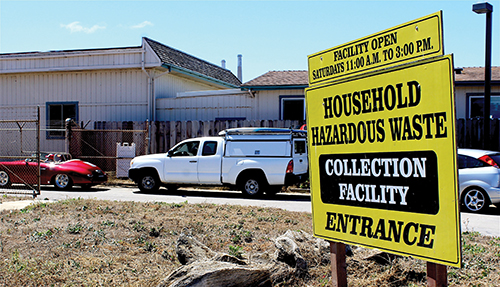

Cars and trucks lined up down the block to drop off items at the Household Hazardous Waste Facility in Morro Bay. The Integrated Waste Management Authority is planning to close the drop-off facility after July 25 but is working on relocating the service. Photo by Neil Farrell
Estero Bay Area residents will have to find a new place to take their household hazardous wastes, after a County agency announced that it would be closing its drop-off facility in Morro Bay.
The Integrated Waste Management Authority or IWMA, the agency that deals with garbage and waste issues countywide, announced that it would be closing its HHW facility at the old Morro Bay-Cayucos Sewer Treatment Plant on Atascadero Road and looking to relocate the service.
IWMA Management Analyst, Sasha Del Giorgio, said in a news release, “The San Luis Obispo County Integrated Waste Management Authority is moving forward with plans to relocate the Morro Bay Household Hazardous Waste Facility to a new location.
“The current site, at the former wastewater treatment plant, is slated for demolition and all existing operations must be relocated.”
She added that the HHW facility in Morro Bay would cease operations after Saturday, July 25. The facility at 160 Atascadero Rd., has been open for drop offs on Saturday afternoons for more than 25 years.
But since the City built its new Water Reclamation Facility or WRF plant at a new, inland location, the old sewer plant has sat unused, except for the HHW facility.
And the Cayucos Sanitary District, which co-owned the treatment plant, also built a new plant on Toro Creek Road that opened in 2022.
The City is currently in escrow to buy out Cayucos’ 40% interest in the old plant and some surrounding properties with an eye at demolishing the facility and making the prime-location property available for some kind of redevelopment.
Decommissioning the old plant was included in the City’s permits for its new one.
The news shouldn’t have been a surprise, as the IWMA knew over a decade ago that Morro Bay’s new wastewater treatment plant didn’t have a HHW facility in the site plans.
Del Giorgio said that they’ve been working hard on finding a new location. “The IWMA has been proactively planning for the future of the program and has completed an extensive review of more than a dozen potential sites in Cayucos, Morro Bay, and Los Osos,” she told Estero Bay News.
“This thorough process has led to the identification of a promising new location that appears well-suited to support continued safe, convenient HHW services for the community.”
She didn’t say where that location is, however. “Negotiations are currently underway, and additional details will be shared once agreements are finalized and approved.”
HHW facilities are locations where residents can get rid of common household products like paint, used motor oil, fluorescent bulbs, batteries, pesticides, household chemicals and cleaners, gasoline and acetone, propane tanks and fire extinguishers, aerosol cans, electronics, and gardening products.
All these things contain chemicals that harm the environment and can even be deadly, according to the IWMA website, and are considered hazardous waste.
HHW facilities were established to give people a place to safely dispose of such items and products instead of dumping them in some remote location and polluting the environment, which has been known to happen. They keep it out of the regular garbage stream, too.
It was also started as part of the whole reduce, reuse, recycle push that started in the early 1990s, when curbside recycling programs were mandated by State Law.
There are three main categories of items that they will accept at HHW facilities: hazardous, universal and e-wastes.
Hazardous items include aerosols, corrosive liquids, fire extinguishers, Mercury (from thermostats), paint (containing PCB), pesticides, and, propane tanks.
Universal wastes are batteries, gasoline, light bulbs, paint, thermostats, and used motor oil.
Electronic or e-wastes includes IT assets — monitors, servers, computers, laptops, routers, hard drives, cables and chargers. Other items are office equipment — telecom systems, copiers, printers, and fax machines; scientific and medical devices — satellite and imaging equipment.
They also collect consumer electronics equipment such as TVs, LCDs, DVDs, VCRs and stereo equipment; cell phones, smart phones and PDAs; small appliances — microwaves, smoke detectors, toasters, and vacuum cleaners.
Of note, they will not accept at HHW facilities stoves, refrigerators, or freezers. You must contact your local appliance retailer or landfill for assistance with these items.
Landfills charge a fee for disposal of such large items, including furniture like recliners and sofas.
SLO County residents can drop off at no cost up to 15-gallons or 125-pounds of hazardous waste per visit, Del Giorgio said.
And retail stores that sell some of the items listed above are also mandated by law to take back certain items, like batteries, fluorescent light bulbs, latex paint, prescription medications, needles and thermostats containing Mercury.
By local ordinance, De Giorgio said, these items are accepted throughout SLO County by any retailer that sells them.
Businesses, she added, can continue to make an appointment to dispose of hazardous, electronic, and universal waste through the ‘Very Small Quantity Generator’ Program, using IWMA’s online appointment request portal at: www.iwma.com.
For more information, see: www.iwma.com/retail-take-back-for-consumers.
Del Giorgio said that the HHW program is very important to her agency, and it “reflects IWMA’s strong commitment to maintaining reliable HHW services for residents. Even during the transition period, it is important to remember that HHW should always be kept out of curbside trash and recycling bins.
“Items such as batteries, paint, pesticides, cleaners, sharps, and fluorescent bulbs require special handling to ensure safety and protect recycling systems. HHW programs play a key role in safely collecting and managing these materials in accordance with environmental standards.”
They may already have a new site located but establishing a new facility will take time, so IWMA is beefing up some of the other aspects of the HHW program.
“In the meantime,” Del Giorgio said, “IWMA is also expanding convenient options for residents and businesses. Retail take-back partnerships are being strengthened to provide easy collection of materials such as household batteries, fluorescent bulbs, sharps, latex paint, and motor oil.
“Residents are strongly encouraged to take any of the items listed in our press release back to any local stores that sell those items, since that is a convenient and free option for residents to use.”
If retail businesses are interested in participating, they should call Sasha Del Giorgio at (805) 781-2192 to schedule a take-back appointment. “IWMA handles transportation and billing, making participation simple and accessible,” she said.
So, after July 25, where can you dispose of HHWs? The nearest HHW facility to the Estero Bay communities is at the Cold Canyon Landfill, 2268 Carpenter Canyon Rd., in rural San Luis Obispo. That facility is open Mondays, Tuesdays, Thursdays, Fridays and Saturdays from 8 a.m. to 3 p.m.
Other HHW facilities are in Nipomo at 509 Southland St.; Chicago Grade Landfill in rural Templeton at 2290 Homestead Rd. Both are open Saturdays from 11 a.m. to 3 p.m.
The Paso Robles Landfill at 9000 Hwy 46 East accepts HHW items and is open Saturdays from 11-3.
And if you’d rather wait it out until another HHW facility opens on the North Coast, Del Giorgio has some tips for how to do it safely.
“Residents,” Del Giorgio said, “are encouraged to safely store HHW materials in a cool, dry, well-ventilated space in their original labeled containers until they are ready for drop-off.
“Many common household products remain stable for long periods when properly stored. In addition, residents can continue to use their curbside used oil collection programs offered through their waste hauler, which provides convenient container and filter bag exchanges with curbside pickup service.”
The IWMA is also working on setting up 1-time collection events “to provide additional convenient options for the North Coast and surrounding communities during the transition. More information will be shared as those events are finalized.”
Formed in 1994, IWMA serves the entire county — both cities and community services districts, to manage local solid waste and recycling programs.
The IWMA governing board consists of the five County Supervisors, one representative from each of seven incorporated cities, and one representative from a dozen CSDs.