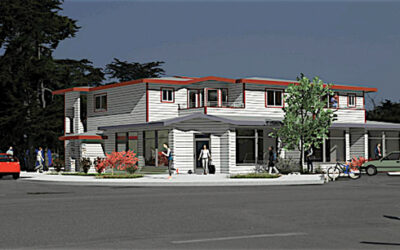


Here’s the design for Phase 1 in the rebuilding of Coleman Park. The City is reviewing bids now for a construction contract.
Morro Bay’s saddest looking public park will be getting a makeover, and the first phase of the transformation should soon have a contractor onboard.
Coleman Park, one of two City parks sitting adjacent to the harbor, has been on the radar for rebuilding for several years.
Earlier, the City hired RRM Design to design the improvements for the harbor-side park, which were developed by the City after several meetings with the Parks and Recreation Commission.
The park currently has a swing set, a basketball court, two small dirt parking areas and two paved parking areas, a trio of picnic tables and not much more; and is covered in loose sand. The Harborwalk pedestrian and bike paths run along the southern edge of the park.

It used to have a public restroom, but that concrete block building was condemned several years ago and torn down. But a rebirth is on the horizon.
The City is out for bids now for “Coleman Park Improvements — Phase 1,” and the deadline to bid was set for Feb. 17.
Once the new City Engineer and the Public Works Department go through the bids and compare pricing, a recommendation for approval will be taken to the City Council to award a contract.
“For this project,” City Engineer Nate Stong told Estero Bay News, “Phase 1 is located just west of the intersection of Coleman Drive and the Embarcadero.”

The Phase 1 work will include grading, installing concrete walkways leading to a new pad that would be plumbed for water and sewer service. The plan is to have another company come in and install a “prefabricated” new restroom.
The City Council approved paying $333,000 to CXT for a pre-cast concrete building that can be done in various layouts and used for different things.
The buildings require a minimum of site preparation and are lifted into place with a crane.
The design rendering shows the new restroom with an outdoor shower/sand rinse station. Originally, Phase 1 had more amenities listed when the City applied for the State Parks grant, but recent cost overruns led the State to suggest a pared down project.
“Based on current cost estimates for the Coleman Park project,” reads a report from last September to the Rec & Parks Commission, “staff recommends focusing funding on a new restroom facility; ADA-compliant parking; accessible playground replacement; ADA pathways connecting these features.”
The new restroom is clearly the priority for this part of the project. It will arrive ready to go.
“Our buildings are prefabricated and delivered complete and ready to use,” reads the website for LB Foster the parent corporation for the CXT buildings, “including plumbing and electrical where applicable. Interiors are designed to resist abusive wear and can be cleaned quickly with warm soapy water and a brush.”
The City’s purchase agreement for the restroom had a delivery date of Memorial Day. The City is buying the building from CXT Precast Concrete Products of Spokane Valley, Wash., also a division of LB Foster.
The City is also using a middleman to save some money. “This purchase is being made through Sourcewell,” the City said in a report, “a national cooperative purchasing program that provides competitively solicited contracts available for use by public agencies. Utilizing Sourcewell contracts allows the City to procure goods and services that have already been bid.”
CXT’s bid was well under the other two it received. Remtec, which builds on site, came in at $562,000 and PRC, also a prefab building, came in from $350,000-$375,000.
The City checked out all three with other agencies who have used them and found no problems with any of them. So, they went with the cheapest one, CXT.
After the restroom buy, the overall budget of some $918,000 still has over $400,000 left.
In a report the funding breakdown for the project includes Deferred Maintenance Fund, $31,500; Castle Wind Community Development, $40,000; Park Fee Fund/1975 Quimby Act, $69,500; Proposition 68 Per Capita Program Grant, $177,952; and Rural Recreation & Tourism Grant, $600,000.
Castle Wind was the company that initially came to the City in 2016 with the idea of putting in floating wind turbines offshore. Castle Wind missed out on winning one of the three lease areas that the Federal Government auctioned off.
The Quimby Act is a program where developers pay in-lieu fees instead of building a public park within subdivision projects. The City often uses these monies for major improvements at existing parks.
RRM’s design contract was for $182,000 and the restroom came in at $333,000, leaving $403,000 in the project fund balance.
The belief is that the construction contract will come in under that amount and the City won’t have to go hunting up more money.
The design doesn’t have any improvements for those who like to launch kayaks or enter the water to scuba at Coleman Beach, which is currently accessed via short, somewhat tricky and narrow pathways from the Harborwalk down to a tiny, calm-water beach.
The basketball court is also not part of this project.
Given its location adjacent to the harbor, Coleman Park has been eyed for a lot of things. The park was used briefly by the Harbor Department during its short-lived attempt to establish bayside campsites for RVs.
The program, which was given a pilot permit during the COVID pandemic, sought to use several public areas along the Embarcadero for RV camping, and Coleman Park had three campsites set up.
But public outcry against the camping program — especially the highly-visible Coleman Park sites — convinced the City Council to nix the program, despite it being pretty successful at raising new revenues for the Harbor Department.
The basketball court too has been somewhat controversial. Initially it was where the City established a skateboard park, with several ramps and other apparatus installed on the pavement.
But that too didn’t set well with the public and eventually it was moved to a Teen Center on Atascadero Road.
But the Teen Center, which took over a former miniature golf and arcade business in a bankruptcy sale, had a relatively short shelf life.
It now sits vacant and unused, the mini-golf courses since removed, though one can occasionally see skaters using the ramps in the front parking lot.
When the skate park moved, the City converted the paved and fenced area into a basketball court. And while some folks do use the court it hasn’t really caught on in popularity.
Coleman Park was also once eyed for a proposed boat haul out and repair facility about 25-years ago by members of the Harbor Advisory Board. But that idea also never went anywhere.
Now Coleman Park is mostly used by families picnicking by the bay and by walkers and bicycle riders who traverse through it on the Harborwalk.
It’s the beach, used for launching kayak, paddleboard and scuba excursions in the kelp forest along the rocks, that seems to make the most use of the park.