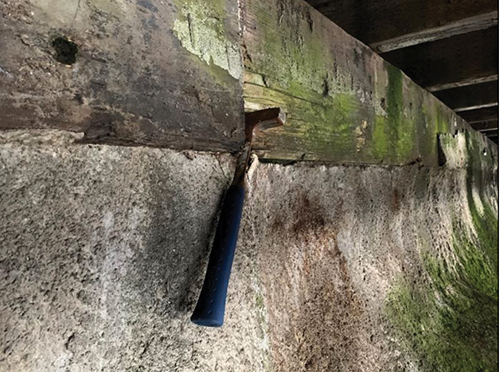

Photo from the support structure for the Morro Bay Fishermen’s Wharf and a deteriorated timber cap. Photo courtesy M.B. Harbor Dept.
More money has been donated by local fishermen to help the Harbor Department repair a rotting wharf that’s a key facility to the local commercial fishing industry.
The Morro Bay Community Quota Fund has granted $150,000 to the Harbor Department to assist with needed repairs to the Fishermen’s Wharf, a fish unloading dock located just south of the North T-pier.
It was the second large donation made by commercial fishers to help fix the aging structure.
Last September, the Morro Bay Commercial Fishermen’s Organization turned over a $400,000 grant it received from the Joint Cable-Fisheries Liaison Committee.
With the Quota Fund’s donation, the local fishers have now given some $550,000 towards fixing the wharf.
An inspection of that and other harbor facilities conducted by a consultant through the Harbor Department showed numerous issues, including missing support piles, an undermined seawall, and a deteriorating support timber.
Called The Brady Report, that study inspected all the City-owned facilities, identified problems and rated the various areas as to the severity of the problem at each one.
It was an eye-opening report that estimated the total costs for needed repairs at from $25.5 million to $54.6 million.
Estero Bay News met with Quota Fund Executive Director, Dwayne Oberhoff, and board members Andrea Lueker and Jeremiah O’Brien in December to talk about the donation and catch up on the Quota Fund’s work.
The Quota Fund was started in 2013 as part of an extensive government overhaul of the trawl fishing industry, under fire for perceived damage to the seafloor done by dragging trawl nets across the bottom.
The fishery targets the “deep-water simplex,” consisting of a number of fish species that live in the deep water. Targeted species include Petrale sole, black cod, various rock cod species and others.
The Federal Pacific Fisheries Management Council (PFMC), which sets federal regulations for the West Coast (except Alaska and Hawaii) set strict catch limits on the trawl industry, which had been the backbone of the local industry, bringing in the most fish and keeping the docks busy.
From that evolved a catch shares program that assigned each fishing boat a certain share of the new limits.
Then The Nature Conservancy environmental advocacy group got involved in an attempt to end trawl fishing and bought up nearly every permit and fishing boat from Port San Luis to Monterey.
But these permits are required to be fished by law and couldn’t simply be retired. So, a quota system was developed, and local quota committees were established to ensure that fish caught in local waters are landed at local ports.
The MB Quota Fund was established to manage the allotted quota in Morro Bay and Port San Luis (Avila Beach), explained Oberhoff.
The Quota Fund leases out its share of the overall catch to local fishermen who then go out and catch the fish.
It’s a complex system with strict limits for each species of fish, making it difficult to navigate.
If a fisherman pulls up more of any species he or she has quota for, they must buy extra quota space or face shutting down for the season, or potentially face stiff fines.
They also have quotas for some fish species, like whiting, that are not fished in local waters, so the Quota Fund is free to lease those fish to fishermen up north, where whiting is commercially fished.
It’s a very complicated system and at this time there is only one local fisherman working it and he uses traps, not a trawl net.
But Oberhoff said they hope to soon have a second boat working the local quota. With a shortage of fishermen, the Quota Fund is free to lease out unused quota to fishermen from other ports.
Those lease payments support the Fund, which also has a grant program.
That grant program has been taking applications since early January and had a March 6 deadline for its 2026 Research Fund. They have some $200,000 available for “research projects that address needs relevant to the fishing communities of Morro Bay and/or Port San Luis,” the Quota Fund said in its announcement. They plan to announce the awards in May.
O’Brien said some of their money can also be used to support critical infrastructure, such as the wharf in Morro Bay, in addition to research projects.
He said Harbor Director Chris Munson had asked for grant monies during one of their board meetings and the board voted to make the donation.
EBN asked Munson for comment about the donation and the extent of the work that needs to be done on the wharf, but he wanted to wait on a Memorandum of Understanding (MOU) he’s putting together to lay out exactly what the City would use the money for.
Lueker added that repairing vital infrastructure like the wharf has a direct link to commercial fishing. “It’s the only place the quota that we lease can be off loaded,” she said.
O’Brien, who also played a hand in the MBCFO’s $400,000 donation, said the Cable Liaison Committee’s donation would not necessarily go towards fixing the same issues with the wharf. “The connection is commercial fishing,” he explained.
Oberhoff said the money “came from leasing the quota since the start [2013].” Also, when the local fund started out it had to purchase its quota from The Nature Conservancy, which owned it but wasn’t using it.
“We were paying them for the first six years,” Oberhoff said. But now that debt has been paid off freeing the Quota Fund to help the overall industry.
While they’ve funded grants for research in the past this is the first time the Quota Fund has allocated money to repair infrastructure.
O’Brien called it a “one-off” allocation, as they don’t anticipate donating to repair infrastructure becoming a regular thing.
Oberhoff added that they make sure the quota they lease outside this area is at least fished and landed in a California port. “We lease about 7-8 million pounds of fish overall,” he said.
O’Brien said, “That’s what we own, the ‘catch shares’ and we can buy, sell or lease it.”
Oberhoff said they sold off some of their quota to pay off The Nature Conservancy. As for the work the City is planning, O’Brien said they only want to make sure it goes to what they agreed it would go to.
The MOU, when it comes out, should spell all that out in contract form.