
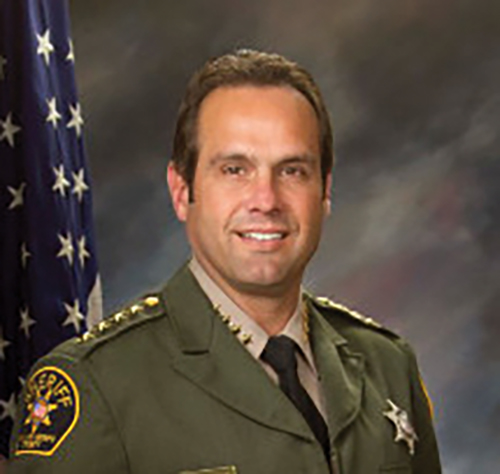

San Luis Obispo County Sherrif Ian Parkinson recently presented the annual Transparent Review of Unjust Transfers and Holds Act (TRUTH Act) report to the County Board of Supervisors.
It was supposed to be a routine report by the Sheriff’s Department, but when it comes to the issue of immigration enforcement, nothing is routine these days.
At the Jan. 27 County Supervisor’s meeting a massive crowd filled the Supervisors’ Chambers, spilling over into an overflow room and onto the sidewalks at the County Government Center to hear Sheriff Ian Parkinson’s annual Transparent Review of Unjust Transfers and Holds Act (TRUTH Act) report.
Assembly Bill 2792 set up the State’s reporting system to monitor whether local law enforcement agencies are complying with the mandate to not assist Immigration and Customs Enforcement (ICE) Agency’s efforts to round up and deport undocumented immigrants, a key aspect of the Sanctuary State policies.
The law requires a public forum be held if a local law enforcement agency returned notification responses to ICE over the prior calendar year (2025).
“The purpose of the forum,” Sheriff Parkinson’s report explained, “is to provide information to the public about ICE’s access to incarcerated persons and to receive and consider public comments.”
The County gave notice in December that the forum would be held, and opponents of ICE’s deportations had plenty of time to rally their troops and let the Sheriff and Supervisors know how they felt about ICE and the Trump Administration’s deportation efforts.
What ensued was nearly five hours of public testimony from both sides of the issue, with the vast majority of speakers railing against ICE and criticizing the Sheriff’s Department for cooperating at all with ICE.
The official TRUTH Act report is only four pages long and goes into explanations about the various requests the department regularly receives from ICE asking for information and access to jail inmates.
“ICE requests include detainer, notification, transfer, and interview requests,” the report explained. “Requests were honored only when they met the legal criteria under California Law.”
Government Code Section 7282.5 lays out all the various crimes that give the OK to let ICE in.
The list of laws that qualify someone to be essentially turned over to ICE is lengthy and spelled out over a dozen or more Penal Codes.
But primarily they involve serious or violent felonies, and felonies punishable by imprisonment in State Prison.
The Sheriff’s report said, “Releases to ICE occurred only when permitted by State Law, and the Sheriff’s Office did not honor 48-hour ICE detainer requests.”
ICE agents can also ask to interview people in jail, but the Sheriff said an inmate must give written approval to be interviewed. The inmate also has the right to refuse to be interviewed.
There is no question about whether the Sheriff’s Department is “sharing” information about those it has in custody, because the Sheriff’s Department website lists all currently incarcerated people as a matter of public information accessible to anyone over the Internet.
“Release information is updated once a release date is established and is not available for individuals with pending cases that have not yet been adjudicated,” the report explained.
So, if ICE wanted that information, it can simply log onto the website and click on the “Jail Information/Who’s in Custody” tab on the drop-down menu.
Still, the Sheriff said they do not work with ICE. “The San Luis Obispo County Sheriff’s Office does not enforce federal immigration law, does not conduct deportations, does not request immigration status, and does not conduct immigration sweeps.”
The report compared the 2024 TRUTH Act stats with 2025, and the numbers, while relatively small compared to what’s been done in larger cities, did not set well with the anti-ICE folks.
In 2024 they recorded a total of 111 ICE requests received. In 2025 that number jumped to 287.
In 2024 none of the 111 requests were complied with, the report said.
In 2025, 204 of the 287 were not complied with, so 83 requests were complied with.
In 2024 they released one inmate to ICE and in 2025 the number jumped to 69.
In 2024, they honored the only U.S. District Court warrant they got and turned that person over to the U.S. Marshall’s Office.
In 2025, they got 19 District Court warrants and 15 were turned over to ICE, with four requests still pending.
In 2024, ICE requested to interview four inmates and none were allowed. In 2025 the number jumped up to 11 but again, none were allowed.
The TRUTH Act report lists the things the Sheriff’s Department does vs. what they don’t do.
They do publicly provide all incarcerated persons release dates via the website; allow Due Process Rights under California Law (SB 54); comply with the State Department of Justice reporting; inform inmates they can refuse to be interviewed by ICE; give an inmate a copy of any ICE requests for them; and they help undocumented victims get U-Visas.
Created in 2000, the U non-immigrant status or U Visa, is for victims of certain crimes who have suffered mental or physical abuse and are helpful to law enforcement or government officials in the investigation or prosecution of criminal activity.
There’s a long list of crimes for which a victim can apply to Federal authorities for a U Visa.
The U visa doesn’t cover all crimes, but it does include domestic violence, stalking, sexual assault, and felony assault, among others, according to the website Womenslaw.org.
Under the heading “What we DO NOT do,” the Sheriff listed enforce Federal Immigration Law; deport anyone; have authority over ICE; ask about immigration status; conduct immigration sweeps; nor hold or detain anyone in jail for extra time, so-called detainers.
The report concludes with, “The Sheriff’s Office does not invite or facilitate civil immigration enforcement actions in the community. Our role is to protect the community.”
In advance of the forum, District Attorney Dan Dow released a statement seeking to warn protestors that while they have the Right to Protest, they won’t be allowed to “cross the line into violence or other criminal conduct. When protest activity becomes unlawful, it may result in arrest and prosecution, just as with any other criminal behavior referred to our office.”
D.A. Dow said, “I will always support the rights of people to protest; however, I strongly urge them to do so safely and within the limits of both Federal and California Law. Any behavior that is violent or otherwise criminal will detract from the weight and value of your political speech and may lead to arrest and prosecution.
“We encourage everyone to exercise their rights peacefully, responsibly, and safely. Our office remains committed to upholding the Constitution, protecting public safety, and ensuring equal justice under the law for all.”
Despite reassurances that his department was following State Law in its dealings with ICE, speaker after speaker criticized the Sheriff for handing anyone over to ICE, and the oft heard rallying cry “ICE Out,” was uttered by many.
There were also numerous speakers who expressed support for the Sheriff’s Department and ICE’s efforts.
County Supervisors supported ICE opponents and Dist. 2 Supervisor Bruce Gibson made a motion to direct the County to look into passing a local ordinance.
The motion called for County staff to look into giving undocumented immigrants taxpayer monies, channeled through local non-profit groups.
The motion seeks to make the County Jail lobby a private space and barring ICE Agents from “private government spaces.”
That aspect seems to try to address a profanity laden confrontation that occurred in December, when anti-ICE protestors stormed into the County Jail lobby and confronted ICE Agents who were inside. A body camera video of the encounter was released on social media in December.
Gibson’s motion was to also prohibit commandeering of public spaces and requiring the Sheriff’s Department to give quarterly reports on ICE interactions and to investigate what other counties are doing about the issue.
The Supervisors also voted unanimously to form an ad hoc committee with Supervisors Dawn Ortiz-Legg and Jimmy Paulding that would work to develop options to help the undocumented immigrant community.